
What is selective pallet racking and how does it benefit my warehouse operations?
Selective pallet racking is a warehouse storage system that gives direct access to individual pallets from designated aisles, making stock handling straightforward. Its adjustable configuration supports efficient use of available space, clear stock rotation and adaptable operations when installed and maintained to appropriate safety standards.
Selective pallet racking is an adjustable warehouse storage system that provides direct access to individual pallets from designated aisles. Each pallet position can normally be reached without moving the pallets in front of it, making the system suitable for operations that handle a wide range of products, require regular stock rotation or need dependable access to specific pallets.
The system consists of upright frames, horizontal beams and pallet support components arranged into storage bays. Beam levels can be adjusted to suit pallet dimensions, load heights and the available building height, subject to the capacity of the equipment and the recommendations of the designer or manufacturer. A properly planned installation also considers aisle widths, handling equipment, pedestrian routes, fire protection requirements, floor conditions and access for inspection and maintenance.
How selective pallet racking works
Pallets are loaded onto beams at different vertical levels, while aisles provide access for forklift trucks or other material-handling equipment. Because each pallet location is independently accessible, operators can store and retrieve stock without first unloading adjoining positions. This is the main distinction between selective pallet racking and higher-density systems that may restrict access to individual pallets.
Storage locations can be labelled or integrated with a warehouse management system so that operators can identify products, batch information and stock quantities accurately. This supports organised put-away and picking processes, particularly where the warehouse holds many stock keeping units rather than large quantities of only a few products.
Key benefits for warehouse operations
- Direct pallet access: every accessible location can be reached from the aisle, reducing unnecessary handling and making retrieval more predictable.
- Good stock visibility: open bays and clearly defined locations make it easier to identify products, inspect loads and check available capacity.
- Flexible configuration: beam heights and bay layouts can often be altered to accommodate changes in pallet sizes, product ranges or operational requirements, provided the revised arrangement is approved and correctly recorded.
- Efficient use of vertical space: storage is developed upwards as well as across the floor, subject to building constraints, equipment reach, load capacities and safety clearances.
- Support for stock rotation: direct access makes it easier to organise locations according to the required rotation method, including first-in, first-out arrangements where the operating process supports this.
- Suitability for mixed inventories: different products and pallet loads can be stored within the same overall system, with locations selected according to load dimensions and weight.
- Straightforward integration: the layout can work alongside standard forklift operations, barcode processes and warehouse management procedures.
These benefits are particularly useful where product demand varies, stock is frequently replenished or orders contain a mixture of product lines. Selective pallet racking generally offers a practical balance between access and storage capacity rather than aiming solely for the highest possible pallet density.
What selective pallet racking does not provide
Direct access requires aisles, so selective pallet racking may store fewer pallets within a given footprint than a high-density system designed for large quantities of the same product. The correct choice depends on the relationship between available space, stock variety, access frequency, handling equipment and required rotation method.
It is also important not to assume that an adjustable system can be altered without assessment. Moving beams, changing pallet types, adding levels or increasing loads can affect the capacity and stability of the installation. Any modification should be reviewed by a competent person and carried out in accordance with the manufacturer’s instructions and the original design assumptions.
Planning an effective layout
A selective pallet racking layout should begin with an accurate review of the operation rather than the available floor area alone. The design should account for:
- the dimensions, weights and condition of the pallets being stored;
- the number and variety of product lines;
- how often pallets are put away, replenished and retrieved;
- the reach, turning requirements and operating characteristics of handling equipment;
- aisle, end-of-aisle and pedestrian clearances;
- the location of loading areas, dispatch points, doors and emergency routes;
- floor capacity, building height, lighting and fire protection arrangements; and
- future changes in stock profile or throughput.
Fast-moving products are often positioned where they can be accessed efficiently, while slower-moving or reserve stock may be placed in less accessible locations. Clear location identification and consistent housekeeping are essential. Damaged pallets, overhanging loads and stock placed outside the intended position can reduce the usable capacity of the installation and increase the risk of impact or falling materials.
Safety and compliance considerations
Selective pallet racking is safe when it is correctly designed, installed, loaded, used and maintained. The safe working load for each bay and beam level must be understood by the warehouse team, with load notices displayed where required and kept accurate after any approved changes.
Operators should be trained to position loads centrally, observe capacity information, report damage and maintain safe separation from moving handling equipment. Upright protectors, end barriers and other protective measures may be appropriate depending on the traffic pattern and the assessed risks. Protection should complement, not replace, careful vehicle operation and suitable site procedures.
Regular inspections are an important part of ongoing control. The warehouse team should report visible damage, missing components, displaced beams, leaning frames and overloaded or unstable loads as soon as they are identified. A formal inspection by a competent person should then assess the condition of the system, classify defects where applicable and specify the required action. Damaged sections should not be returned to service simply because they appear operational.
Is selective pallet racking suitable for your warehouse?
It is usually well suited to warehouses that need broad product access, adaptable storage locations and a clear relationship between stock records and physical pallet positions. It may be less suitable where the operation stores very large quantities of a small number of identical products and access to every individual pallet is not necessary. In those cases, a different system or a combination of systems may provide more appropriate capacity.
The most reliable decision comes from assessing the complete operating requirement: stock characteristics, access frequency, rotation rules, equipment, building limitations, safety controls and expected future changes. A system that appears space-efficient on a plan may perform poorly if aisles are unsuitable for the handling equipment or if locations do not match the way stock is actually moved.
For an existing installation, a review can also identify opportunities to improve location planning, protect vulnerable areas, replace unsuitable components and confirm that the current configuration remains appropriate. Combining a sound layout with documented loading rules, trained operators and planned inspections helps selective pallet racking deliver consistent access, efficient storage and safe day-to-day operation.
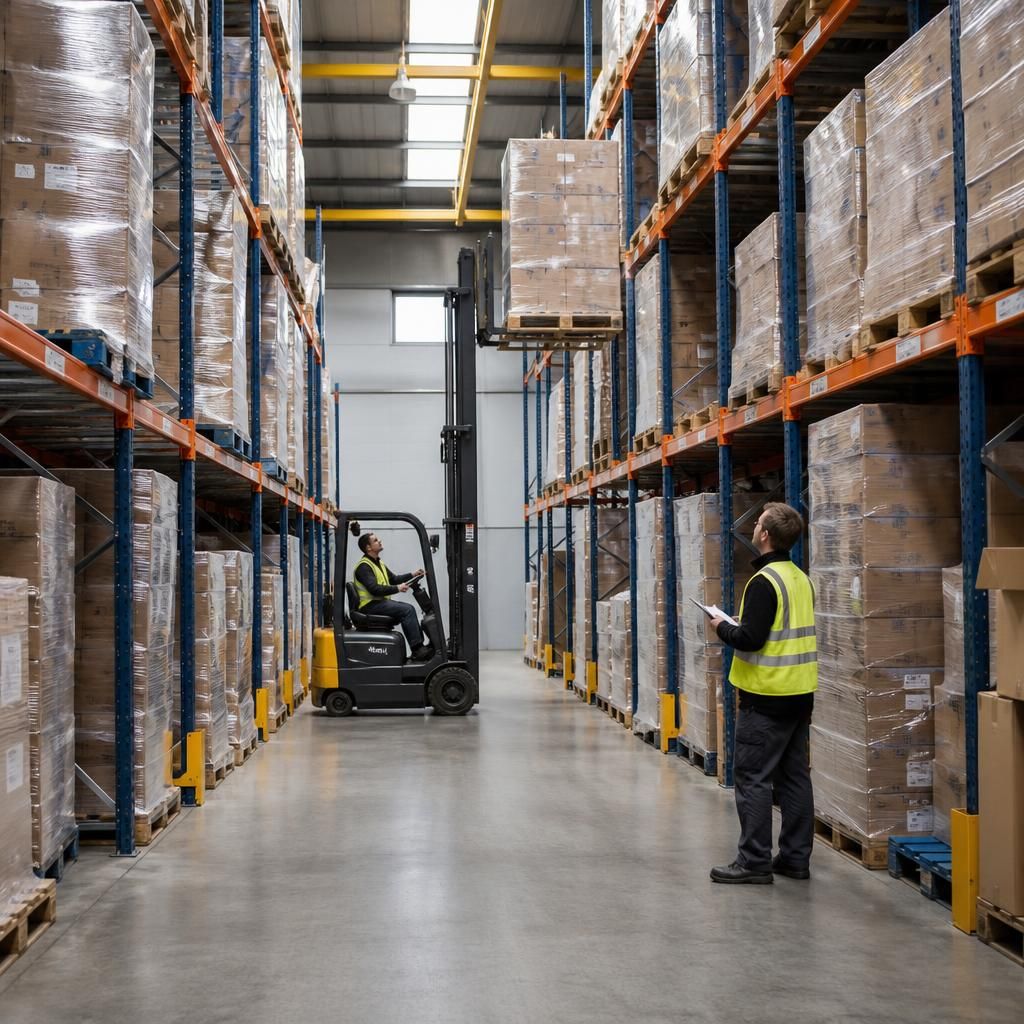
Selective pallet racking is designed to give operators direct access to individual pallet locations from the aisle, without needing to move other pallets first. This makes put-away and retrieval more predictable, particularly where a warehouse stores many product lines or needs regular access to specific stock.
Clearly labelled bays and open storage positions also support accurate stock checks, product identification and rotation procedures. The layout should still be planned around pallet dimensions, handling equipment, aisle clearances and safe working loads so that accessibility does not compromise safe operation or available storage capacity.
Discuss your selective pallet racking requirements
Contact Able Racking to discuss your selective pallet racking requirements, including layout, load capacity, access needs and future changes. Our experienced team can help review your existing installation or plan a safe, practical solution for your warehouse.