
What are the benefits of using drive-in racking systems for high-density storage?
Drive-in racking systems are high-density storage solutions that allow forklifts to enter storage lanes, making better use of available warehouse space than many conventional layouts. They are particularly effective for storing large quantities of the same product, reducing unused aisles while supporting efficient handling of palletised goods.
Drive-in racking systems are high-density warehouse racking solutions that allow forklift trucks to enter storage lanes and place pallets on supported rails. By reducing the number of access aisles required, they make better use of the available floor area and vertical space than many conventional pallet storage layouts. They are most effective where a warehouse stores substantial quantities of the same product and operates on a last-in, first-out (LIFO) basis.
The main benefits of drive-in racking include:
- High storage density: Pallets are stored in deep lanes rather than individual, separately accessed locations. This reduces the space lost to aisles and can increase the number of pallets held within the same warehouse footprint.
- Better use of available space: The system uses the warehouse height as well as its floor area. This can be useful where expansion is restricted or where making better use of an existing building is more practical than moving to larger premises.
- Efficient storage of uniform stock: Drive-in racking is well suited to warehouses holding large volumes of the same product, product type or batch. Fewer access points are needed because several pallets can be stored behind one another in the same lane.
- Reduced aisle requirements: As forklift trucks travel inside the storage structure, the layout can require fewer operating aisles than selective pallet storage. The space saved can be allocated to additional pallet positions, subject to safe access, handling and fire safety requirements.
- Suitable for slower-moving goods: High-density lanes can be particularly useful for stock that does not need to be accessed every day. The system keeps reserve stock compact while allowing operators to retrieve pallets when required.
- Lower structural complexity than some automated options: Drive-in racking is operated by forklift trucks rather than requiring a fully automated storage and retrieval system. This can provide a relatively straightforward high-density arrangement, although it still requires careful design, competent installation and trained operators.
How drive-in racking operates
Each lane contains guide rails that support the pallets. A forklift enters the lane, travels to the required storage position and places the pallet onto the rails. To retrieve stock, the forklift removes pallets from the lane in the reverse sequence. Because the first pallet placed into a lane is normally the last one removed, drive-in racking naturally supports LIFO stock rotation.
This operating principle is important when deciding whether the system is suitable. It works well for goods that can be stored and issued in batches, but it is less appropriate where every pallet needs direct access or where strict first-in, first-out (FIFO) rotation is essential. In those cases, selective pallet racking, drive-through racking or another storage system may provide better stock control.
Operational considerations
Drive-in racking can improve space utilisation, but density should not be considered in isolation. Forklift movements inside the lanes require clear operating procedures, suitable equipment and properly maintained guide rails, uprights, arms and pallet supports. Pallets must be compatible with the system and loaded evenly so that they remain stable throughout storage and retrieval.
Good stock planning is also essential. Grouping compatible products into dedicated lanes helps prevent unnecessary handling and reduces the risk of placing the wrong pallet in a lane. Warehouse teams should understand the loading sequence, retrieval sequence, permitted loads and any restrictions on forklift access.
Safety and maintenance requirements
As forklift trucks operate within the structure, drive-in racking can be exposed to impact damage. A damaged upright, rail, arm or bracing component can affect the stability and load-bearing performance of the wider installation. Operators should report impacts and defects immediately, isolate unsafe areas where necessary and ensure that repairs are completed by a competent specialist.
Regular visual checks by trained warehouse personnel should be supported by formal warehouse racking inspections carried out by a suitably competent person. Inspections should consider structural damage, missing or displaced components, overloading, pallet condition, aisle clearance, load notices and any changes to the original layout. Repairs should not be improvised or carried out by modifying components without suitable technical assessment.
When is drive-in racking the right choice?
Drive-in racking is generally a strong option when a warehouse needs high-density storage for palletised goods, carries relatively uniform stock and can work with limited direct access. It is less suitable where there are many different product lines, frequent picking from individual pallets, rapid stock rotation or a strict FIFO requirement.
The correct solution depends on the building dimensions, pallet specification, goods stored, forklift type, handling processes, required stock rotation and planned future use. A properly designed installation should balance storage density with safe access, inspection requirements and efficient daily operation. Able Racking can assess the existing layout, identify practical risks and advise on installation, maintenance and inspection requirements for a drive-in racking system.
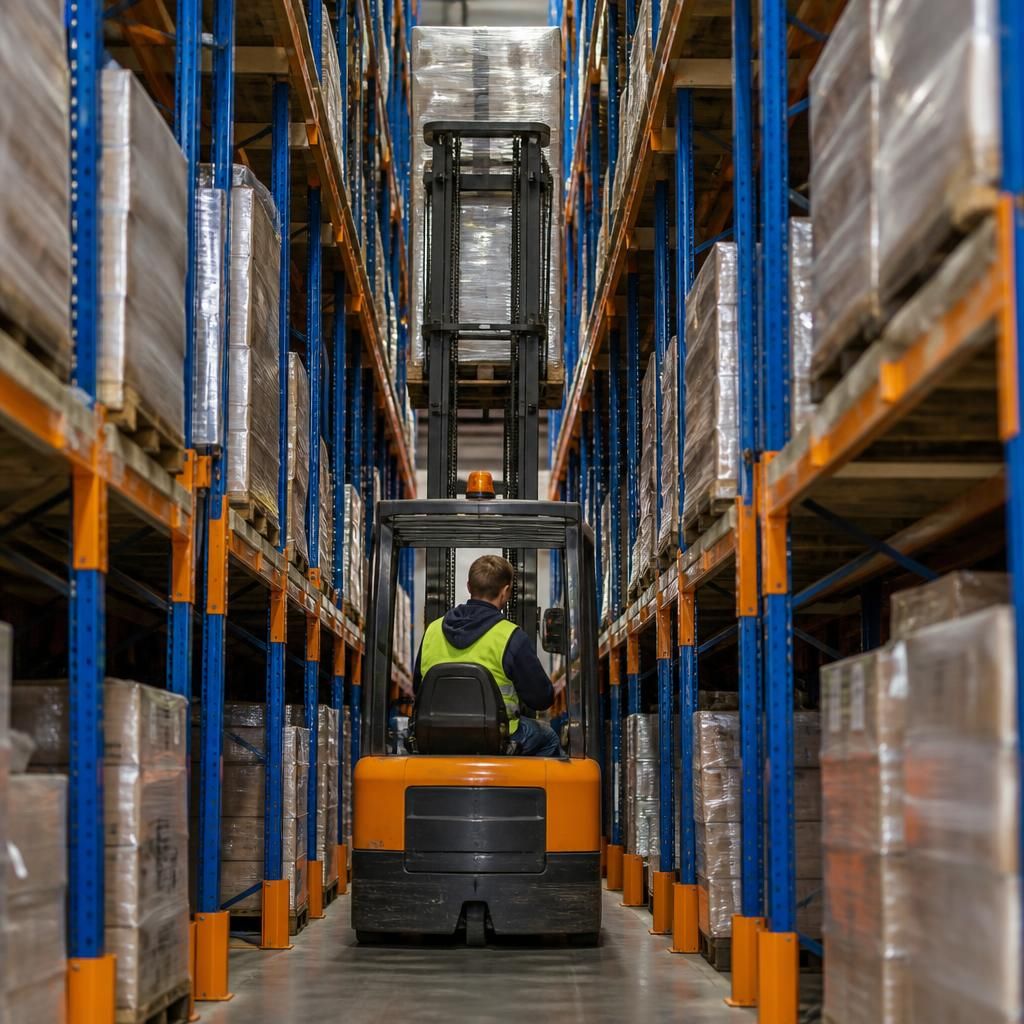
Drive-in racking systems provide high-density storage by placing pallets in deep lanes, reducing the number of access aisles needed. Forklift trucks enter the lanes to load and retrieve pallets, allowing more stock to be stored within the available warehouse footprint and height.
This arrangement is most effective for warehouses holding large quantities of similar products that can be managed on a last-in, first-out basis. It is less suitable where every pallet requires direct access or strict first-in, first-out stock rotation. Pallet compatibility, load limits, forklift operation and regular warehouse racking inspections must also be considered to maintain safe and reliable performance.
Discuss your drive-in racking requirements
Discuss your drive-in racking requirements with Able Racking to assess storage density, stock rotation, forklift access and safety considerations. Our experienced team can advise on a suitable installation, inspection or maintenance plan for your warehouse.