
What is the significance of compliance with warehouse racking safety standards?
Compliance with warehouse racking safety standards helps protect employees, maintain structurally sound storage systems and meet UK workplace health and safety requirements. Regular inspections, competent maintenance and prompt repairs reduce the risk of collapse, product damage, operational disruption and enforcement action.
Compliance with warehouse racking safety standards is significant because it helps prevent collapse, protects employees and visitors, supports legal duties and keeps storage operations reliable. A compliant warehouse racking system is properly designed, installed, loaded, inspected and maintained for the conditions in which it is used. Compliance is not a one-off approval; it is an ongoing process of managing structural condition, loading risks, changes and damage.
In the UK, warehouse operators have duties under workplace health and safety legislation to provide and maintain safe work equipment and a safe working environment. Warehouse racking is work equipment, so it must be suitable for its purpose, used correctly and kept in a safe condition. Guidance such as HSE recommendations and BS EN 15635 provides a recognised framework for managing warehouse racking safety. Where a system has been designed or supplied for a particular load, layout or operating method, those limitations must also be respected.
Protecting people from avoidable hazards
Damaged or overloaded warehouse racking can become unstable without obvious warning. Impact from forklifts, missing safety components, incorrect beam positioning, uneven floors, unauthorised alterations and poor load distribution can all reduce the system’s capacity. If a failure occurs, the consequences may include falling stock, trapped or struck employees, blocked escape routes and further structural damage.
Effective compliance controls these risks before they develop into an incident. Staff should know how to report damage, operators should use the system within its stated limits, and any unsafe area should be made secure until it has been assessed. This preventative approach is more reliable than waiting for visible movement, a serious impact or a partial collapse.
Maintaining structural performance
Warehouse racking is designed as a complete system. Frames, beams, bracing, baseplates, floor fixings, guards, locking devices and load notices all contribute to safe performance. Removing or replacing one component without checking compatibility can affect the whole installation.
Compliance therefore includes checking that:
- the warehouse racking is suitable for the loads, pallets, handling equipment and working conditions;
- uprights, beams, bracing, connectors and fixings are free from unsafe damage;
- loads are positioned evenly and do not exceed the stated capacity;
- beam levels, safety pins, pallet supports and protection are correctly installed;
- aisles, access points and escape routes remain clear;
- load notices are present, legible and consistent with the current layout; and
- alterations, relocations and repairs have been assessed by a competent person.
Meeting inspection and maintenance duties
A suitable inspection programme normally combines routine checks by warehouse personnel with formal inspections by a technically competent person. Employees working around the storage system are often best placed to identify new impacts or obvious defects quickly. Their checks should be recorded and any concerns passed to the person responsible for warehouse racking safety.
A formal inspection examines the installation in greater detail, including damage, displacement, corrosion, missing components, protection, floor conditions, loading information and evidence of overloading. BS EN 15635 calls for a systematic inspection regime, including a thorough inspection at intervals not exceeding twelve months, unless a competent risk assessment identifies a more appropriate arrangement. The inspection frequency should also reflect traffic levels, the type of handling equipment, the age and condition of the system and the severity of the working environment.
Inspection records should identify the location and nature of each defect, its severity, the action required and the person responsible for completion. A system for categorising damage helps the business prioritise immediate isolation, urgent repair and routine monitoring. Closing an inspection report should mean that the required corrective action has been completed and verified, not simply that the report has been filed.
Reducing operational and financial disruption
Unsafe warehouse racking can cause more than an injury risk. A damaged bay may need to be emptied, stock may become inaccessible, picking and dispatch may be delayed, and damaged products may need to be written off. An unplanned shutdown can also affect deliveries, staffing and customer commitments.
Planned inspections and preventative maintenance allow defects to be identified while they are more manageable. Prompt repairs can help preserve the existing installation, although a repair should only be carried out using suitable components and an approved method. Where damage is severe or the system has been altered beyond its original design, replacement or a new structural assessment may be necessary.
Demonstrating responsible management
Good records provide evidence that warehouse racking risks are being actively managed. Relevant documentation may include the original design information, load specifications, installation or handover records, inspection reports, repair certificates, training records, layout drawings and evidence of action taken after reported damage.
These records are useful during internal reviews, insurance enquiries, audits and visits from enforcing authorities. They also help new managers and maintenance teams understand the system’s limitations. However, paperwork cannot make an unsafe installation compliant. Records must reflect what is actually present in the warehouse and be supported by competent inspections and effective action.
Supporting safe use by employees
Employees should receive instruction relevant to their role, including safe loading practices, capacity limits, pedestrian and forklift separation, reporting procedures and the importance of not altering the system without authorisation. Forklift operators should understand how impacts can damage uprights and beams, while warehouse supervisors should know how to respond when a defect is reported.
Training should be refreshed when the layout, equipment, working method or warehouse racking changes. It should also be reviewed after an incident, repeated damage or evidence that employees are not following the agreed controls. Clear signs and load notices support training, but they do not replace supervision or practical instruction.
What to do when damage is found
- Stop using the affected bay or area if there is a reasonable risk of instability.
- Prevent further loading and keep people and handling equipment away from the hazard.
- Report the damage to the responsible manager and record its location.
- Arrange an assessment by a competent warehouse racking specialist.
- Complete the recommended repair, replacement or other corrective action before returning the area to service.
- Update the inspection record and review the cause, such as vehicle impact, poor loading or inadequate protection.
Temporary unloading or making an area unavailable may be necessary, but pushing damaged components back into position, removing safety devices or continuing to use a compromised bay is not a suitable repair. Repairs and alterations should preserve the system’s design performance and be checked before normal use resumes.
For an existing customer, the practical measure of compliance is whether the warehouse racking remains suitable, clearly controlled and supported by current inspection and maintenance records. Regular checks, competent formal inspections, accurate load information, appropriate training and prompt corrective action work together to reduce risk. They help protect people, satisfy workplace safety responsibilities and maintain an efficient storage operation.
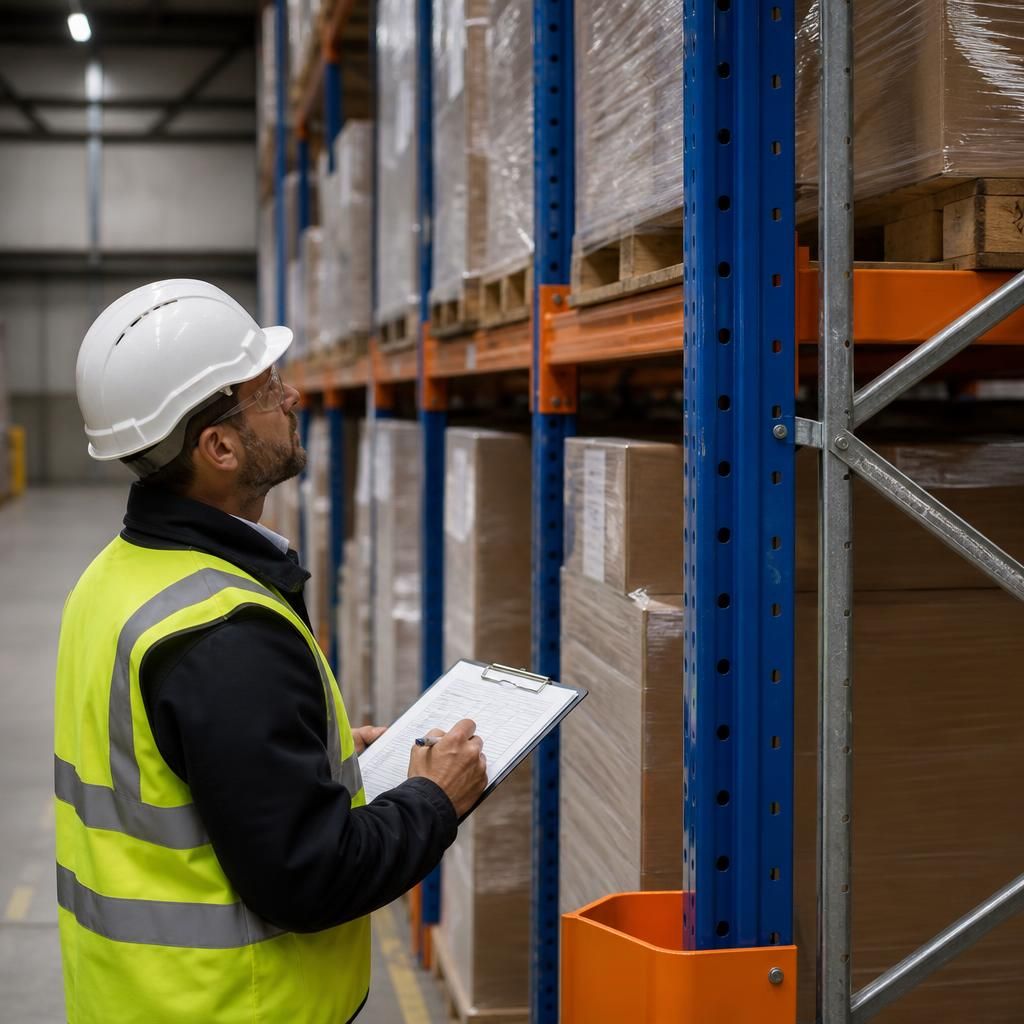
Compliance with warehouse racking safety standards means keeping the installation suitable, structurally sound and safely controlled throughout its working life. Regular inspections are central to this process because impacts, overloading, missing components and unauthorised alterations can reduce capacity before a defect becomes obvious.
Warehouse personnel should report damage as soon as it is found, while a competent specialist should assess the affected area and specify the appropriate action. Where stability may be affected, the bay should be isolated and kept out of use until repair or replacement is completed and verified. Accurate records should show the defect, its location, the corrective action and when the area was returned to service.
Arrange a warehouse racking safety inspection
Arrange a warehouse racking safety inspection with Able Racking to identify damage, confirm compliance and keep your storage system safe to use.