
What are the different types of pallet racking systems available for warehouses?
Warehouses can choose from several pallet racking systems, including selective, drive-in, push-back, pallet flow, double-deep and mobile racking. The most suitable option depends on available space, stock rotation, pallet characteristics, access requirements and the level of selectivity needed.
Pallet racking systems are structured warehouse storage arrangements designed to hold palletised goods safely and make the best use of available floor and vertical space. The main types include selective, double-deep, drive-in, drive-through, push-back, pallet flow, mobile, shuttle and automated systems. Each offers a different balance between storage density, pallet accessibility, stock rotation, handling equipment and installation cost.
The correct choice depends on the warehouse layout, pallet dimensions and weights, product turnover, access requirements, available handling equipment and the degree of stock selectivity required. A high-density system is not automatically the most suitable: reducing direct access to individual pallets can make picking, replenishment and stock control more complicated.
Selective pallet racking
Selective pallet racking is the most widely used arrangement because it provides direct access to every pallet location. Pallets are stored on adjustable beams within upright frames, with each level configured to suit the load and available height.
- Every pallet can be located and removed without moving other pallets.
- It suits warehouses holding a broad range of products or stock-keeping units.
- It supports straightforward stock rotation and accurate inventory control.
- It can be adapted to different pallet sizes, load weights and handling methods.
Its principal limitation is that the aisles required for access use more floor area than some higher-density alternatives. The aisle width must also be compatible with the reach trucks, counterbalance trucks or other equipment operating in the warehouse.
Double-deep pallet racking
Double-deep pallet racking places one pallet position behind another, allowing two pallets to be stored in depth. This increases storage density compared with standard selective layouts, but the rear pallet is not directly accessible from the aisle.
This system is generally suitable where several pallets of the same product are stored and where stock rotation requirements are less demanding. Specialised reach equipment is normally needed to place and retrieve the rear pallet. Good location control is important, as the front pallet may need to be moved before the rear position can be accessed.
Drive-in pallet racking
Drive-in pallet racking allows a handling vehicle to enter the storage lanes to deposit and retrieve pallets. Rails support the pallets within each lane, making it possible to store multiple pallets at depth while reducing the number of access aisles.
It provides high storage density and is often considered for large quantities of similar products with relatively low stock rotation. However, it normally operates on a last-in, first-out basis, and the handling vehicle must work inside the structure. This means pallet condition, load stability, vehicle operation and impact protection require particular attention.
Drive-through pallet racking
Drive-through pallet racking has access from both ends of the storage lanes. This can support a first-in, first-out sequence when pallets are loaded from one side and retrieved from the other, although the actual stock rotation depends on how the warehouse is managed.
The arrangement can be useful where goods need to flow through the storage area or where separate loading and unloading points are required. It requires suitable space on both sides of the structure and careful control of traffic routes to prevent collisions and congestion.
Push-back pallet racking
Push-back pallet racking uses inclined rails or nested carts. When a new pallet is loaded, it pushes the existing pallets further back into the lane. When the front pallet is removed, the stored pallets move forward under gravity.
- It provides more storage density than standard selective layouts.
- Several pallets of the same product can be held in one lane.
- All loading and retrieval can take place from the aisle side.
- It is generally suited to last-in, first-out stock management.
The lane depth, pallet quality and load characteristics must be compatible with the equipment. Damaged or inconsistent pallets can affect smooth movement and increase the risk of operational problems.
Pallet flow racking
Pallet flow racking, also called gravity flow pallet racking, uses rollers within the storage lanes. Pallets are loaded at one end and travel towards the picking face, allowing stock to move through the system in a controlled sequence.
This arrangement is particularly useful for products requiring first-in, first-out rotation, including goods with defined shelf lives. It can separate replenishment and picking activities, reducing the need for handling vehicles to enter the storage lanes. Braking systems, lane separators and stop mechanisms must be selected for the pallet type and load weight, and the equipment needs regular checks to confirm that movement remains controlled.
Mobile pallet racking
Mobile pallet racking is installed on powered or mechanically operated bases that move along floor rails. The bases can open a working aisle where access is required and close again to remove unused aisle space.
This can increase storage capacity where floor area is limited while retaining direct access to the selected aisle. It is more mechanically complex than fixed systems, so floor condition, rail alignment, electrical provision, safety controls and emergency access must be considered during design and maintenance. Operating procedures should prevent people or vehicles from entering a closing aisle.
Shuttle pallet racking
Shuttle systems use a powered shuttle carrier to move pallets along storage lanes. A forklift places the shuttle and pallets at the lane entrance, while the carrier transfers loads into or out of the lane.
This reduces the need for handling vehicles to drive into deep storage lanes and can provide dense storage for large quantities of similar products. Shuttle systems can be configured for different stock rotation methods, but they depend on compatible pallets, reliable controls, battery management and planned access for servicing.
Automated pallet storage systems
Automated pallet storage systems use equipment such as stacker cranes, conveyors or robotic carriers to store and retrieve pallets under software control. They can make efficient use of height and reduce routine vehicle movements within the storage area.
These systems require a detailed assessment of building tolerances, fire protection, power supplies, software integration, emergency procedures and maintenance access. The warehouse also needs suitable arrangements for dealing with system faults, manual recovery and changes in pallet dimensions or product profiles.
Specialist layouts and configurations
Some warehouses use variations of these systems rather than one arrangement throughout the building. For example, selective pallet racking may be used for mixed products, while a high-density system stores reserve stock. Very narrow aisle layouts can increase storage locations by reducing aisle widths, but they require compatible trucks, accurate floor conditions and carefully controlled traffic routes.
Adjustable beam levels, pallet supports, back protection, guide rails, row spacers and end-of-aisle protection can also be specified according to the risk assessment. These components are not simply optional accessories: their suitability depends on the pallet type, load characteristics, handling equipment and site layout.
How to choose between the systems
Begin by documenting the pallets and products to be stored. Record pallet dimensions, maximum weights, load stability, product turnover, expiry requirements and whether individual pallet access is essential. The design should also account for the building’s clear height, floor capacity, columns, doors, sprinklers, lighting, escape routes and other fixed services.
Next, assess the operating method. Consider the type of handling equipment, aisle requirements, loading and unloading patterns, picking frequency, replenishment processes and the level of stock control required. A system that appears efficient on a plan may reduce productivity if vehicles cannot manoeuvre safely or if workers must move several pallets to reach the required stock.
All pallet racking should be designed, installed and altered by competent people, with the intended loads and operating conditions clearly identified. The completed installation should be inspected before use, protected against foreseeable vehicle impact and kept under a documented inspection and maintenance programme. Routine user checks and formal inspections by a competent person help identify damage, displacement, overloading and other defects before they affect structural performance.
For an existing warehouse, do not assume that a new system can be connected to or placed beside the current installation without assessment. The layout, frame specification, beam levels, floor condition, clearances, load notices and protection measures must be reviewed together. A properly selected system should improve usable capacity without compromising access, stock control or the safe operation of the warehouse.
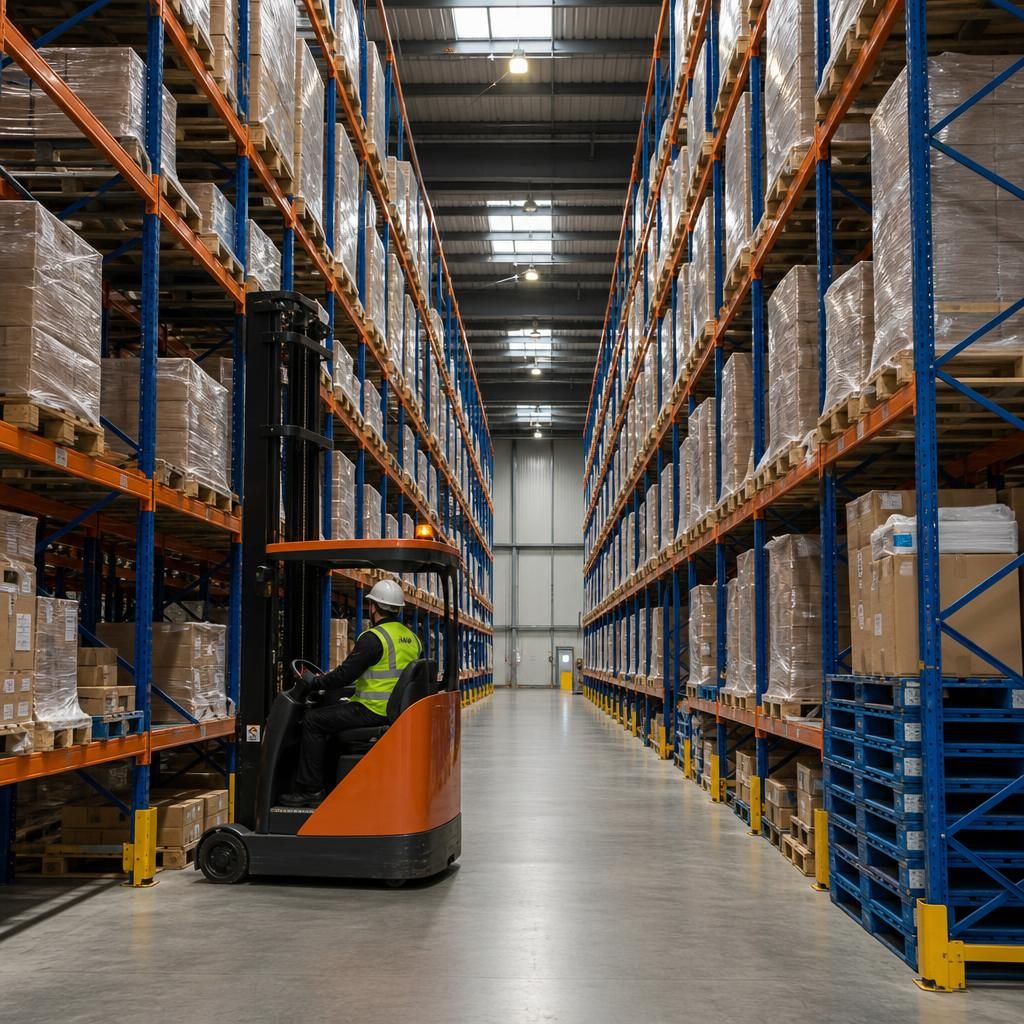
The most suitable pallet racking system depends on how your warehouse stores and retrieves stock. Selective pallet racking provides direct access to every pallet, while drive-in, push-back and pallet flow systems increase storage density by limiting access or controlling the movement of goods.
Before choosing a layout, assess pallet dimensions and weight, stock rotation, handling equipment, available height and the level of individual pallet access required. A high-density system may appear efficient, but it can restrict picking or complicate stock control if it does not match the warehouse’s operating methods. The completed installation should also be checked for load suitability, vehicle clearances, impact protection and safe access.
Get expert advice on your pallet racking system
Speak to Able Racking for expert advice on selecting, inspecting or adapting a pallet racking system to suit your warehouse layout, stock and handling equipment. Our experienced team can help you assess suitability and plan a safe, compliant installation.