
How important is alignment accuracy in pallet racking installation?
Alignment accuracy is essential in pallet racking installation because upright frames, beams and aisles must sit level, plumb and correctly positioned to provide stable load support. Precise installation helps maintain the system’s designed capacity, supports compliance with safety requirements, reduces the risk of impact or premature damage, and enables efficient warehouse operations.
Alignment accuracy is fundamental to a safe and effective pallet racking installation. Upright frames must be plumb, beams must be level and each bay must be positioned correctly in relation to the warehouse floor, adjoining bays and operating aisles. Accurate fitting allows the warehouse racking system to perform as designed, supports its stated load capacity and reduces the likelihood of instability, impact damage and inefficient warehouse operations.
Warehouse racking is designed as a complete structural system. Its performance depends on the relationship between the upright frames, horizontal beams, bracing, floor fixings, pallets and loads. If one part is incorrectly positioned, the resulting forces may not be distributed as intended. Small installation errors can therefore become more significant when the system is loaded, exposed to forklift impacts or used continuously.
What alignment accuracy involves
Alignment is more than making the front faces of the bays look straight. A competent installation checks several aspects of the system, including:
- Vertical alignment: Upright frames should remain plumb rather than leaning along or across the aisle.
- Horizontal alignment: Beams should be correctly levelled and seated in their connectors.
- Bay spacing: Each bay should be installed to the specified dimensions so that pallet positions, clearances and load levels remain consistent.
- Aisle alignment: Runs should be positioned accurately to provide the planned operating width and prevent obstructions.
- Frame and brace positioning: Bracing and other structural components must be fitted in the correct arrangement and securely connected.
- Floor and anchor alignment: Baseplates and anchors must be located on a suitable floor and installed as specified.
These checks should be made using suitable measuring equipment and the installation drawings or manufacturer’s instructions. Visual inspection alone may not identify a gradual lean, uneven floor condition or a cumulative error across a long run of warehouse racking.
Why poor alignment affects safety
An upright that is out of plumb may introduce stresses that were not included in the original design. The frame can be less effective at carrying loads vertically, while connections, bracing and floor fixings may experience forces in directions for which they were not intended. Uneven beams can also cause pallets to sit incorrectly, increasing the risk of unstable storage or contact with adjacent components.
Accurate alignment helps maintain the intended load path from the stored pallet, through the beams and upright frames, into the floor. It also helps ensure that the clearances shown in the design are available during normal operation. This is particularly important where forklifts place pallets at height or where the available space between loads and the structure is limited.
Effect on load capacity and design compliance
The stated capacity of a pallet racking system applies only when the system is installed, loaded and used in accordance with its design. Alignment is one part of that requirement. If the installed geometry differs materially from the approved layout or manufacturer’s specification, the original capacity may no longer be reliable without further assessment.
For this reason, installation teams should work from the correct layout drawings, component specifications and load information. Any discrepancy in floor levels, bay dimensions, frame positions or component condition should be recorded and resolved rather than concealed through adjustment or force. Unauthorised alterations, such as drilling new holes, changing beam levels or substituting components, can also affect the design assumptions.
Where alignment concerns are identified after installation, the system should be assessed by a suitably competent person. It may be necessary to unload affected bays, restrict access, correct the installation or obtain technical confirmation before the warehouse racking is returned to normal use.
Effect on warehouse efficiency
Accurate installation supports smooth day-to-day operation. Consistent bay spacing gives forklift operators predictable pallet positions and reduces the need for repeated adjustments. Correct aisle alignment helps vehicles manoeuvre safely and reduces the risk of striking upright frames, beams or stored goods.
Accurate alignment also makes future inspections and maintenance more straightforward. A system that follows its intended layout provides a reliable reference for identifying new damage, movement or deterioration. Where bays are uneven or irregular from the outset, it can be more difficult to distinguish an installation issue from subsequent impact damage.
How alignment should be controlled during installation
- Confirm the design information: Check the approved layout, bay dimensions, load requirements, aisle widths, component schedule and floor information before work begins.
- Inspect the installation area: Identify uneven floors, obstructions, damaged surfaces and services that could affect the planned positions.
- Set out the positions accurately: Mark the location of frames, rows, end bays, access points and protection equipment before assembling the system.
- Assemble components correctly: Fit frames, beams, bracing, safety components and connections in accordance with the relevant instructions.
- Check the geometry: Measure plumb, level, bay spacing, row alignment and aisle clearances rather than relying solely on visual checks.
- Install and verify floor fixings: Anchors should be suitable for the floor and installed in the specified locations and manner.
- Complete a final inspection: Confirm that the finished warehouse racking matches the design, that components are undamaged and that outstanding issues have been resolved.
Installation records should identify the system inspected, the checks completed and any corrective work undertaken. Clear records help demonstrate that the installation has been controlled properly and provide useful information for later safety inspections, repairs or alterations.
Floor conditions and cumulative error
The warehouse floor is an important part of alignment accuracy. Variations in level can affect the position of baseplates and cause a run to deviate if they are not identified and addressed in accordance with the design. Packing or shimming should never be improvised; any method used must be approved for the system and suitable for the loads involved.
Small deviations can also accumulate along a long run. A bay that is only slightly out of position may appear acceptable in isolation, but repeated deviations can reduce aisle clearance or cause the end of the run to be significantly out of line. Setting out and checking the complete run helps identify this type of problem before the system is loaded.
Alignment and forklift impact protection
Accurate alignment does not eliminate the possibility of forklift impact, but it helps maintain the intended clearances and makes protective equipment more effective. Upright guards, end-of-aisle protection and other safety measures must be positioned so they protect the relevant structural components without interfering with normal pallet placement.
Any impact should be reported and assessed, even if the warehouse racking appears to remain upright. A collision can alter alignment, damage connections or weaken a component without causing immediate collapse. Repairs and re-alignment should be completed using suitable replacement components and competent methods; damaged parts should not be straightened or modified unless formally approved.
What customers should verify after installation
- The installed layout corresponds with the approved drawings and agreed storage requirements.
- Uprights and runs have been checked for plumb and alignment.
- Beams are correctly seated, level and secured.
- Anchors, baseplates, bracing and safety components are present and correctly installed.
- Load notices and other required information are displayed where applicable.
- Required aisle, pallet and operating clearances are available.
- Any deviations or remedial actions have been documented and closed.
Alignment should also be considered whenever warehouse racking is extended, relocated, repaired or altered. Moving a bay, changing beam levels or adding components can affect the original design and may require a revised layout or technical review. Regular inspections remain necessary because accurate installation cannot prevent later damage, overloading or misuse.
In practical terms, alignment accuracy is a foundation of pallet racking safety rather than a cosmetic finishing detail. Precise setting out, careful assembly and documented verification help preserve structural performance, maintain usable clearances and support compliance with the system’s design and applicable safety requirements. Where there is any doubt about the condition or geometry of an installed system, it should be checked by a competent warehouse racking specialist before the affected area continues in service.
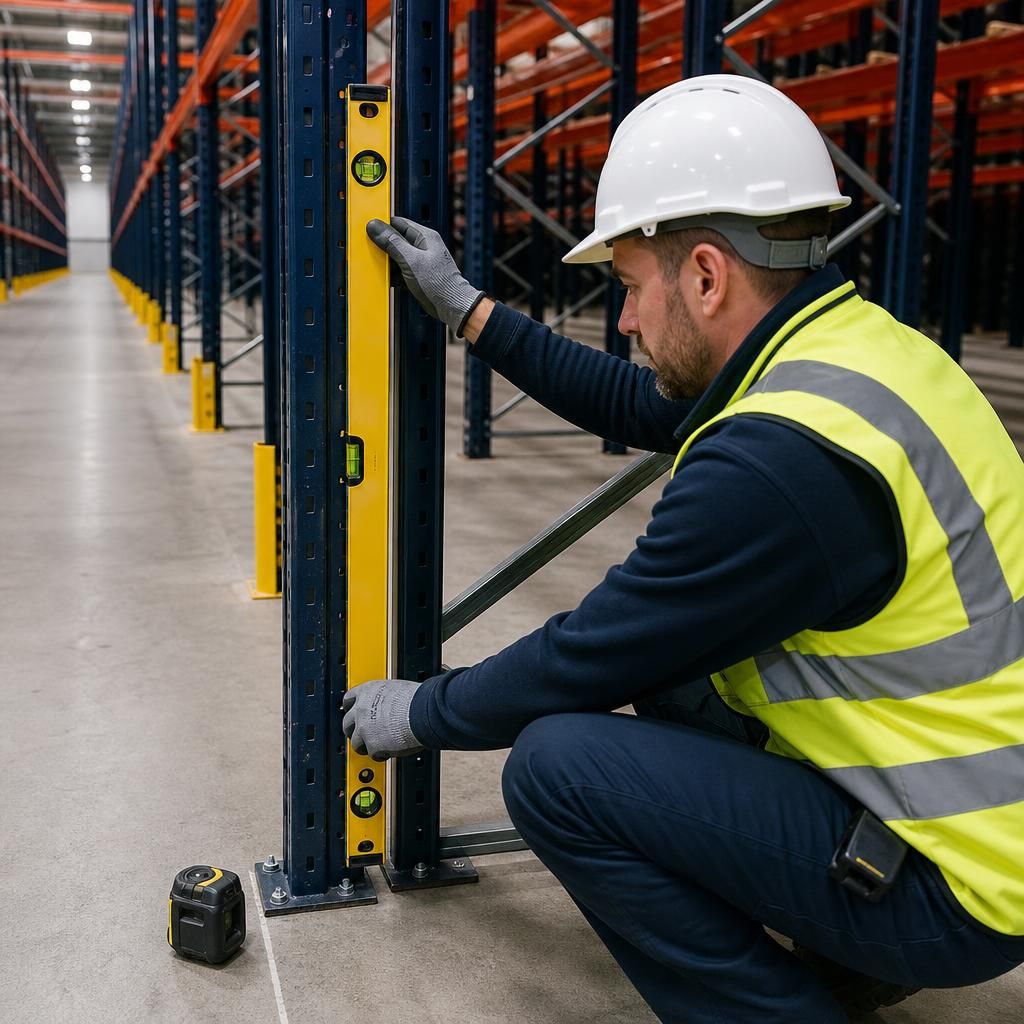
Alignment accuracy ensures that every upright frame, beam and aisle is positioned to the approved layout and remains level, plumb and correctly spaced. This is essential because even small deviations can affect pallet clearances, forklift access and the way loads transfer through the warehouse racking into the floor.
Checks should account for floor levels, bay spacing and the alignment of the complete run, not just individual bays. A competent installation team verifies the finished geometry against the design, confirms that baseplates and anchors are correctly positioned, and records any deviation before the warehouse racking is loaded. This helps preserve structural performance and provides a reliable reference for future inspections and maintenance.
Book a pallet racking installation assessment
Book a pallet racking installation assessment to verify alignment, floor fixings, clearances and compliance with the approved design. Our competent team can identify and address installation concerns before they affect safe warehouse operations.