
Why are regular warehouse racking inspections necessary?
Regular warehouse racking inspections identify damage, instability and other hazards before they cause injury, stock loss or operational disruption. They also support compliance with workplace safety duties, helping you maintain a safe, efficient and reliable warehouse storage system.
Regular warehouse racking inspections are necessary to identify damage, instability and unsafe conditions before they lead to injury, falling loads, stock loss or operational disruption. They provide a structured way to check that the storage system remains suitable for its intended loads and use, while supporting your wider health and safety responsibilities.
They help prevent small defects becoming serious hazards. Warehouse racking can be damaged by forklift impact, incorrect loading, changes to the layout, missing components or repeated use. A bent upright, displaced beam, damaged safety pin or loose connection may initially appear minor, but can reduce the system’s load-bearing capacity and affect adjacent sections. Inspections identify these defects so they can be assessed and dealt with promptly.
Inspections should consider the complete installation, not just the most visible damage. A competent inspector will typically assess:
- uprights, frames, beams, bracing and connections;
- baseplates, floor fixings, guards and safety pins;
- signs of impact, distortion, corrosion, cracks or missing components;
- load notices and whether the system is being used within its stated capacity;
- the condition and positioning of pallets, decking and other supporting components;
- clearances, access routes and the potential for goods to fall; and
- any changes to the layout, loading pattern or working practices.
They support compliance with workplace safety duties. Employers must take reasonably practicable steps to protect employees and others affected by their work. Storage equipment should be maintained and used safely, with suitable arrangements for identifying defects and taking corrective action. HSE guidance recommends systematic inspections by a technically competent person, with the frequency determined by the risks and conditions on site. A formal expert inspection should normally take place at least annually, or more frequently where the risk assessment requires it.
A formal inspection does not replace routine checks by warehouse staff. Operators should report damage, unusual movement, fallen goods or other concerns as soon as they are noticed. These reports should be followed by a suitable assessment, with affected areas isolated where necessary until they are confirmed safe. Routine observations and formal inspections work together: daily awareness can identify recent incidents, while an expert assessment provides a more detailed review of the installation and its condition.
They protect people, stock and business continuity. A failure can result in falling materials, restricted access, damaged products, equipment downtime or an enforced closure of part of the warehouse. Preventative inspections make it easier to plan repairs during controlled maintenance periods rather than responding to an unexpected failure. They can also reveal recurring impact points or working practices that need to be addressed through traffic management, operator training or changes to the layout.
Inspection records are important because they show what was examined, which defects were found, how serious they were and what action was recommended. A useful report should identify the location of each issue clearly and distinguish between items requiring immediate attention and those that can be monitored or scheduled for repair. Keeping records of inspections, repairs and follow-up checks helps demonstrate that defects are being managed rather than simply recorded.
Inspections are especially important after changes or incidents. A further assessment should be considered after a significant impact, a change in loading requirements, alterations to the installation, relocation of components or any event that may have affected stability. New stock profiles, different handling equipment or increased traffic can also change the risks, even when the physical installation has not changed.
Regular warehouse racking inspections therefore form part of a preventative safety process. They do not guarantee that damage will never occur, but they reduce the time between a defect developing and appropriate action being taken. Combined with suitable training, clear load information, prompt reporting and properly completed repairs, they help keep your warehouse storage system safe, compliant and efficient.
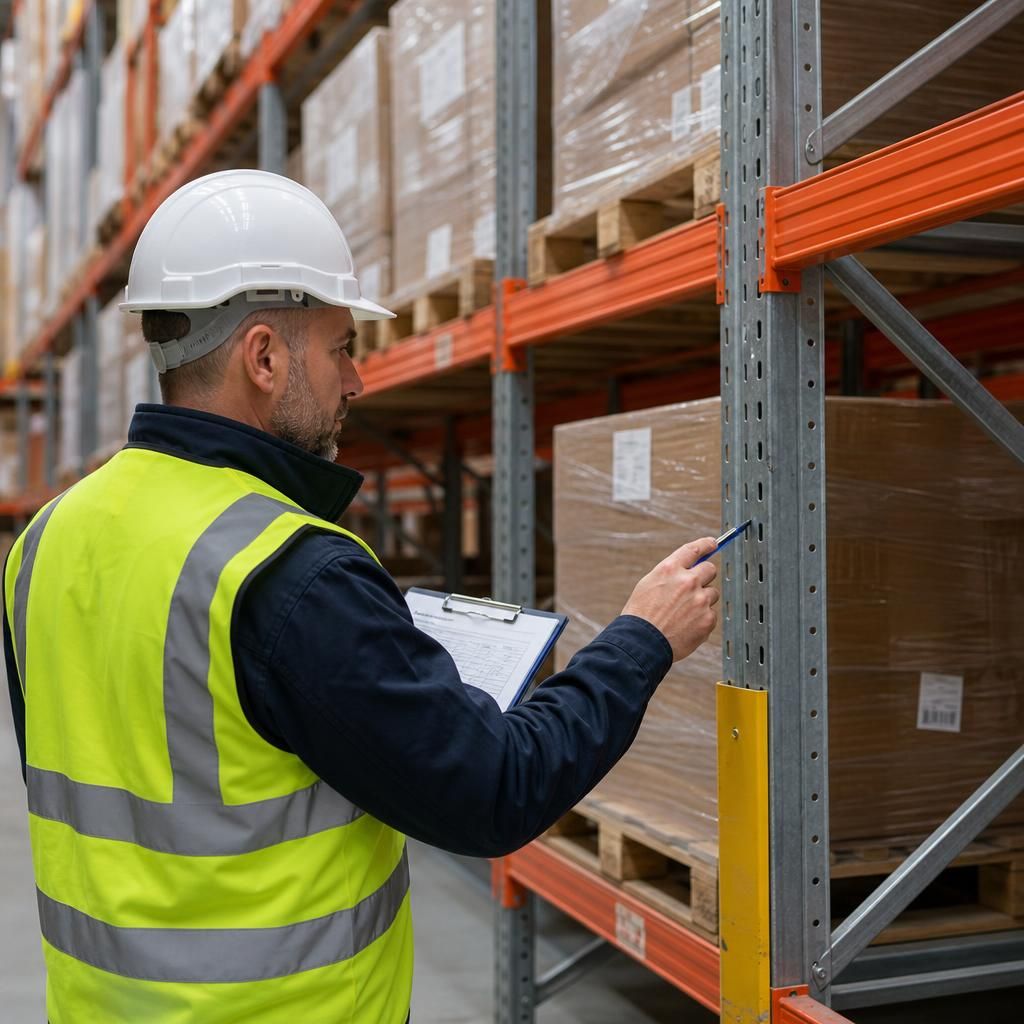
A regular warehouse racking inspection is a structured assessment of the installation’s condition, stability and safe use. It identifies damage, missing components, overloading and unsafe changes before they contribute to falling loads, equipment failure or injury.
Inspections are most effective when findings lead to prompt action. A competent inspector should record each defect clearly, assess its seriousness and recommend whether the affected area needs immediate isolation, repair or continued monitoring. This creates a practical record of how risks are being controlled.
Routine checks by warehouse staff should continue between formal inspections. Reports of forklift impact, unusual movement, damaged beams or displaced pallets should be acted on without waiting for the next planned visit. Following an incident, layout change or change in loading requirements, an additional assessment may also be necessary.
Arrange Your Warehouse Racking Inspection
Arrange your warehouse racking inspection with Able Racking to identify defects, confirm safe use and plan any necessary corrective action.