
What role do pallet rack safety pins play in maintaining warehouse racking integrity?
Pallet rack safety pins are retaining devices that secure horizontal beams to the upright frames of warehouse racking. By preventing beams from being accidentally lifted or dislodged during forklift impacts, loading or unloading, they help preserve structural integrity and support safer, compliant storage operations.
Pallet rack safety pins are retaining devices fitted to the beam-to-upright connections in warehouse racking. Their primary role is to prevent a horizontal beam from being accidentally lifted, displaced or dislodged during forklift movements, loading activity or an impact. By keeping each beam correctly seated in its connector, they help preserve the intended configuration and structural integrity of the storage system.
A safety pin does not increase the rated capacity of a beam or compensate for damaged components. The beam connector and upright frame carry the operational loads; the pin provides essential retention at the connection. This distinction is important because a system may appear complete while still having a missing, incorrectly fitted or unsuitable pin that leaves a beam vulnerable to movement.
When warehouse racking is struck by handling equipment, the impact can create an upward or sideways force at a beam connection. Without an effective retaining device, the beam may lift out of the upright, particularly if the impact occurs while the bay is loaded. Even partial disengagement can alter the load path, reduce stability and place additional stress on adjacent components. A correctly fitted pin helps prevent this type of dislodgement, although any impact should still be reported and assessed.
Safety pins should be compatible with the specific warehouse racking system and installed in accordance with the manufacturer’s instructions. They need to be fully engaged, correctly positioned and easy to identify during an inspection. Substituting a different pin, using improvised fixings or relying on a damaged connector can undermine the connection and may affect the system’s compliance and safe working condition.
During routine checks, attention should be given to:
- missing safety pins or pins that are not fully inserted;
- bent, distorted, loose or corroded pins;
- beam connectors that are not fully engaged with the upright;
- uprights, beams or bracing showing signs of impact or deformation;
- evidence that a beam has lifted, shifted or moved from its original position; and
- incompatible replacement parts or improvised methods of securing the connection.
A missing or damaged pin should not be treated as a minor housekeeping issue. The affected bay should be reported promptly, and the area may need to be isolated or unloaded until a competent person has assessed it. Replacement should use the correct manufacturer-approved component, followed by a check that the beam and its connectors have not also been damaged.
Safety pins form part of a wider warehouse racking safety arrangement. They work alongside correctly installed frames, beams, bracing, baseplates, floor fixings, load notices and suitable operating controls. They cannot prevent damage caused by overloading, poor loading practices, unauthorised alterations or repeated forklift impacts. These risks still require controls, staff awareness and prompt reporting.
Inspections should include both the presence and condition of the pins, rather than simply confirming that a beam is in place. Visual checks by trained staff can identify obvious defects between formal assessments, while a competent warehouse racking inspector can examine connection damage, frame alignment and the wider system following an impact or reported defect. Inspection arrangements should reflect the manufacturer’s guidance, site risks and applicable warehouse racking safety requirements, including the principles set out in BS EN 15635.
In practical terms, pallet rack safety pins provide a small but critical safeguard against beam dislodgement. Keeping them correctly fitted, checking them as part of routine warehouse racking inspections and replacing defective components promptly helps maintain the designed configuration and supports safer, more compliant storage operations.
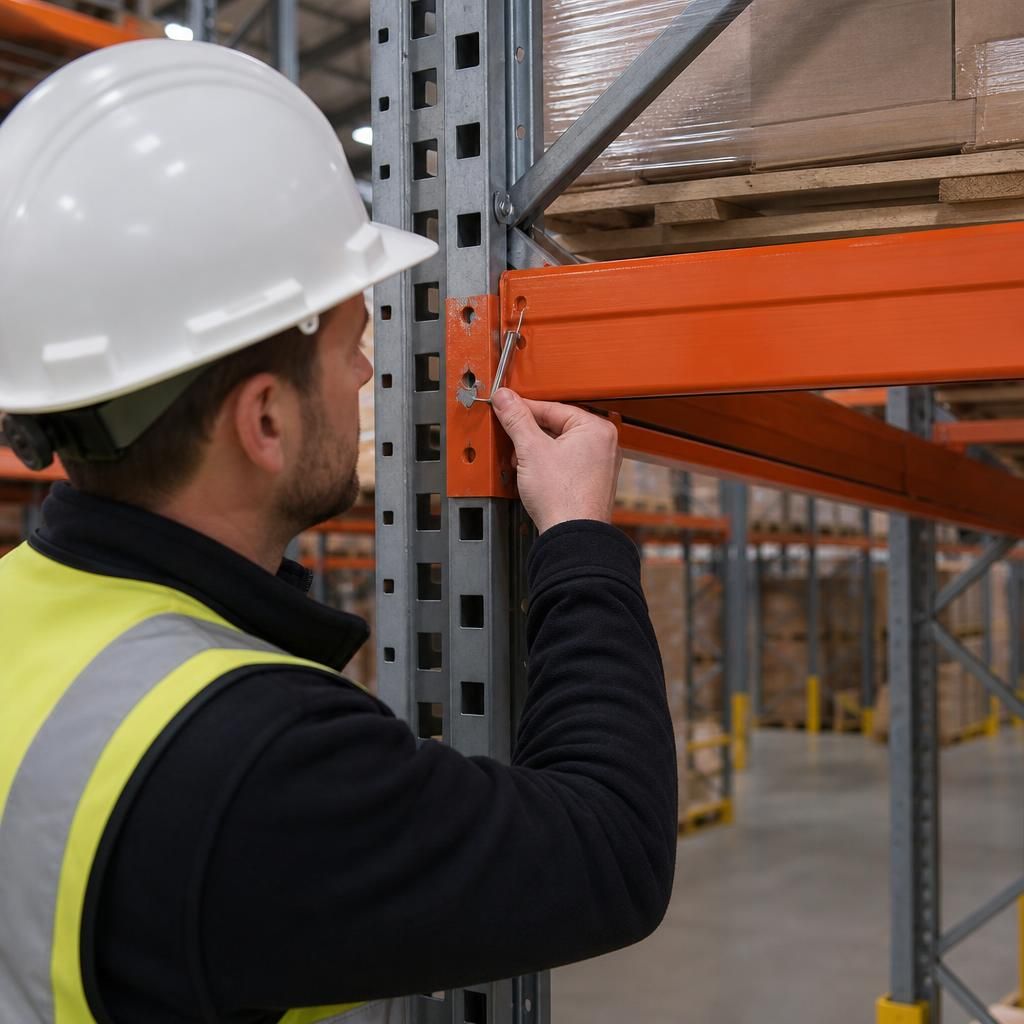
Pallet rack safety pins help prevent a warehouse racking beam from lifting out of its upright connector when the system is struck or subjected to movement during loading and unloading. They retain the beam in its intended position, helping preserve the designed load path and reducing the risk of partial dislodgement.
During an inspection, the pin should be present, correctly positioned and fully engaged. A bent, loose, corroded or incompatible replacement pin can leave the connection ineffective, even if the beam appears to be seated correctly. Any missing or damaged pin should be reported promptly, and the affected bay should be assessed before the correct manufacturer-approved component is fitted.
Arrange a Warehouse Racking Safety Inspection
Arrange a warehouse racking safety inspection to check pallet safety pins, beam connections and other components for damage or defects. Contact Able Racking to book an assessment for your site.