
How often should warehouse racking be inspected?
Warehouse racking should receive regular visual inspections, typically weekly or at an interval determined by your risk assessment, with a formal inspection by a technically competent person at least every 12 months. More frequent inspections may be necessary where the warehouse environment, traffic levels, damage history or operational risks justify them.
Warehouse racking should receive routine visual inspections at an interval set by your risk assessment, commonly weekly, and a formal inspection by a technically competent person at least every 12 months. Inspections must be more frequent where there is heavy forklift traffic, frequent stock changes, a history of damage, difficult operating conditions or any other factor that increases the likelihood of failure.
The annual formal inspection is the minimum recommended interval for a detailed examination of warehouse racking. It should not be treated as a substitute for regular in-house checks. The person responsible for the warehouse should ensure that defects are identified promptly between formal inspections and that concerns are escalated without delay.
A practical inspection programme should include:
- Routine visual checks: Look for impact damage, bent or distorted components, missing or displaced safety pins, loose connections, damaged beams, overloaded sections and changes to the warehouse racking layout.
- Regular recorded inspections: A nominated, suitably trained person should examine the warehouse racking at the frequency identified by the risk assessment and record the findings.
- Immediate post-impact checks: Any warehouse racking struck by a forklift, pallet truck or other equipment should be assessed straight away, even if the damage is not obvious.
- Formal expert inspections: A technically competent person should complete a more detailed inspection at least annually, or more often where the risk assessment requires it.
The inspection frequency should reflect how the warehouse operates. A low-traffic area with stable loads may require a different routine from a busy distribution environment where vehicles operate close to storage frames throughout the day. The condition and age of the warehouse racking, the type and weight of stored goods, loading practices, building conditions and previous incidents should all be considered.
Warehouse racking should also be inspected whenever there has been a significant change. This includes alterations to the layout, changes to beam levels or load capacities, the introduction of different handling equipment, relocation of the system or changes in the type of pallets and goods stored. A change can affect clearances, load distribution and vehicle movements, so the original inspection frequency may no longer be suitable.
Damage should be reported as soon as it is found. Where a component is seriously damaged or its condition creates an immediate risk, the affected section should be isolated and unloaded where it is safe to do so. It should not be put back into service simply because the damage appears minor or because the next planned inspection is due soon. Repairs and replacements should be completed using suitable components and in accordance with the system design and manufacturer’s requirements.
Inspection records should identify the date, location, person carrying out the check, findings, risk classification, action required and date of completion. Keeping these records makes it easier to track recurring damage, confirm that corrective work has been completed and demonstrate that the inspection process is being managed effectively.
A suitable inspection programme therefore combines frequent workplace checks with a documented formal assessment at least once every 12 months. The correct interval is the one supported by the warehouse’s risk assessment and adjusted when operating conditions change. If damage, repeated overloading or higher traffic levels are present, Able Racking can help review the inspection arrangements and identify the appropriate level of control.
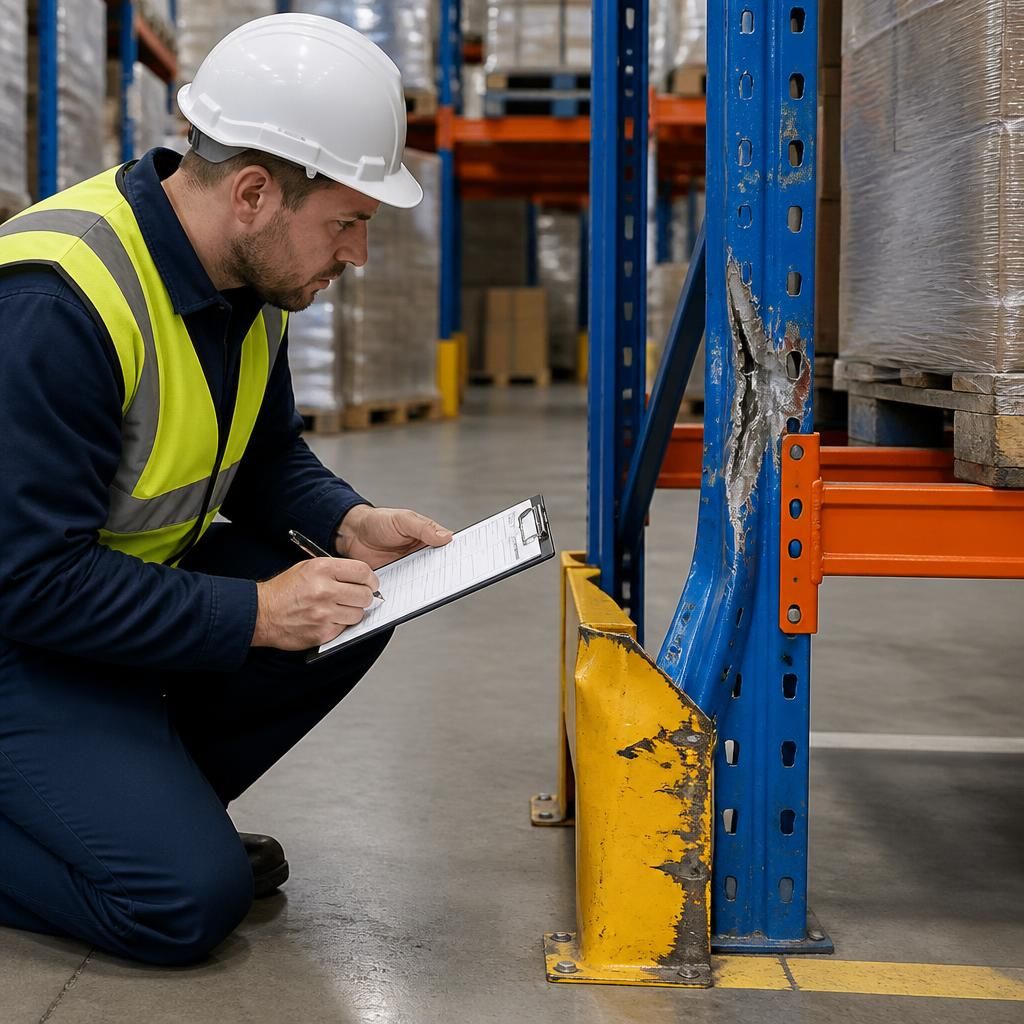
Any warehouse racking struck by a forklift, pallet truck or other handling equipment should be checked immediately, regardless of when the next planned inspection is due. Impact can distort uprights, beams, bracing or connections without producing damage that is obvious from a distance.
Where damage is found, the affected section should be isolated and unloaded where safe to do so, then assessed by a suitably competent person. It should not return to service until the necessary repair or replacement has been completed using suitable components and in line with the system design and manufacturer’s requirements.
Review your warehouse racking inspection schedule
Review your warehouse racking inspection schedule against your current risk assessment, operating conditions and damage history. Contact Able Racking if you need help confirming whether your inspection arrangements remain suitable.