
What are the benefits of using different types of warehouse racking systems?
Different types of warehouse racking systems provide distinct benefits for storage capacity, product access, stock rotation and operational efficiency. The right system depends on your available space, inventory characteristics, handling equipment and required access frequency.
Different types of warehouse racking systems offer different advantages because they are designed around particular storage, access and stock-handling requirements. The most suitable choice depends on the available floor and clear height, the dimensions and weight of the goods, stock rotation requirements, handling equipment, access frequency and the need to use space efficiently. A well-planned solution may also combine more than one type of warehouse racking to support different product categories.
Adjustable pallet warehouse racking
Adjustable pallet warehouse racking is a versatile option for sites storing palletised goods in a range of sizes. Beam levels can usually be repositioned to suit changing load dimensions, which makes this type of warehouse racking useful where stock profiles are varied or likely to change. Each pallet position can generally be accessed directly, supporting straightforward stock control and efficient picking.
Its flexibility also makes it easier to adapt a warehouse racking layout when product lines, pallet heights or handling processes change. However, direct access to every pallet usually requires more aisle space than higher-density solutions. The design must account for load capacities, beam configuration, clearances, forklift operation and protection against impact.
Narrow-aisle warehouse racking
Narrow-aisle warehouse racking increases storage capacity by reducing the width of operating aisles while retaining direct access to individual pallet locations. It can make better use of the available floor area and building height, particularly where land is limited or expansion is difficult.
This approach requires suitable handling equipment and carefully controlled traffic routes. The operating clearances must be compatible with the trucks being used, and the warehouse racking must be installed accurately to maintain safe tolerances. It is most effective when the site has consistent operating procedures, suitable floor conditions and equipment designed for the aisle arrangement.
Drive-in warehouse racking
Drive-in warehouse racking provides high-density storage by allowing handling equipment to enter storage lanes. It reduces the number of access aisles and can hold large quantities of similar goods, making it appropriate where many pallets share the same product type and direct access to every pallet is not essential.
This type of warehouse racking is commonly suited to goods with longer storage periods or limited stock variety. It is less suitable where frequent individual pallet picking or strict first-in, first-out stock rotation is required. Operators need clear loading procedures because the structure and its guide rails can be more exposed to forklift contact during loading and retrieval.
Push-back warehouse racking
Push-back warehouse racking allows pallets to be stored at greater depth while keeping loading and retrieval operations at the front of the lane. Pallets are placed on carrier arrangements that move along inclined rails, making this a useful option for increasing density without requiring access aisles on both sides.
It is generally suitable for products stored in batches or with a last-in, first-out rotation method. Push-back warehouse racking can reduce travel through the warehouse and provide good use of vertical space, but it requires compatible pallet dimensions, controlled loading techniques and regular checks of the moving components.
Pallet-flow warehouse racking
Pallet-flow warehouse racking uses rollers or wheel tracks to move pallets from the loading side towards the picking side. This supports first-in, first-out stock rotation and creates a clear separation between replenishment and order-picking activities. It can be particularly effective for date-sensitive goods, high-volume picking or operations where stock rotation is a priority.
The system requires accurate loading and compatible pallets so that goods move at a controlled speed. Braking arrangements, separators and end stops must be selected and maintained appropriately. The warehouse racking layout should also allow safe access for replenishment, picking and inspection without creating conflicts between different handling activities.
Carton-flow warehouse racking
Carton-flow warehouse racking is designed for smaller cartons, totes and individual items rather than full pallets. Inclined rollers or wheels allow cartons to move towards the picking face, helping staff identify products quickly and replenish stock from the opposite side.
This type of warehouse racking can improve pick-face organisation, reduce unnecessary reaching and support first-in, first-out rotation. It is useful for order-picking operations with many product lines, although each channel must be planned around carton size, weight, packaging strength and expected pick frequency.
Cantilever warehouse racking
Cantilever warehouse racking is designed for long, awkward or non-uniform loads that cannot be stored efficiently on conventional pallet beams. Its arms provide open access for items such as timber, pipes, profiles, sheets and other lengthy materials.
Because the front of the structure is unobstructed, loading and retrieval can be more practical for irregular goods. The design must consider the length, weight and balance of each load, as well as the possibility of items rolling or projecting beyond the arms. Appropriate restraints, end stops and operating controls are important where goods could move during handling.
Mobile warehouse racking
Mobile warehouse racking is installed on powered or manually operated bases that move along floor tracks. By opening an aisle only where it is needed, it can provide high storage density while retaining access to the stored goods. This may be useful where floor space is restricted or where secure, controlled access is required.
Mobile warehouse racking needs careful consideration of floor loading, track installation, emergency access, electrical arrangements and operator controls. Safety features should include appropriate interlocks, obstruction detection and emergency stopping arrangements. The system also requires planned maintenance because movement mechanisms are essential to safe operation.
How the benefits differ
- For maximum direct access: adjustable pallet warehouse racking is usually the most flexible starting point.
- For higher storage density: narrow-aisle, drive-in, push-back or mobile warehouse racking may reduce the space needed for access aisles.
- For stock rotation: pallet-flow and carton-flow warehouse racking can support first-in, first-out processes.
- For uniform product batches: drive-in or push-back warehouse racking can store greater quantities with fewer access routes.
- For long or irregular materials: cantilever warehouse racking provides the necessary open-front support.
- For mixed operations: combining warehouse racking types can create separate areas for pallet storage, picking, bulk goods and long products.
Factors to check before choosing a system
Storage density should not be considered in isolation. A high-density warehouse racking arrangement may reduce the number of access aisles but increase travel distances, restrict selectivity or require specialised handling equipment. Conversely, a more accessible arrangement may use additional floor space but improve picking speed and stock visibility.
Before selecting warehouse racking, review the load unit, pallet condition, maximum load weight, product dimensions, stock rotation method, order profile and expected future changes. The available building height, floor capacity, lighting, sprinkler clearances, pedestrian routes and forklift operating areas must also be included in the design.
Safety is equally important. Warehouse racking should be designed and installed for its intended loads and use, with clear load notices and suitable protection at vulnerable locations. The structure should be inspected at planned intervals by a competent person, with damage recorded, assessed and repaired or isolated without delay. Any changes to beams, levels, components or layout should be controlled rather than carried out informally.
In practice, the best warehouse racking solution is the one that balances capacity with safe access, reliable stock control and efficient daily handling. A site assessment and layout review can establish whether an existing arrangement remains suitable, whether different warehouse racking types should be combined and what precautions are needed to keep the installation compliant throughout its working life.
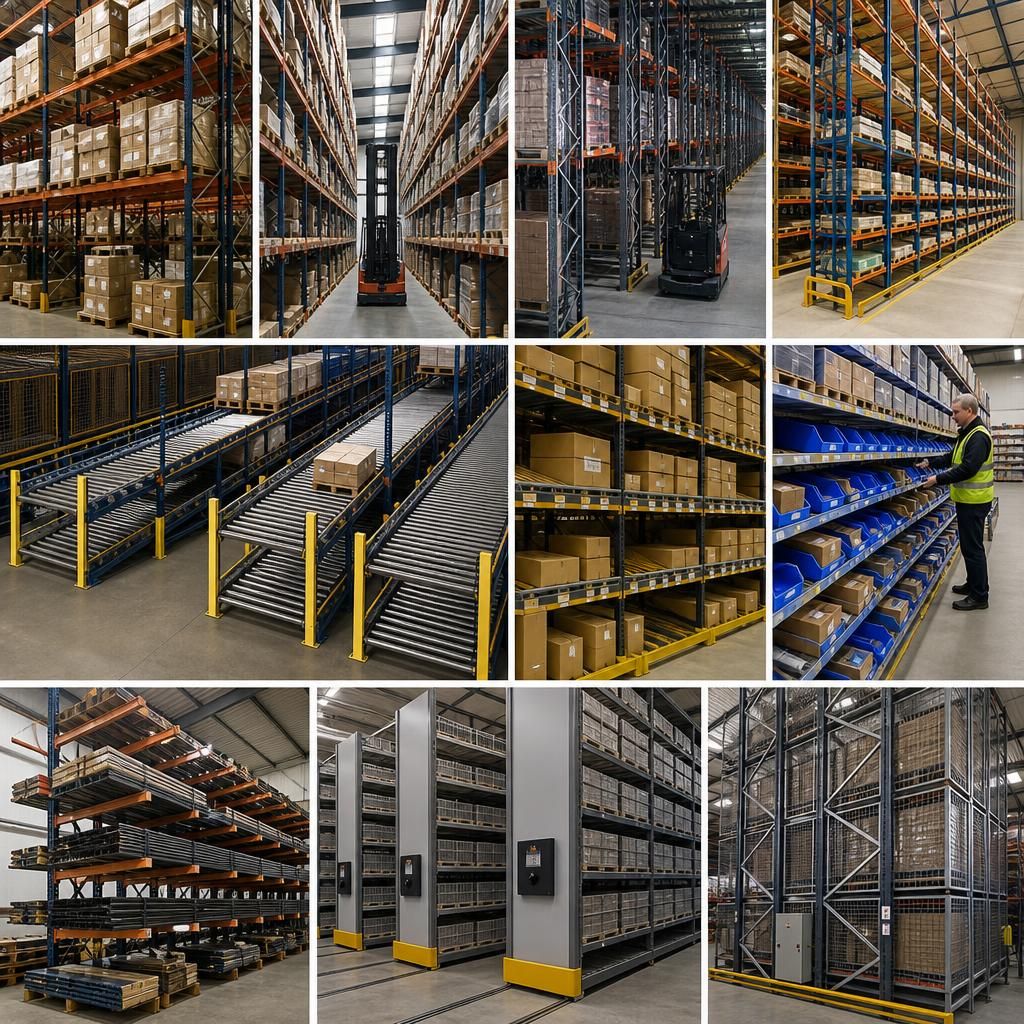
The main benefit of choosing the right warehouse racking system is that it aligns storage capacity with how goods are accessed, rotated and handled. Direct-access systems support fast picking and clear stock visibility, while higher-density systems make better use of floor area and building height where selective access is less important.
For example, pallet-flow warehouse racking can support first-in, first-out stock rotation, while drive-in or push-back warehouse racking may suit uniform products stored in batches. Cantilever warehouse racking provides practical support for long or irregular loads, and carton-flow warehouse racking can organise smaller items at an efficient picking face. Selecting the system around the load, handling equipment and operating process helps maintain safe access without sacrificing useful storage capacity.
Review Your Warehouse Racking System Options
Speak to Able Racking to review your warehouse racking options and identify a safe, efficient system for your stock, handling equipment and available space.