
What types of damage require immediate warehouse racking repairs?
Damage requiring immediate warehouse racking repairs includes bent, twisted or cracked uprights and beams, failed or missing beam locks, damaged bracing, loose connections, displaced components and any sign that the structure is unstable or overloaded. Isolate the affected area, prevent further use and arrange an expert inspection before the warehouse racking is repaired and returned to service.
Immediate warehouse racking repairs are required when damage may affect the load-bearing capacity, stability or safe use of the installation. This includes bent, twisted or cracked uprights and beams, damaged bracing, failed beam locks, loose connections, displaced components, severe corrosion, impact damage and any sign that the warehouse racking is leaning, overloaded or no longer securely anchored. The affected area should be isolated immediately and assessed by a competent warehouse racking specialist before it is used again.
Do not attempt to straighten, weld, drill or otherwise modify damaged components as a temporary fix. Unauthorised alterations can change how loads are distributed and may conceal a more serious structural problem. Where damage is significant, the safest action is to unload the affected section, prevent access and arrange an urgent inspection.
Damage that normally requires immediate action includes:
- Bent or twisted uprights: Uprights carry vertical loads through the frame. A visible bend, crease, split, buckle or twist can reduce their capacity, particularly where the damage is close to a connection, baseplate or beam position.
- Damaged beams: Beams with bends, dents, kinks, cracks, excessive deflection or signs of distortion should not continue carrying stock until they have been assessed. Damage can result from forklift impact, overloading or incorrect placement of pallets.
- Failed or missing beam locks: Beam locks and safety pins help prevent beams from becoming displaced. A missing, broken or incorrectly fitted locking device can allow a beam to lift or move if it is struck or loaded unevenly.
- Damaged bracing: Horizontal and diagonal bracing helps maintain the shape and stability of each frame. Bent, fractured, detached or missing bracing should be treated as urgent, especially when the frame has also been impacted.
- Loose or damaged connections: Missing bolts, loose fixings, enlarged bolt holes, damaged hooks and deformed connectors can weaken the connection between components. Connections should be checked rather than tightened without understanding why they have loosened.
- Damaged baseplates or anchors: A displaced, cracked or distorted baseplate, or an anchor that has pulled out of the floor, can affect the stability of the complete frame. The surrounding floor should also be checked for cracking or other movement.
- Impact damage: A collision may cause serious internal or concealed damage even when the visible mark appears minor. Forklift impacts to uprights, guards, bracing or beam ends require prompt assessment and may require the damaged component to be replaced.
- Corrosion, cracks or metal fatigue: Heavy corrosion, particularly around joints and floor-level components, can reduce section strength. Cracks, splits and sharp tears should never be ignored or covered with paint before inspection.
- Displaced components or unstable frames: Any frame that is leaning, out of alignment, moving under normal use or visibly separating at a connection indicates a potential stability problem. Stop using the affected section and keep people and handling equipment clear.
- Overloading or unauthorised changes: Loads above the stated capacity, altered beam levels, incompatible components and changes to the layout can compromise the original design. The installation should be reviewed before further loading takes place.
Immediate steps after damage is found
- Stop placing or removing stock from the affected section unless doing so is necessary to make the area safe and can be completed under a controlled plan.
- Keep staff, visitors and handling equipment away from the damaged area. Use suitable barriers and clearly identify the section as out of service.
- Inform the responsible warehouse manager and record what happened, including the location, visible damage, approximate time and any impact or loading event.
- Take photographs from a safe position if this can be done without entering a hazardous area. Photographs support the inspection but do not replace it.
- Arrange an inspection by a suitably competent specialist. The assessment should consider the complete frame, connected components, floor condition, anchors, load information and any nearby damage.
- Follow the written repair or replacement recommendation. Do not return the section to service until the work has been completed and its condition has been confirmed as safe.
An expert inspection distinguishes repairable damage from components that need replacement. Some issues may be resolved by replacing a damaged upright, beam, brace, connector, guard or locking device with a compatible component. Other damage may require a wider repair because forces can transfer through connected frames. A local bend should therefore not be treated in isolation without checking the surrounding structure.
Warehouse racking repairs should be completed using components that are compatible with the original system and installed in accordance with the relevant manufacturer’s requirements and the repair specification. Replacement parts should not be selected solely because they look similar. Differences in profile, steel thickness, connection design or load rating can affect performance.
Damage that is cosmetic and does not affect the structure may not require immediate repair, but it should still be recorded and reviewed during the next planned inspection. Examples might include superficial paint loss or a minor mark that has not distorted the metal. The decision should be made by a competent person, not based only on appearance.
After warehouse racking repairs, update the inspection and maintenance records, review the cause of the damage and check whether additional protection or operational controls are needed. Improvements may include impact protection, revised traffic routes, clearer load notices, operator training, better housekeeping or changes to loading practices. Regular inspections then help identify early deterioration before it becomes an urgent safety issue.
If there is any doubt about the severity of damage, treat the section as unsafe until it has been inspected. Isolating warehouse racking promptly protects people and stock while allowing the correct repair decision to be made without increasing the risk of collapse or further damage.
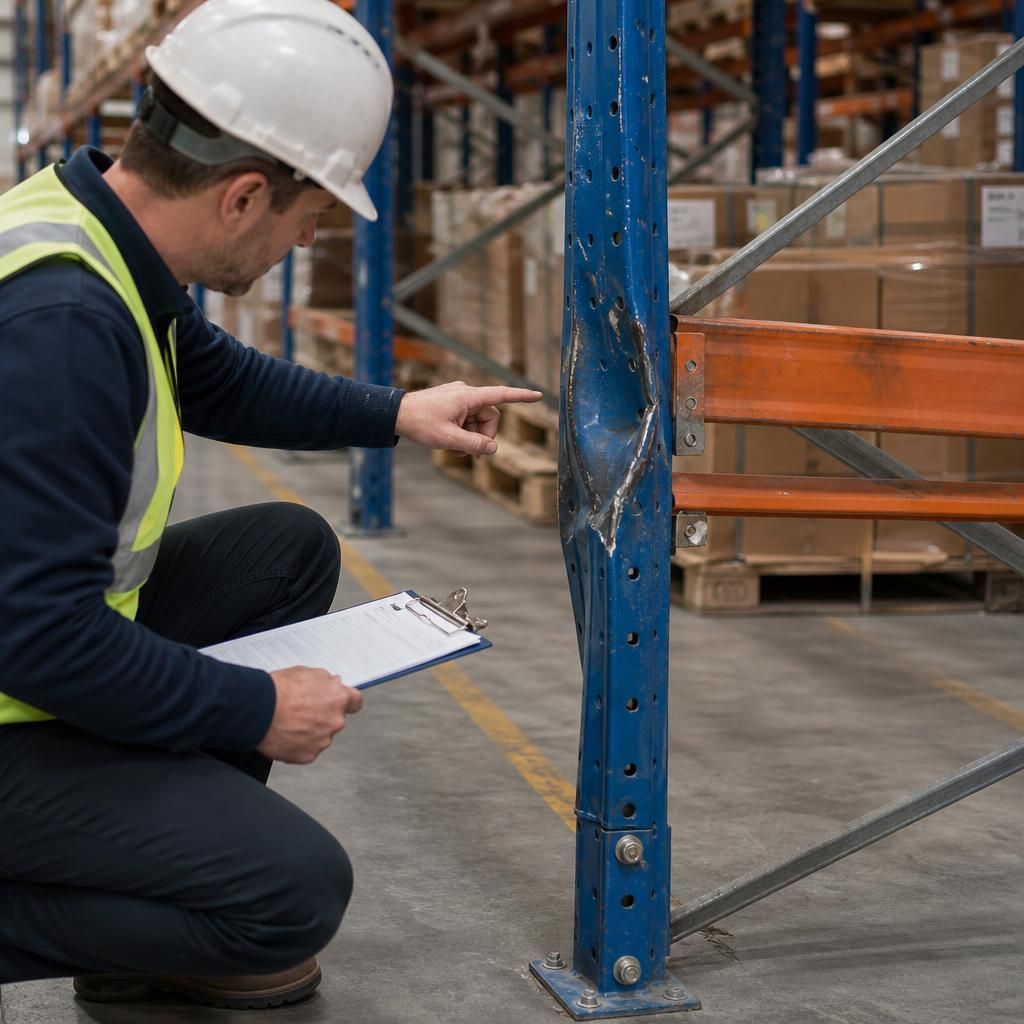
Forklift impact damage requires immediate attention because a visible dent or bend may indicate concealed damage to the upright, beam connection, bracing or floor anchor. Stop using the affected section, keep people and handling equipment clear, and arrange a competent inspection before any stock is moved.
Do not straighten, weld or drill the damaged component as a temporary repair. The inspection should assess the complete frame and connected components, identify whether repair or replacement is necessary, and confirm that the section is safe before it returns to service.
Arrange an urgent warehouse racking repair inspection
If damage may affect the stability or load-bearing capacity of your warehouse racking, isolate the affected area and arrange an urgent inspection by a competent specialist. Contact Able Racking to assess the damage and confirm whether repair or component replacement is required before the section returns to service.