
What steps should I take if I identify damage to my warehouse racking during an inspection? Isolate the affected area, prevent further use, record and report the damage, then arrange an assessment and suitable repair by a competent warehouse racking specialist before the system is returned to service.
If you identify damage to your warehouse racking during an inspection, immediately isolate the affected area, prevent further use, record and report the damage, and arrange an assessment by a competent warehouse racking specialist. Do not return the system to service until any necessary repair has been completed and its safety has been confirmed.
If damage is identified during an inspection, immediately stop using the affected section of warehouse racking, prevent access to the risk area, record the findings and report them to the responsible person. The damage should then be assessed by a competent warehouse racking specialist, with suitable repairs or replacement parts arranged before the affected area is returned to service.
Make the area safe immediately
Do not continue loading, unloading or working beneath warehouse racking that may have been weakened. Remove people and handling equipment from the immediate area and establish a clearly marked exclusion zone. If there is a risk of collapse, falling goods or instability, isolate the complete run or bay rather than restricting access only to the visibly damaged component.
Where safe to do so, prevent further contact from forklift trucks and other handling equipment. Do not attempt to straighten, weld, drill, cut or temporarily modify damaged warehouse racking. Unauthorised alterations can affect the load-bearing capacity and may conceal the extent of the problem.
Assess the type and severity of damage
Look for damage to uprights, beams, bracing, base plates, anchors, guards, connectors and other structural or protective components. Also check whether frames are out of alignment, whether beams have become displaced, and whether stored loads or adjacent bays have been affected. Damage is not always limited to the point of impact, so the surrounding structure should be examined as part of the assessment.
Some damage requires immediate action, including:
- severely bent, buckled or split uprights;
- beams that are visibly distorted, detached or no longer seated correctly;
- missing, loose or damaged connectors, locking devices or anchors;
- displaced, unstable or fallen loads;
- significant damage to bracing or other components that maintain stability;
- warehouse racking that is leaning, moving or showing signs of progressive deformation.
If the level of risk is unclear, treat the affected warehouse racking as unsafe until it has been assessed. A competent specialist can determine whether the issue requires immediate unloading, isolation, repair, component replacement or further investigation.
Record the findings accurately
Create a clear inspection record while the condition is visible. Include the location of the affected bay or run, the components involved, the apparent cause, the severity of the damage and any immediate controls applied. Photographs can help demonstrate the condition, particularly when repairs are being planned, but they should support rather than replace a written description.
Record whether goods were present, whether any load had shifted and whether nearby warehouse racking appeared affected. Where available, refer to the relevant layout drawing, asset identification or inspection reference so that the correct area can be identified without ambiguity.
Report the damage through the correct process
Tell the warehouse manager, responsible person or designated safety contact as soon as possible. The affected area should be entered into the site’s defect or maintenance system, with ownership assigned for arranging the assessment and controlling access. Operators should also be informed so that the isolated area is not used accidentally.
The inspection record should remain available with other warehouse racking safety documentation. This creates an auditable history of the defect, the actions taken and the decision made about returning the area to service.
Arrange a competent assessment and repair
Repairs should be specified and completed by a suitably competent warehouse racking specialist, following the original design requirements, manufacturer information and applicable safety guidance. The assessment should establish whether the damaged component can be repaired using an approved method or whether it must be replaced. It should also consider load capacity, connection integrity, anchorage, alignment and any damage caused by the original impact.
Replacement parts must be compatible with the warehouse racking system and installed correctly. A visually similar component is not necessarily suitable, and improvised repairs may alter the way loads are transferred through the structure. If the original specification is unavailable, the specialist may need to verify the system before defining the repair.
Control the area while work is pending
Keep the affected warehouse racking isolated until the repair has been completed and its condition has been checked. Do not use warning tape alone where it can be moved or ignored; use a control that reflects the level of risk and the site’s operating arrangements. If goods need to be removed, this should be planned and carried out safely by trained personnel, with the specialist’s advice where stability is uncertain.
Where only part of a run is affected, do not assume that adjacent bays can continue operating without assessment. Loads, impact forces and structural connections can transfer risk beyond the point where damage was first observed.
Verify the repair before returning the area to service
After the repair, confirm that the specified work has been completed, the relevant components are secure and the warehouse racking is correctly aligned and anchored. Check that locking devices, guards, bracing and load notices are present and suitable. The responsible person should retain the repair details and any inspection or completion documentation provided.
The area should only be released when a competent person is satisfied that it is safe for its intended use. If the repair has changed the configuration, capacity or operating conditions, update the relevant documentation and communicate any new loading or handling requirements to warehouse staff.
Review why the damage occurred
Once the immediate risk has been controlled, investigate the cause. Common causes include forklift impact, unsuitable loading, overloading, poor load placement, inadequate protection, unauthorised alterations and failures in site traffic management. Reviewing the event can identify whether additional column protection, revised procedures, operator training, housekeeping controls or changes to inspection arrangements are needed.
Continue with the planned inspection regime after the repair. The required frequency should reflect the warehouse environment, traffic levels, type and condition of the system, previous damage and the findings of competent inspections. Prompt reporting and preventative maintenance help limit disruption and reduce the likelihood of a small defect becoming a wider safety issue.
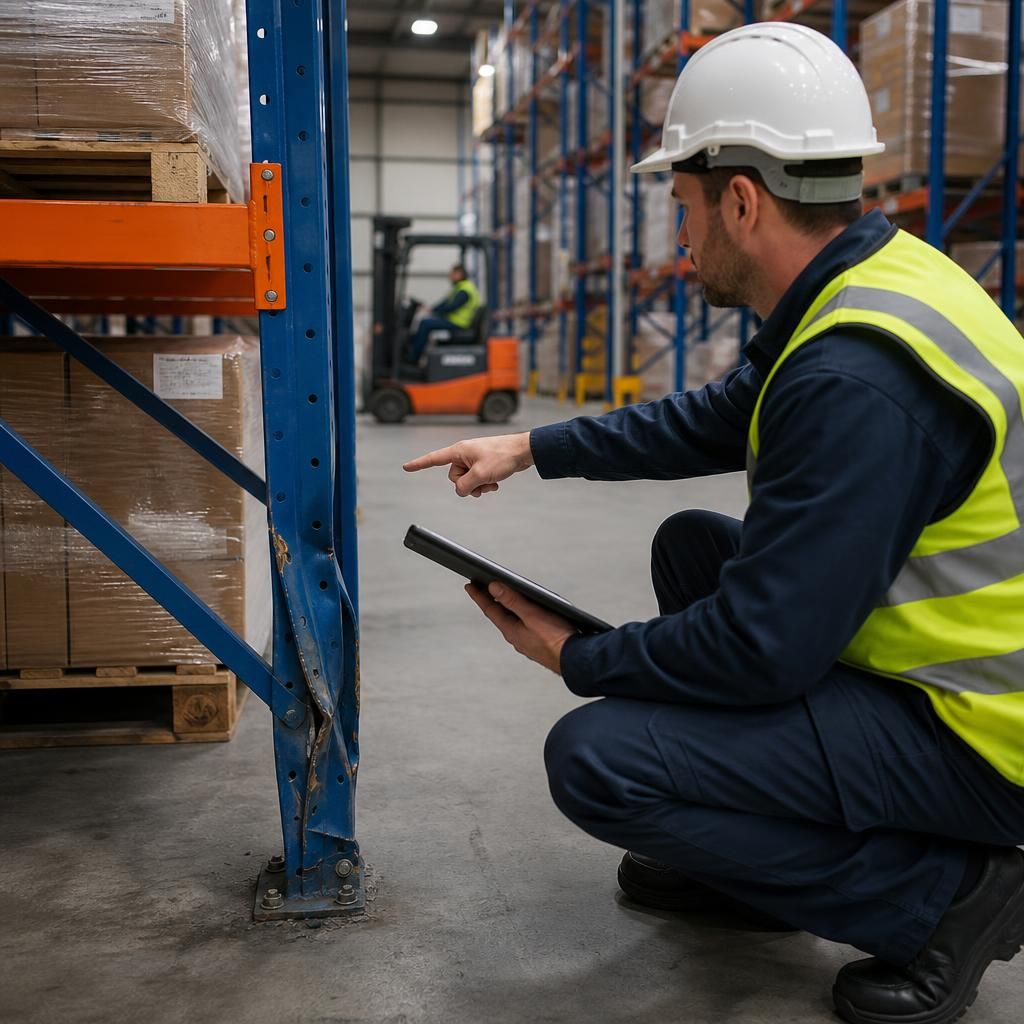
Damage to warehouse racking should be treated as a safety defect until its severity has been assessed. Immediately stop loading, unloading and working in the affected bay, remove people and handling equipment, and establish a clearly marked exclusion zone.
Where there is a risk of instability, falling goods or collapse, isolate the complete run rather than only the visibly damaged component. Do not straighten, weld, drill or modify damaged warehouse racking, as an improvised repair can reduce structural capacity and conceal further damage. Record the location and condition, report it to the responsible person and arrange assessment by a competent warehouse racking specialist before the area is used again.
Arrange an Expert Damage Assessment
Arrange an assessment with a competent warehouse racking specialist to confirm the extent of the damage and specify the appropriate repair or replacement. Keep the affected area isolated until its safety has been verified and it has been formally cleared for use.