
What steps are involved in the warehouse racking repair process?
The warehouse racking repair process involves assessing the damage, making the affected area safe, identifying the correct replacement parts or repair method, and completing the work in line with the manufacturer’s guidance and relevant safety requirements. A competent inspection and final safety check then confirm that the warehouse racking is suitable for continued use.
The warehouse racking repair process starts with identifying and assessing the damage, then making the affected area safe before selecting and carrying out the appropriate repair. The completed work must be checked by a competent person to confirm that the warehouse racking is stable, correctly installed and suitable for continued use.
A controlled repair process helps prevent minor damage from becoming a structural or operational problem. It also provides a clear record of what was found, what action was taken and whether any follow-up inspection or monitoring is required.
1. Report and record the damage
Damage should be reported as soon as it is noticed, whether it is found during a planned inspection, a daily visual check or after contact with handling equipment. The location and condition of the affected warehouse racking should be recorded, ideally with photographs and details of the incident.
Useful information includes the aisle or bay reference, the damaged component, the apparent cause, any load that was present and whether the damage has changed since it was first observed. Accurate records help the repair team identify the correct components and assess whether nearby areas may also have been affected.
2. Make the affected area safe
Until the damage has been assessed, the affected bay or section may need to be isolated. This can involve preventing access, removing loads where it is safe to do so, and stopping handling equipment from operating close to the damaged structure. Loads should not be removed or altered without considering the risk of further movement or collapse.
The appropriate immediate action depends on the severity and position of the damage. A bent upright, displaced beam, damaged connection or missing safety component can affect the stability of connected parts, so the surrounding warehouse racking should be checked rather than treating the visible defect in isolation.
3. Assess the extent and severity of the damage
A competent inspector examines the affected warehouse racking and its surrounding components. The assessment considers the type of damage, its location, the extent of any distortion, the condition of fixings and connections, and whether the structure remains within the manufacturer’s intended tolerances.
The inspection should also consider operational factors that may have contributed to the damage, such as vehicle impact, overloading, incorrect loading, poor housekeeping or changes to the layout. Where necessary, the inspector may review load notices, original design information, previous inspection records and the manufacturer’s guidance.
Damage is commonly categorised according to its severity and the level of immediate action required. Minor defects may be monitored or addressed during planned work, while more significant damage can require prompt unloading, isolation and repair. The decision should be made by a suitably competent person rather than based only on appearance.
4. Decide whether repair or replacement is appropriate
Not every damaged component can be safely repaired in place. The repair method depends on the component, the material, the nature of the damage and the manufacturer’s instructions. In many cases, a damaged structural part must be replaced with a compatible component rather than straightened, welded or altered on site.
The proposed solution should preserve the original design performance of the warehouse racking. Replacement parts must be suitable for the specific system and installed in the correct position. Substituting an unsuitable component, drilling unapproved holes or modifying a frame without technical approval can compromise capacity and invalidate the intended design.
Where the damage is linked to a wider issue, the repair plan may also include replacing missing pins or guards, correcting an anchorage problem, renewing a damaged beam connection or improving protection against future impacts. Any change that affects the configuration or load capacity should be reviewed by an appropriately qualified person.
5. Prepare the work area and repair method
Before work begins, the repair team should confirm the scope of work, access arrangements, isolation requirements and equipment needed. The area must remain controlled throughout the repair, particularly where loads are being removed or components are being dismantled.
The repair method should follow the manufacturer’s guidance, relevant design information and recognised workplace safety requirements. It should account for temporary stability while components are removed and for the safe use of access equipment and handling equipment. Repair work should not create a new risk to warehouse staff, visitors or nearby operations.
6. Carry out the repair or component replacement
Experienced operatives remove or repair the affected parts using the approved method. This may include replacing a damaged upright or beam, renewing a connection, fitting a protective component, reinstating missing fixings or correcting a defect identified during the assessment.
Components should be installed in accordance with the system design, with connections, anchors, safety locks and protective equipment correctly positioned. The repair team should avoid improvised alterations and should not return a section to service simply because the visible damage has been made less obvious.
Where welding, cutting or another hot-work process is proposed, it should only be undertaken where it has been specifically authorised and controlled by a suitable technical assessment. In many situations, replacement is the safer and more appropriate option.
7. Inspect the completed work
After the repair, a competent person should inspect the completed work and the adjacent warehouse racking. The check should confirm that the correct parts have been used, fixings and connections are secure, frames and beams are correctly aligned, protection is in place and there are no remaining defects that could affect safe operation.
The inspection should also confirm that load notices and other safety information remain accurate. If the repair has altered the configuration, capacity or use of the warehouse racking, the relevant technical information must be reviewed before loads are reinstated.
8. Return the area to service in a controlled way
The repaired area should only be returned to use when the competent person is satisfied that it is safe and suitable for the intended loads. Loads should be put back in accordance with the stated capacity, bay layout and loading rules. Warehouse staff may need to be reminded of any restrictions or changes identified during the repair.
If the repair cannot be completed immediately, the area should remain isolated or be subject to clearly defined restrictions. A temporary measure should not be treated as a permanent repair unless it has been formally assessed and approved for that purpose.
9. Update the records and arrange follow-up checks
The repair record should include the inspection findings, photographs where useful, the work completed, replacement components, any limitations and the date the area was approved for use. Keeping this information with the warehouse racking inspection records creates an audit trail and helps identify repeated impact or maintenance issues.
Follow-up checks may be appropriate where damage was extensive, where a repair has been monitored before final work, or where the underlying cause has not yet been resolved. Regular visual checks and planned expert inspections should continue after the repair, because a repaired component can be damaged again by vehicle contact, poor loading or changes in warehouse activity.
When to seek urgent assistance
Stop using the affected area and seek competent advice promptly if there is a visibly bent upright or beam, a displaced connection, a broken safety lock, detached anchorage, severe impact damage, an unstable load or any sign that the structure is leaning or moving. Do not attempt to straighten structural components or make unapproved alterations.
Using a documented repair process ensures that damage is assessed properly rather than concealed or treated in isolation. It supports safe warehouse operations, helps maintain compliance with the manufacturer’s requirements and provides confidence that the warehouse racking has been checked before it is put back into service.
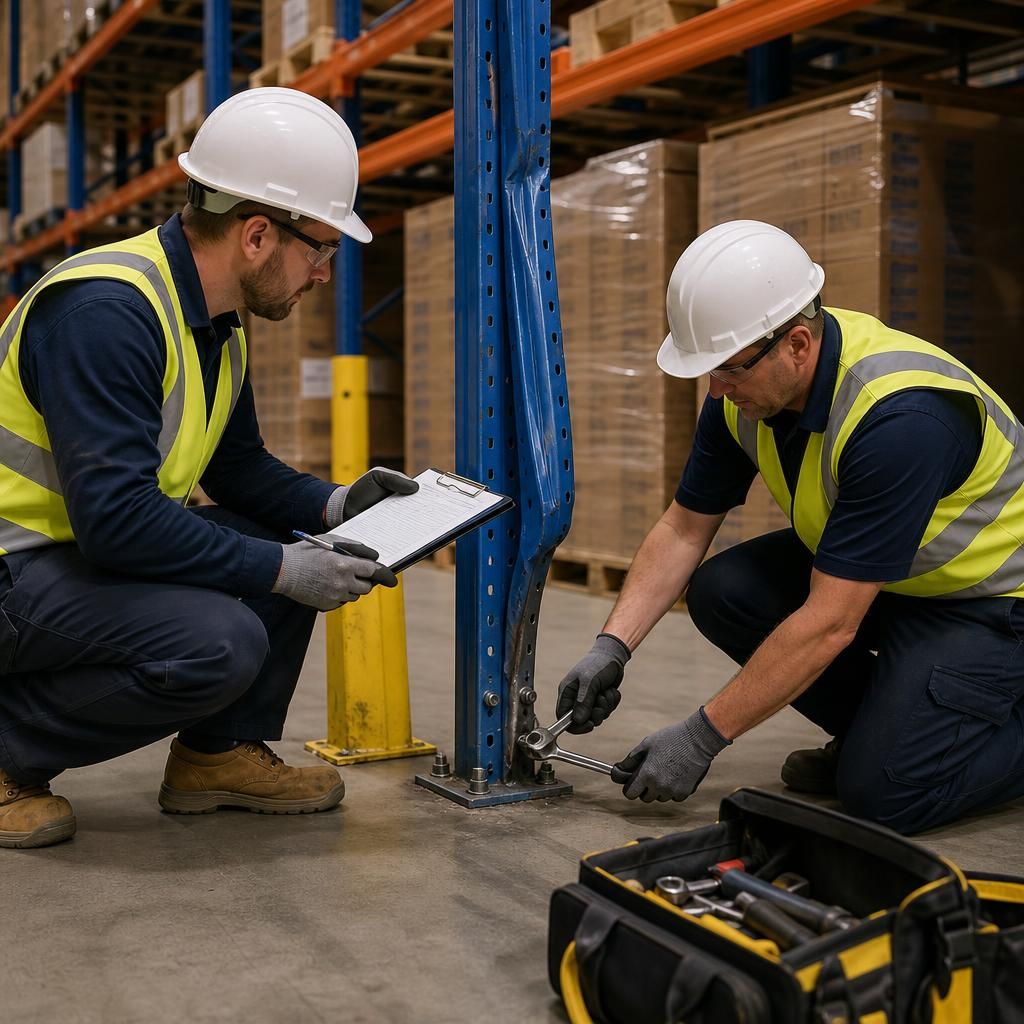
The final safety check is the step that confirms a warehouse racking repair has been completed correctly and that the affected area is suitable for continued use. A competent person should inspect the repaired section and adjacent components before loads or handling equipment are allowed back into the area.
The check should confirm that the approved replacement parts are correctly fitted, connections and fixings are secure, frames and beams are aligned, and safety locks, guards and anchors are in place. Any load notices or system information affected by the repair should also be reviewed to ensure they remain accurate.
The repair should be recorded with the inspection findings, work completed and approval to return the area to service. If concerns remain, the section should stay isolated or operate under clearly defined restrictions until the necessary action has been completed.
Arrange a warehouse racking repair assessment
If your warehouse racking has been damaged or you are unsure whether it remains safe to use, arrange a warehouse racking repair assessment with our competent team. We will assess the affected area, advise on the appropriate repair and confirm the checks needed before it returns to service.