
What are the common causes of warehouse racking damage that necessitate repairs?
Warehouse racking damage commonly results from forklift impact, overloading, incorrect loading, unauthorised alterations, poor installation, corrosion and general wear. These issues can weaken uprights, beams, bracing and connections, so prompt inspection and expert repairs are needed to restore safe, compliant operation.
Warehouse racking damage is most commonly caused by forklift and other materials-handling equipment impacts, overloading, incorrect loading, poor installation, unauthorised alterations, corrosion and gradual wear. Damage can affect uprights, beams, bracing, connectors, protection equipment and floor fixings, reducing the warehouse racking system’s ability to carry loads safely. Any suspected damage should be reported, assessed by a competent person and repaired or replaced before normal use continues.
Forklift and equipment impacts
Forklift impact is one of the most frequent causes of warehouse racking damage. Contact with an upright, frame, beam or guard can occur when vehicles turn in narrow aisles, approach a pallet at an angle or misjudge the available clearance. Even a low-speed impact may bend an upright, loosen a connection or transfer force into adjacent components that appear undamaged.
Repeated minor contact can be particularly difficult to identify because the damage may develop gradually. Scrapes, dents, buckling, distorted profiles, displaced beams and damaged floor fixings should not be treated as cosmetic issues. The affected area should be isolated and inspected so that the extent of the damage can be established. Depending on the findings, repairs may involve replacing a component, installing an approved repair system or correcting associated damage to bracing and fixings.
Overloading and incorrect load distribution
Warehouse racking is designed for specified working loads and load arrangements. Exceeding the stated capacity can overstress beams, uprights and connections, particularly when heavy pallets are concentrated in one position rather than distributed as intended. Loads that are taller, deeper or wider than the approved configuration can also reduce clearances and increase the risk of contact with adjacent components.
Load signs and capacity information should remain visible and reflect the current warehouse racking layout. Changes to beam levels, pallet types or stored goods may alter the loading conditions and require a review. If a component has visibly deflected, connections have moved or the system has been loaded beyond its approved capacity, the affected bays should be unloaded safely and assessed before being returned to service.
Poor loading practices
Incorrect placement of pallets can cause localised damage even when the total load is within the stated capacity. Pallets should be positioned securely and centrally on the supporting beams, with suitable clearances and adequate support for the pallet design. Broken pallets, unstable loads and goods protruding into access areas can create impact hazards and impose uneven forces on warehouse racking.
Loads placed directly against frames, pushed into position with a forklift or stored with inadequate back support can damage components and increase the likelihood of falling goods. Damaged pallets should be removed from use, and operators should follow the site’s loading procedures rather than forcing a pallet into a restricted or obstructed location.
Incorrect installation or unsuitable alterations
Damage may originate from installation errors rather than day-to-day operation. Examples include incorrectly assembled connections, missing or unsuitable fixings, inadequate floor anchoring, misaligned frames and bracing that has not been installed as specified. An installation that does not match the design assumptions can place unusual stresses on the system and make later damage more likely.
Unauthorised changes can have a similar effect. Removing bracing, relocating beams, cutting components, drilling new holes or fitting non-approved parts may weaken the structure or change its load-bearing characteristics. Warehouse racking should not be altered without a competent technical assessment and confirmation that the revised arrangement is suitable. Where an alteration has compromised the system, the remedy may require reinstatement, replacement components or a wider inspection of the affected run.
Corrosion, moisture and harsh working conditions
Moisture, condensation, cleaning chemicals and aggressive warehouse environments can cause corrosion. Rust may begin on exposed surfaces, around floor fixings, at damaged coatings or in areas where water collects. As corrosion progresses, it can reduce the effective thickness of a component and weaken connections.
Corroded warehouse racking should be assessed rather than simply painted over. The correct repair depends on the depth and location of the corrosion, the condition of surrounding components and the cause of the moisture. Improving drainage, controlling condensation and repairing damaged finishes can help prevent recurrence, but severely affected components may need replacement.
General wear, fatigue and deterioration
Warehouse racking is subject to repeated loading and unloading, vibration and movement throughout its service life. Normal use can gradually loosen connections, damage protective coatings and wear accessories such as guide rails, pallet supports and upright guards. Repeated impacts or poor handling can accelerate this process.
Wear is more likely to require repair when it affects the stability, alignment or load capacity of the system. A competent inspection should consider both visible defects and the operating conditions that caused them. Replacing one damaged part may not be sufficient if adjoining components have also been distorted or if the same handling problem remains unresolved.
Building movement and floor problems
Uneven or deteriorating floors can affect the alignment and stability of warehouse racking. Settlement, cracking, damaged concrete or changes to the floor surface may place additional stress on baseplates and anchors. Warehouse operations, building works and accidental damage to the floor can all contribute to this risk.
Where floor movement or anchor damage is suspected, repairs should address the underlying condition as well as the visible warehouse racking defect. Simply realigning a frame without checking the floor and fixings may leave the system vulnerable to further movement.
What damage usually requires prompt repair?
- Bent, twisted, split or buckled uprights.
- Beams that are visibly deflected, displaced or damaged at their connectors.
- Missing, loose or damaged safety pins, locking devices, bracing or fixings.
- Detached or distorted floor anchors and baseplates.
- Severe corrosion, cracks or deformation in structural components.
- Damaged pallet supports, guide rails, upright guards or other protective equipment.
- Evidence that a load has struck the warehouse racking or that a bay has been overloaded.
- Unapproved modifications that change the original configuration or loading arrangement.
When serious damage is identified, the affected location should be clearly marked and taken out of service where necessary. Loads should only be removed if this can be done without creating an additional hazard. Staff should not straighten, weld, drill, bolt or otherwise modify damaged warehouse racking as an informal repair.
How professional warehouse racking repairs are determined
A repair assessment considers the component affected, the type and extent of the damage, the load being carried, the surrounding structure and the likely cause. The inspection should also check adjacent bays, because an impact or overload may have transferred force beyond the point where damage was first noticed.
The appropriate solution may be a replacement component, an approved structural repair, renewed protection or correction of the loading and operating conditions. Repairs should use compatible parts and follow the manufacturer’s or designer’s requirements. After completion, the repaired area should be checked for correct alignment, secure connections, suitable clearances and safe capacity before it is put back into service.
Preventing repeat damage
Repair work is most effective when combined with preventative action. Review vehicle routes and aisle clearances, maintain visible load information, train operators in safe loading practices and keep impact protection in good condition. Regular inspections should identify early signs of damage, corrosion, loose components and unsafe alterations before they develop into more serious defects.
Keeping records of inspections, incidents, repairs and component changes helps identify recurring causes and supports a consistent maintenance programme. If the cause is uncertain or damage affects a structural part, arrange an expert assessment rather than relying on visual reassurance. Prompt action protects employees, stored goods and the continued safe operation of the warehouse racking system.
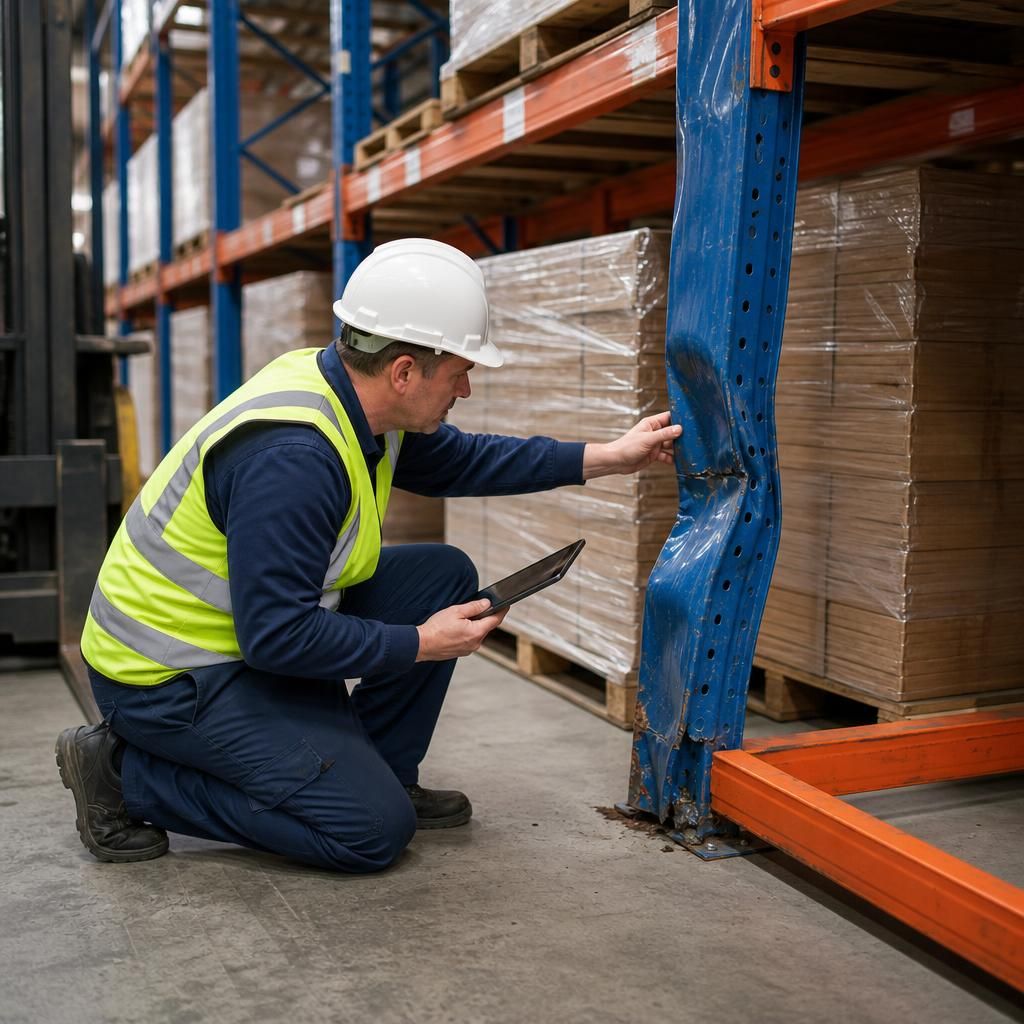
Forklift impact is a leading cause of warehouse racking damage. Even a low-speed collision can bend an upright, displace a beam, loosen a connection or damage floor fixings. Repeated minor contact may be difficult to see but can gradually reduce the system’s stability and load-bearing capacity.
Any warehouse racking involved in an impact should be reported and assessed by a competent person. Mark the affected area, prevent further loading where necessary and do not attempt to straighten or modify damaged components. An expert repair assessment will determine whether approved repairs, component replacement or checks to adjacent bays are required before the area returns to service.
Arrange an expert warehouse racking repair assessment
If your warehouse racking has been struck, overloaded or shows signs of damage, arrange an expert repair assessment before the affected area is used again. Able Racking can identify the cause, assess surrounding components and recommend compliant repairs or replacement parts.