
How do I know when my warehouse racking needs repairs?
Your warehouse racking needs repairs when an inspection identifies damage, deformation, instability, loose or missing components, or any change that could reduce the system’s safe load-bearing performance. Report and isolate affected areas immediately, then arrange assessment and repairs by a competent professional before the racking is returned to service.
Your warehouse racking needs repairs when it has damage, deformation, instability, loose or missing components, or any other change that may reduce its safe load-bearing performance. If damage is found, report it immediately, prevent further use of the affected area and arrange an assessment by a competent warehouse racking professional before it is returned to service.
Warehouse racking can appear serviceable while having damage that affects its strength or stability. Repairs should therefore be based on a competent inspection rather than appearance alone. The person assessing the system should consider the type, location and severity of the damage, the loads being stored, the original design and the condition of connected components.
Common indications that warehouse racking may require repairs include:
- Upright damage: Bent, twisted, dented or visibly buckled uprights can reduce the structure’s ability to carry loads safely. Damage near the base is particularly important because it can affect the stability of the entire frame.
- Damaged beams: Beams that are bent, distorted, cracked, displaced or showing damaged end connectors should be taken seriously. A beam does not need to have collapsed to require attention.
- Loose, missing or damaged components: This may include locking pins, safety clips, bracing, footplates, anchors, guards or other components needed to keep the system secure and correctly aligned.
- Visible leaning or movement: Racking that appears out of plumb, rocks, shifts during loading or has become separated from its intended position may indicate impact damage, failed fixings or a wider stability problem.
- Damaged anchors, floors or protection: Failed floor fixings, cracked areas around anchors or missing protection can leave uprights vulnerable to further impact and may affect the installation’s stability.
- Overloaded or incorrectly loaded locations: Loads that exceed the stated capacity, project beyond the intended storage position or are unevenly distributed can place excessive stress on warehouse racking. This may require more than a physical repair; the storage arrangement and load information may also need review.
- Changes to the configuration: Altering beam levels, removing bracing, adding components or changing the layout without suitable design approval can compromise the original specification. The system should be reassessed before continued use.
- Repeated impact: A location that has been struck by a forklift or other handling equipment may have hidden or progressive damage, even if no major deformation is immediately visible.
Damage is not the only reason to arrange repairs. A repair assessment is also appropriate when warehouse racking has been installed incorrectly, when components no longer match the original system, when warning notices or capacity information are absent, or when previous repairs have not resolved the underlying problem. Unusual noise, unexplained movement or falling items should also be treated as warning signs rather than normal operating conditions.
How to decide whether action is urgent
Any damage that could affect the stability or load-bearing capacity of warehouse racking should be treated as urgent. The affected bay, frame or area should be clearly identified and isolated so that it cannot be loaded or accessed until it has been assessed. Where a damaged component is supporting a load, do not attempt to remove the load or carry out an improvised repair unless this has been planned and made safe by a competent person.
As a practical guide, immediate isolation is appropriate where an upright or beam is visibly bent, a connector has pulled away, a locking device is missing, an anchor has failed, the structure is leaning or there is any uncertainty about whether stored loads are safely supported. Minor-looking damage should still be recorded and assessed, because small defects can worsen through repeated impacts or continued loading.
What to do when damage is found
- Stop using the affected location. Prevent new loads from being placed into the damaged area and restrict access where necessary.
- Report the defect. Tell the responsible warehouse manager or appointed person and record when, where and how the damage was found.
- Identify the likely cause. Note whether the damage may have resulted from vehicle impact, overloading, poor loading practice, unauthorised alteration or another event. Addressing the cause helps prevent recurrence.
- Arrange a competent assessment. An experienced inspector or repair specialist should determine whether the component can be repaired, needs replacing or requires further investigation.
- Complete suitable repairs. Repairs should use compatible components and follow the system design and the manufacturer’s requirements where available. Straightening or welding damaged structural components without appropriate approval is not a reliable substitute for a properly specified repair.
- Check the completed work. The repaired area should be inspected before loads are reinstated, with records updated to show what was identified and what action was taken.
Warehouse racking should not be returned to service simply because a damaged component has been pushed back into position, painted over or made to look straight. A repair must restore the required structural performance and ensure that fixings, connections, protection and load information remain suitable. If the damage is extensive or the system’s original design cannot be confirmed, replacement or a more detailed engineering assessment may be safer than a local repair.
Inspections help identify repair needs early
Routine checks by trained staff can identify obvious defects between formal inspections. These checks should look for impact damage, displaced loads, missing components, changes in alignment and signs that the system is being used incorrectly. They do not replace a formal inspection by a competent person, particularly after an incident, a significant alteration or a change in the loads being stored.
Inspection records should show the location of each defect, its severity, the temporary controls applied and the date by which corrective action is required. Photographs can help identify the affected area, but they should support rather than replace an on-site assessment. Once repairs have been completed, the defect should be closed out formally rather than left on an open action list.
If you are unsure whether a defect requires repair, treat it as a potential safety issue and prevent further use until it has been assessed. Able Racking can help identify the cause and severity of warehouse racking damage, recommend appropriate corrective action and verify that repaired areas are suitable for continued operation. Prompt reporting and competent repairs protect people, stock and the wider warehouse operation while reducing the risk of a minor defect becoming a more serious failure.
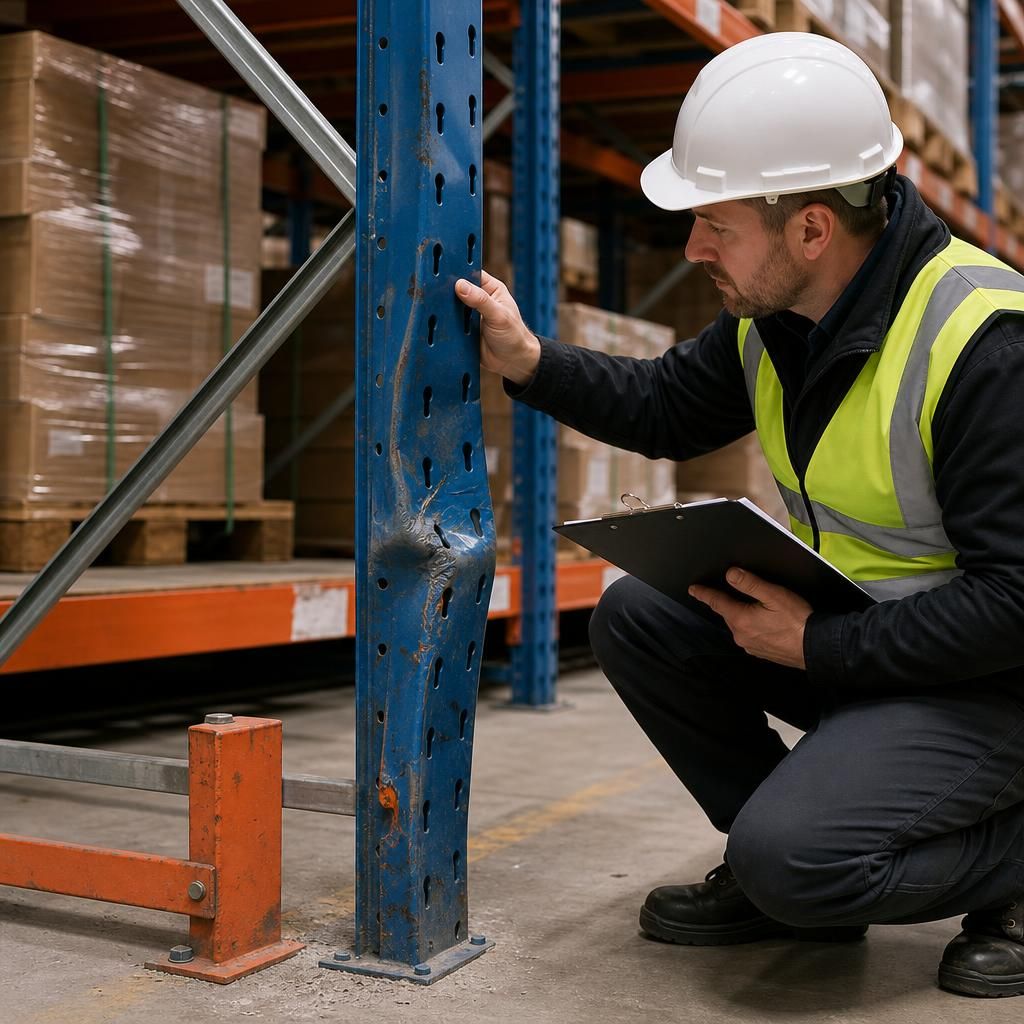
Warehouse racking needs prompt repair when damage, movement or missing components could affect its stability or load-bearing performance. Visible bends, leaning frames, displaced beams, damaged connectors, failed anchors and missing locking devices should never be treated as cosmetic defects.
If a defect is found, stop using the affected bay or frame and prevent further loading until it has been assessed by a competent professional. Do not straighten, weld or otherwise alter a damaged component without suitable technical approval, as this may conceal or worsen the underlying problem.
Record the location and type of damage, identify any likely cause such as vehicle impact or overloading, and arrange an assessment. The repair specialist can then confirm whether the component requires repair, replacement or further investigation. The area should only return to service after the work has been checked and the system’s safe use confirmed.
Arrange a warehouse racking repair assessment
Arrange a warehouse racking repair assessment with Able Racking if you have identified damage, movement, missing components or any concern about safe load-bearing performance. Our competent team can assess the affected area and advise whether repair, replacement or further investigation is required.