
What are the signs that indicate the need for immediate warehouse racking maintenance?
Immediate warehouse racking maintenance is needed when you find damaged or deformed frames, beams or bracing, loose or missing components, significant corrosion, unstable sections, displaced loads or evidence of forklift impact. Isolate the affected area, prevent further use and arrange an inspection promptly so the damage can be assessed and repairs completed safely.
Immediate warehouse racking maintenance is required when any part of a storage system is damaged, deformed, unstable, corroded or no longer securely connected. The most urgent warning signs include bent frames or beams, displaced loads, missing components, loose fixings, impact damage and sections that appear to lean or move. The affected area should be isolated, loading and unloading stopped, and a competent inspection arranged before the warehouse racking is used again.
Do not treat visible damage as cosmetic. Even a small distortion can affect how loads are supported and may indicate that a connection, upright or protective component has lost its intended strength. Damage can also develop after an impact without causing an immediate collapse, so the absence of obvious movement does not confirm that the warehouse racking is safe.
Signs that need prompt attention include:
- Bent, twisted or dented uprights: Vertical frames that are no longer straight may have been weakened by forklift impact, overloading or movement of the structure.
- Deformed beams: Beams that are visibly bowed, twisted or pulled away from their normal seating position should not continue to carry stock until they have been assessed.
- Damaged bracing: Missing, bent or cracked horizontal and diagonal bracing can reduce the stability of a frame.
- Loose, missing or damaged connectors: Beam locks, bolts, clips, safety pins and other retaining components must be present and correctly engaged.
- Signs of forklift or vehicle impact: Scrapes, fresh paint transfer, dents, gouges or damage to guards can indicate that force has been transferred into the warehouse racking.
- Leaning or unstable sections: Any visible movement, leaning, rocking or change in alignment requires the affected bay or run to be taken out of service.
- Significant corrosion: Flaking, deep rust, pitting or corrosion around joints and base plates can reduce the condition of structural components.
- Displaced or overloaded stock: Loads that project beyond the intended footprint, rest unevenly, exceed the designated capacity or have fallen from their normal position create an immediate risk.
- Damaged floors, base plates or anchors: Cracked concrete, disturbed anchors or displaced base plates may affect the transfer of loads into the floor.
- Repeated movement or unusual noise: New creaking, vibration or movement during normal use should be investigated rather than ignored.
What to do when damage is found
- Stop activity in the affected area. Prevent further loading, unloading and vehicle movement near the damaged section. Keep people away until the risk has been assessed.
- Secure the stock and surrounding area. If a load is unstable, do not attempt to remove it without a suitable plan, appropriate equipment and competent supervision. Moving stock can increase the risk of failure.
- Report the defect clearly. Record the location, type of damage, likely cause and any affected loads. Photographs can support the inspection, but they do not replace an on-site assessment.
- Arrange an inspection by a competent person. The inspection should consider the complete bay or run, connected components, load requirements, floor condition and any evidence of impact or overloading.
- Complete the required repair or replacement. Damaged components should be repaired or replaced using suitable parts and an approved method. Straightening structural members on site is not an appropriate substitute unless specifically assessed and authorised by a suitably qualified specialist.
- Confirm that the area is safe before reuse. Any temporary restriction should remain in place until the inspection findings, repair work and return-to-service decision have been documented.
Some defects require immediate isolation, while others may be suitable for controlled monitoring under a documented inspection process. This decision should be based on the location, severity and likely effect of the defect, not simply on whether the warehouse racking is still standing. Damage to a primary load-bearing member, a connection, an anchor or a component supporting a live load should be treated particularly seriously.
Immediate maintenance may also be necessary where there is evidence of a change in use. New pallets, heavier goods, altered beam levels, different handling equipment or changes to traffic routes can introduce loads and impact risks that the original arrangement was not designed to withstand. Check the stated load notices, layout drawings and manufacturer’s information before making changes, and do not exceed the specified capacities.
A prompt inspection should establish the cause as well as the visible defect. Forklift impacts, poor loading practice, unsuitable pallets, missing protection, uneven floors, unauthorised alterations and repeated overloading can all lead to recurring damage. Corrective action may therefore include replacing components, improving protection, changing traffic controls, retraining operatives or reviewing the warehouse racking layout and capacity information.
Routine visual checks by trained staff help identify problems early, but they are not a substitute for a formal inspection where serious damage is present. Keep inspection, repair and incident records up to date, including the affected location and the action taken. This provides a clear maintenance history and helps demonstrate that defects are being controlled in line with the organisation’s health and safety arrangements, relevant guidance and the equipment manufacturer’s requirements.
If you identify a suspected immediate risk, isolate the affected warehouse racking and contact Able Racking to arrange an appropriate inspection and repair response. Do not return the area to service until a competent person has confirmed that it is safe to do so.
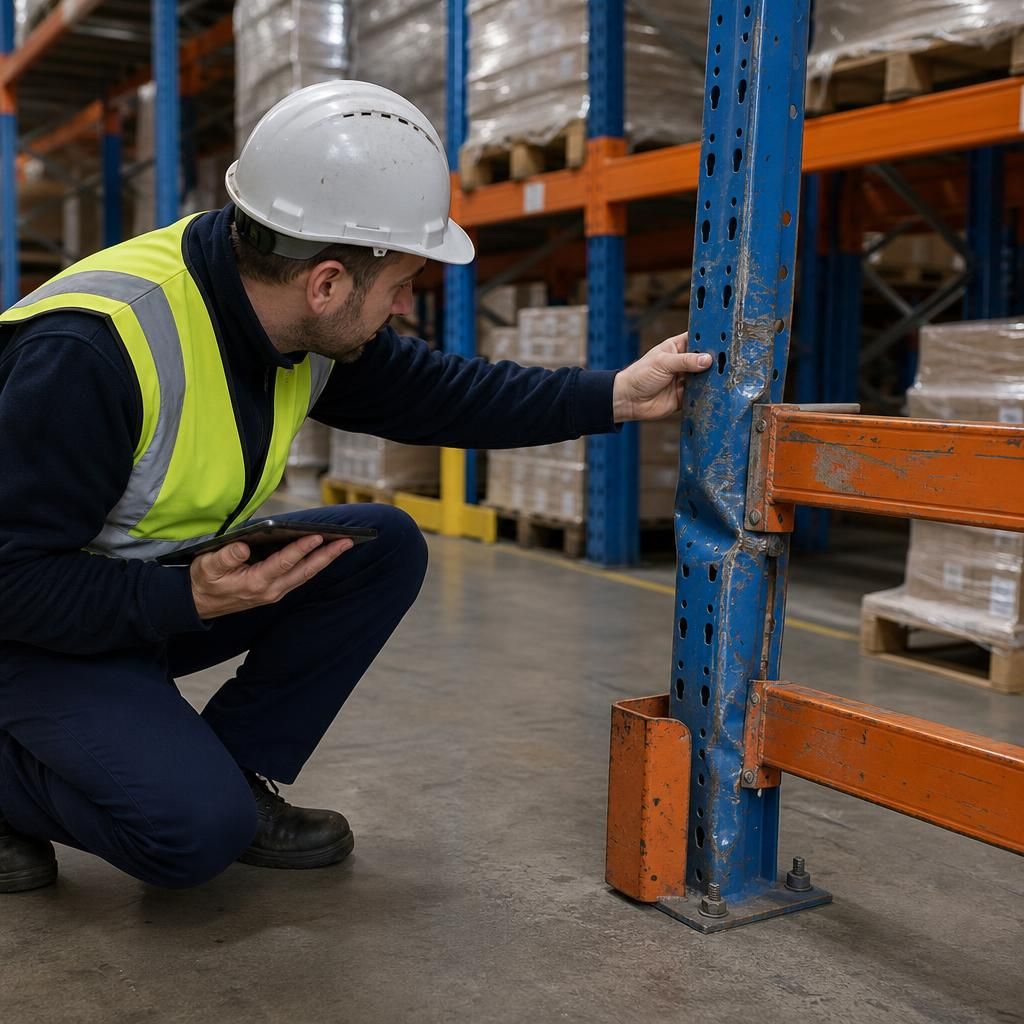
Forklift impact damage requires immediate warehouse racking maintenance, even when the affected section appears stable. Dents, scrapes, paint transfer, bent uprights or damaged guards can indicate that force has reached load-bearing components. Stop activity around the affected bay, prevent further loading and arrange a competent inspection before allowing the area back into use.
Do not straighten damaged components or move an unstable load without a suitable risk assessment and competent supervision. The inspection should identify the full extent and cause of the damage, so that repairs, component replacement, protection improvements or changes to traffic controls can be completed safely.
Arrange immediate warehouse racking maintenance
If you identify damage or instability, contact Able Racking to arrange an expert warehouse racking inspection and any required repairs. Keep the affected area out of use until it has been assessed and confirmed safe.