
What are the most common signs that a warehouse racking system needs maintenance?
Common signs that a warehouse racking system needs maintenance include bent or damaged frames, beams or bracing, loose components, missing safety pins, overloaded or unevenly loaded bays, and visible instability. Any damage or change that could affect the system’s strength, alignment or safe use should be reported promptly and assessed by a competent racking specialist.
The most common signs that a warehouse racking system needs maintenance are damaged or distorted components, loose or missing connections, signs of instability, incorrect loading, corrosion and repeated impact damage. Any change that could reduce the system’s strength, alignment or ability to carry its stated load should be reported promptly, with the affected area assessed by a competent racking specialist before it is returned to service.
Regular inspections help identify deterioration before it becomes a serious safety issue. Maintenance should not be limited to obvious structural failure; relatively small defects can worsen through continued loading, forklift contact, vibration or repeated movement of stored goods.
- Bent, twisted or dented frames: Upright columns, frame bracing and footplates can be damaged by forklift impact or contact with handling equipment. Dents, kinks, buckling, leaning frames and distorted sections may affect the system’s load-bearing capacity and alignment.
- Damaged or deflected beams: Beams should sit correctly in their connectors and remain visibly straight when loaded within their specified limits. A beam that is bent, pulled out of position or showing unusual deflection requires investigation. Do not assume that unloading it has removed the risk, as the component may have suffered permanent damage.
- Loose, missing or incorrectly fitted components: Missing locking pins, loose bolts, displaced connectors, damaged bracing, absent protectors and unsecured accessories can reduce the stability of a bay. Components should not be replaced with improvised alternatives; replacement parts must be suitable for the system and fitted correctly.
- Visible movement, leaning or instability: A warehouse racking system that rocks, leans, shifts during loading or appears out of square may have damaged connections, inadequate anchoring, a compromised floor interface or an installation problem. The affected bay should be taken out of use until its condition and stability have been checked.
- Incorrect, uneven or excessive loading: Loads placed beyond the stated capacity, concentrated in one part of a beam, stored unevenly or positioned outside the intended bay arrangement can overstress components. Warning signs include bowed beams, damaged pallets, goods projecting into access routes and load notices that no longer reflect the current configuration. Check that the storage arrangement matches the designed load limits and approved layout.
- Corrosion or deterioration: Rust, flaking coatings, moisture damage and chemical deterioration can weaken steel components over time. Pay particular attention to areas exposed to water, condensation, cleaning chemicals or corrosive stock. Surface corrosion should be assessed rather than simply painted over, because concealed loss of material may be more extensive than it first appears.
- Repeated impact or recurring defects: Fresh scrapes, paint transfer, damaged upright guards and repeated contact from forklift trucks indicate that the cause of the damage may still be present. Replacing a component without addressing vehicle routes, visibility, operator behaviour, protection or housekeeping may allow the same defect to return.
Other warning signs include damaged pallets resting on beams, goods falling from storage positions, obstructions around baseplates, changes to the floor near the rack feet and alterations that were made without a design or competent review. Adding beams, changing beam levels, removing bracing or modifying bay dimensions can change the system’s capacity even when the alteration appears minor.
When a defect is found, the priority is to prevent further use of the affected area. Stop loading or unloading the bay where appropriate, keep people and handling equipment clear, and report the condition to the person responsible for warehouse safety. Serious damage, instability or a risk of collapse should be treated as an immediate hazard. Goods should only be removed where this can be done safely and in accordance with the site’s risk assessment; staff should not climb on the structure or attempt to straighten, weld, drill or repair components themselves.
A competent inspection should establish the nature and extent of the damage, whether adjacent bays are affected, whether the loading arrangement remains suitable and what corrective action is required. Depending on the findings, the outcome may be continued use with monitoring, unloading and repair, replacement of components, adjustment of the layout or a further engineering assessment. Repairs should follow the manufacturer’s requirements or an appropriate technical specification, and the system should be checked before it is brought back into normal use.
Maintenance records should identify the location of each defect, the date it was reported, the risk classification or action required, the person responsible and the date of completion. Photographs, inspection findings and repair documentation provide a useful audit trail and help identify recurring damage. They also support communication between warehouse managers, operators, maintenance teams and anyone responsible for arranging formal inspections.
Preventative maintenance is most effective when combined with routine visual checks, planned expert inspections, suitable impact protection, clear load notices, controlled alterations and staff training. Keeping access routes clear and correcting unsafe loading practices can reduce the likelihood of damage, but good housekeeping does not replace a technical assessment of structural defects.
If any of these signs are present, contact Able Racking so the condition can be reviewed by an experienced specialist. Prompt reporting and properly recorded repairs help protect employees, preserve the performance of the storage system and reduce the risk of unplanned operational disruption.
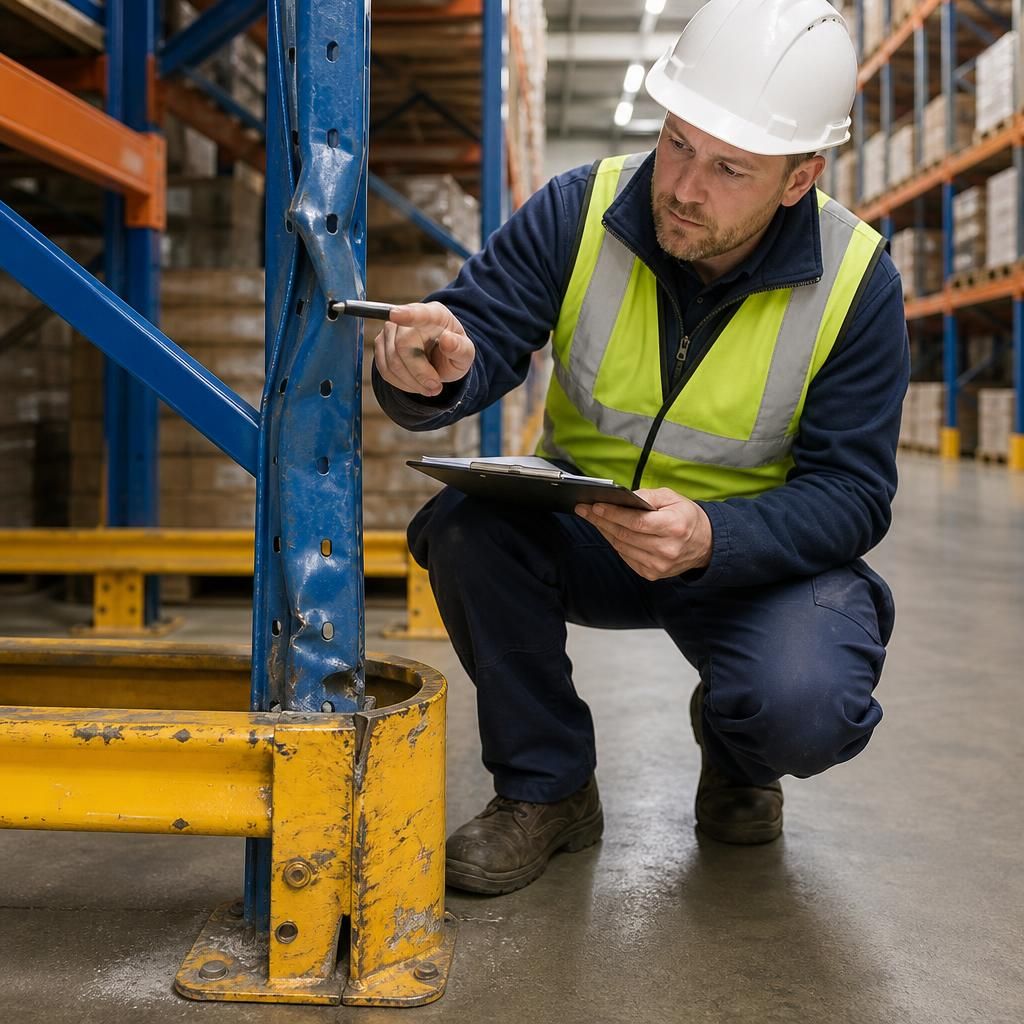
Forklift impact damage is a clear sign that warehouse racking needs maintenance, even when the affected component appears to remain upright. Dents, scrapes, bent upright columns, damaged bracing, displaced beams or marked upright protectors can indicate that the structure or its connections have been compromised.
Keep the affected bay clear and report the damage for assessment by a competent specialist. Do not straighten, weld or replace components without an appropriate technical review. The inspection should establish whether adjacent bays are affected and confirm whether repair or replacement is required before the area is returned to normal use.
Arrange a warehouse racking maintenance assessment
Arrange a warehouse racking maintenance assessment with Able Racking to identify defects, confirm the required remedial work and help keep your storage system safe and compliant.