
What are the best practices for maintaining warehouse racking systems?
The best practices for maintaining warehouse racking systems are to carry out scheduled inspections, record and assess damage promptly, complete repairs using suitable components, control loading and housekeeping, and train staff to report hazards. A planned maintenance programme, supported by competent inspections and clear records, helps keep warehouse racking safe, compliant and efficient.
The best practices for maintaining warehouse racking systems are to combine planned inspections, prompt damage reporting, controlled repairs, accurate load management, good housekeeping and suitable staff training. A documented maintenance programme, managed by competent people and aligned with the system manufacturer’s instructions and applicable guidance, helps identify defects before they affect safety, compliance or warehouse operations.
Establish a documented maintenance programme
Maintenance should be planned rather than carried out only after visible damage or an incident. The programme should define inspection responsibilities, reporting routes, repair procedures, escalation arrangements and record-keeping requirements. It should also reflect the type, age, configuration and operating environment of the warehouse racking system.
Keep an up-to-date asset record showing the location and configuration of each system, including any extensions, alterations or changes in use. The record should identify the relevant manufacturer’s information, safe working loads, inspection findings, completed repairs and outstanding actions. Accurate records make it easier to track recurring damage and demonstrate that safety issues are being managed.
Use layered inspections
Effective maintenance normally includes several levels of checking:
- Routine observations by warehouse staff, who should look for obvious damage, displaced components, overloading, missing safety equipment and obstructions.
- Recorded internal inspections by a nominated responsible person who understands the warehouse racking system and knows how to identify developing defects.
- Periodic expert inspections by a suitably competent inspector who can assess structural condition, risk and the need for corrective action.
The frequency of each inspection should be based on risk, usage, the working environment, the manufacturer’s recommendations and relevant guidance. Busy areas exposed to frequent vehicle movements or repeated impact may require closer monitoring than lightly used locations. Inspections should also be reviewed after a significant incident, layout change or change in loading arrangements.
Report and assess damage immediately
Every employee should know how to report damage and understand that apparently minor defects can affect the stability or capacity of the overall system. Reports should include the exact location, the type of damage, any affected loads and photographs where useful.
Damaged warehouse racking should be assessed by a competent person rather than ignored or judged solely on appearance. Depending on the severity and location of the defect, the affected area may need to be unloaded, isolated and clearly marked until it has been assessed. Where there is a serious risk of collapse or instability, access and use should be prevented without delay.
Findings are commonly prioritised according to risk. Lower-risk defects should still be monitored and scheduled for action, while more serious damage requires urgent controls and repair. Removing a damaged component from service does not remove the need to investigate how the damage occurred.
Complete repairs correctly
Repairs should be designed and completed using suitable components and methods approved for the specific warehouse racking system. Do not straighten, weld, drill, cut or modify structural members without appropriate technical approval. Improvised repairs can change the load-bearing characteristics of the system and may create a greater hazard than the original damage.
Before work begins, the affected area should be made safe and unloaded where necessary. Following repair, the system should be checked to confirm that components are correctly installed, connections are secure, frames are appropriately aligned and protection measures have been reinstated. Close-out records should state what was repaired, when the work was completed and whether any further action is required.
Control loads and prevent overloading
Safe working load information should be displayed clearly and kept legible. Loads must remain within the stated capacity and should be compatible with the beam levels, pallets, decking and configuration of the system. Changes to beam positions, bay widths, pallet types or storage methods can affect capacity and should be reviewed before implementation.
Staff should be trained to identify unsuitable or damaged pallets, unevenly distributed loads, excessive deflection and goods projecting into traffic routes. Loads should be placed securely and consistently, with sufficient clearance for safe handling. Any change from the original design use should be assessed by a competent person before the area is brought into service.
Protect the system from impact
Forklift and other handling equipment impacts are a common cause of damage. Good practice includes separating vehicles and pedestrians where possible, maintaining clear routes, using suitable protective measures and ensuring operators have adequate visibility and training. Speed control, well-maintained floors and clearly defined operating areas can also reduce contact with uprights and other components.
Protection devices such as upright guards and end-of-aisle barriers should be inspected as part of the maintenance programme. They are not a substitute for safe driving and should not be treated as evidence that damaged warehouse racking can remain in use.
Maintain good housekeeping
Housekeeping supports both inspection and safe operation. Keep aisles, emergency routes, access points and areas beneath the system free from waste, loose packaging and stored items that could obstruct movement or conceal damage. Spilled liquids should be dealt with promptly, particularly where they could affect floor condition, corrosion or vehicle control.
Clear working areas make it easier to identify bent components, loose fixings, missing clips, displaced pallets and changes in alignment. Housekeeping standards should be checked routinely and included in staff responsibilities rather than left solely to the maintenance team.
Manage environmental conditions
Inspect warehouse racking for corrosion, moisture damage, chemical exposure, excessive heat and deterioration caused by the surrounding environment. Particular attention may be needed in chilled, damp, external or chemically demanding areas. Damage to coatings, signs of rust and changes in floor condition should be recorded and assessed before the problem spreads.
Any cleaning or treatment products used near the system should be suitable for the materials involved. Leaks, condensation and drainage problems should be corrected at source where possible. Environmental changes, such as introducing wash-down processes or moving storage outdoors, should trigger a review of the maintenance requirements.
Control alterations and contractor work
Do not alter a warehouse racking layout informally. Moving beams, adding levels, changing pallet positions or combining components from different systems can invalidate the original design assumptions. Proposed changes should be reviewed by a suitably competent person and recorded once approved.
Contractors working near the system should receive site information, including access arrangements, isolation requirements, traffic controls and known hazards. After installation, alteration or repair work, the area should be inspected before normal operations resume and relevant documentation should be updated.
Train staff and encourage prompt reporting
Training should cover safe loading, damage recognition, housekeeping, traffic awareness, reporting procedures and the consequences of using an isolated area. Employees do not need to diagnose structural defects, but they should be able to recognise when warehouse racking may be unsafe and know who to contact.
Refresher training is appropriate when procedures change, new equipment is introduced, inspections identify repeated problems or staff are observed working outside the agreed process. A clear reporting culture helps prevent minor damage and unsafe practices from becoming normalised.
Review trends, not just individual defects
Inspection records should be reviewed for recurring damage, repeated overloading, poor pallet quality, vehicle contact or defects concentrated in particular aisles. Trend information can identify underlying causes and support practical improvements, such as revising traffic routes, improving protection, changing loading methods or providing targeted operator training.
Maintenance should also be reviewed after incidents, near misses, significant repairs, changes in occupancy or changes to the stored goods. This keeps the programme relevant as the warehouse develops.
Following these practices provides a consistent way to preserve the condition and performance of warehouse racking systems. Regular competent inspections are essential, but they work best when supported by accurate records, controlled loading, effective repairs, trained staff and prompt action whenever a defect is identified.
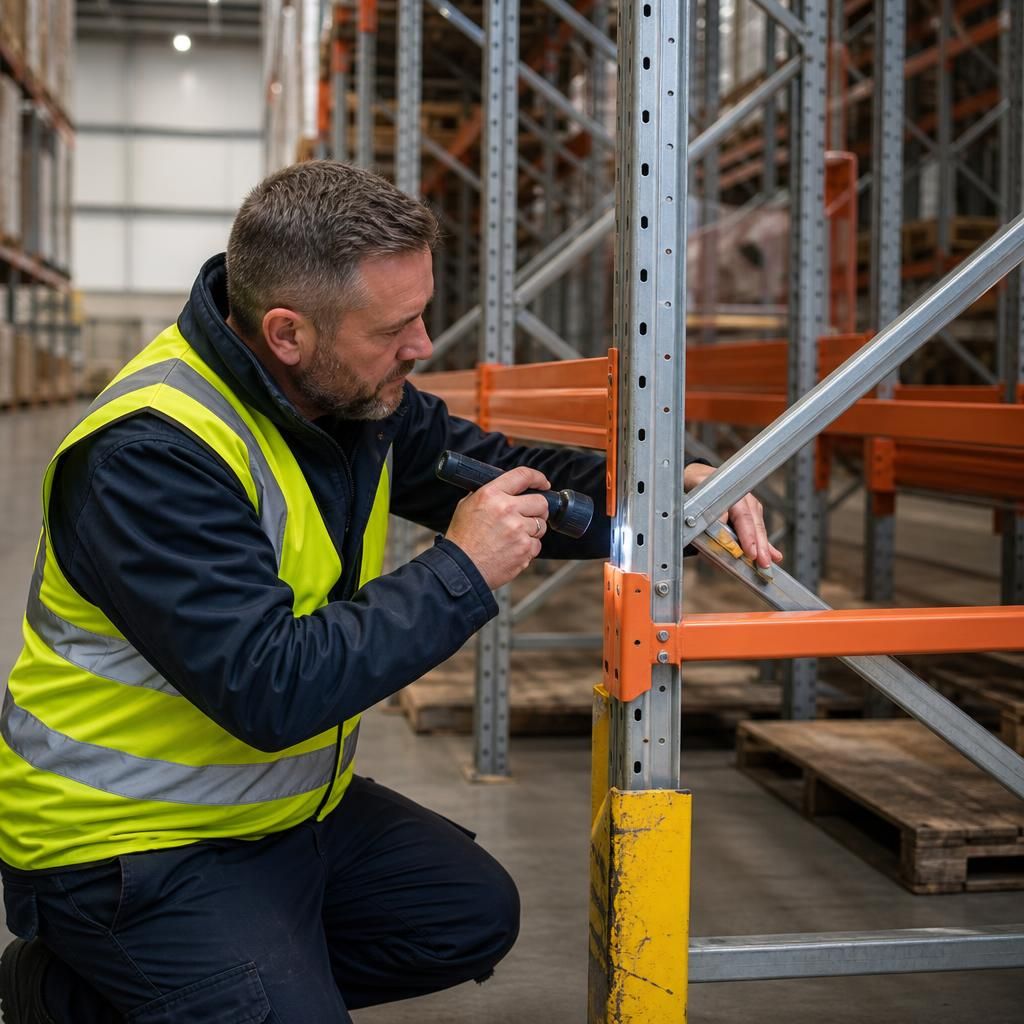
Promptly reporting and controlling damage is one of the most important practices for maintaining warehouse racking systems. Any bent upright, displaced beam, missing component, damaged protection device or sign of instability should be reported as soon as it is noticed, even if the defect appears minor.
The affected area should be assessed by a competent person and, where necessary, unloaded, isolated and clearly marked until corrective action is completed. Repairs must use suitable components and approved methods for the specific warehouse racking system; unauthorised welding, drilling, cutting or straightening can alter its load-bearing performance. After repair, the area should be checked, records updated and the warehouse racking returned to service only when it is confirmed to be safe.
Arrange a warehouse racking maintenance assessment
Arrange a warehouse racking maintenance assessment with Able Racking to review system condition, identify defects and confirm any required repairs or corrective actions.