
How can routine warehouse racking maintenance prevent operational disruptions?
Routine warehouse racking maintenance prevents operational disruptions by identifying damage, loosening, misalignment and wear before they cause unsafe conditions, product loss or access restrictions. Planned inspections and prompt repairs help keep storage areas available, protect staff and stock, and extend the serviceable life of the warehouse racking system.
Routine warehouse racking maintenance prevents operational disruptions by identifying damage, looseness, misalignment and wear before they develop into unsafe conditions, stock losses or access restrictions. Planned checks and prompt repairs help keep storage locations available, protect people and goods, and extend the serviceable life of the warehouse racking system.
Warehouse racking is exposed to regular loading, unloading and vehicle movements. Even minor impacts can distort an upright, damage a beam connector or dislodge protective components. If these defects are not identified, they may worsen during normal use and require an unplanned area closure. Routine maintenance provides a controlled way to detect and address problems before they interrupt warehouse operations.
A practical maintenance programme should work alongside formal warehouse racking inspections. Inspections identify defects and assess their level of risk, while maintenance addresses the underlying problem through adjustment, replacement, repair or monitoring. The work should be completed by competent operatives using suitable components and methods for the particular warehouse racking system.
Regular maintenance helps prevent disruption in several important ways:
- It reduces the risk of sudden failures: Damaged frames, beams, bracing, locking devices and floor fixings can be dealt with before their condition deteriorates.
- It keeps storage locations usable: Correcting misalignment and damaged components helps maintain safe access for handling equipment and reduces the need to cordon off larger areas.
- It protects stock: Stable, correctly maintained warehouse racking supports loads as intended and reduces the likelihood of products being displaced or damaged.
- It limits unplanned stoppages: Planned repair work can be arranged around deliveries, picking activity and shift patterns rather than being carried out during an urgent operational incident.
- It supports consistent warehouse flow: Clear aisles, secure components and properly positioned loads help operatives work without avoidable obstruction or delay.
Effective maintenance starts with accurate defect reporting. Warehouse staff should report impacts, unusual movement, damaged components, changes in load requirements and any signs that a storage location is no longer performing as expected. Reports should be recorded promptly, with the affected location identified clearly so that the issue can be assessed without delay.
Defects should then be prioritised according to their risk. A serious defect may require the affected warehouse racking bay or area to be unloaded and taken out of service immediately. Less urgent issues may be scheduled for repair within an agreed timescale, provided the system remains safe to use and any required controls are followed. A damaged component should not be straightened, welded or altered without a suitable technical assessment.
Planned maintenance should include checks of the components and conditions that most commonly affect performance, including:
- uprights, frames and bracing for impact damage, distortion or corrosion;
- beams, connectors and locking devices for movement, damage or incomplete engagement;
- floor fixings and baseplates for looseness, damage or deterioration;
- guards and barriers intended to reduce damage from handling equipment;
- load notices and configuration details to confirm that the warehouse racking is being used within its intended limits;
- aisles, clearances and working areas for obstructions that could increase the risk of impact;
- repairs and replacement components to confirm that the completed work is suitable and secure.
Maintenance records are also important in preventing repeat disruption. A useful record should identify the defect, location, date reported, risk classification, action taken and date closed. Reviewing these records can reveal recurring impacts, poor traffic routes, unsuitable loading practices or components that require more frequent attention. Addressing the cause, rather than repeatedly repairing the same damage, improves reliability and may reduce future interruptions.
Maintenance planning should reflect the way the warehouse operates. Areas with frequent vehicle movements, high stock turnover, demanding loading conditions or a history of impact may need closer observation and faster response. Repair activities should be coordinated with warehouse management so that stock is safely removed, access is controlled and the work does not create an additional hazard.
Routine maintenance cannot remove every operational risk, and it does not replace the need for competent inspections, staff training or safe loading practices. It is one part of a wider warehouse racking safety programme. When inspection findings, staff reports and repair records are managed together, defects can be dealt with in a consistent and traceable way.
The most effective approach is preventative: inspect the warehouse racking at the required intervals, report damage as soon as it is found, restrict unsafe areas where necessary, complete repairs using appropriate parts and verify the work before returning the location to service. This structured process helps prevent avoidable downtime while maintaining a safe, compliant and efficient warehouse.
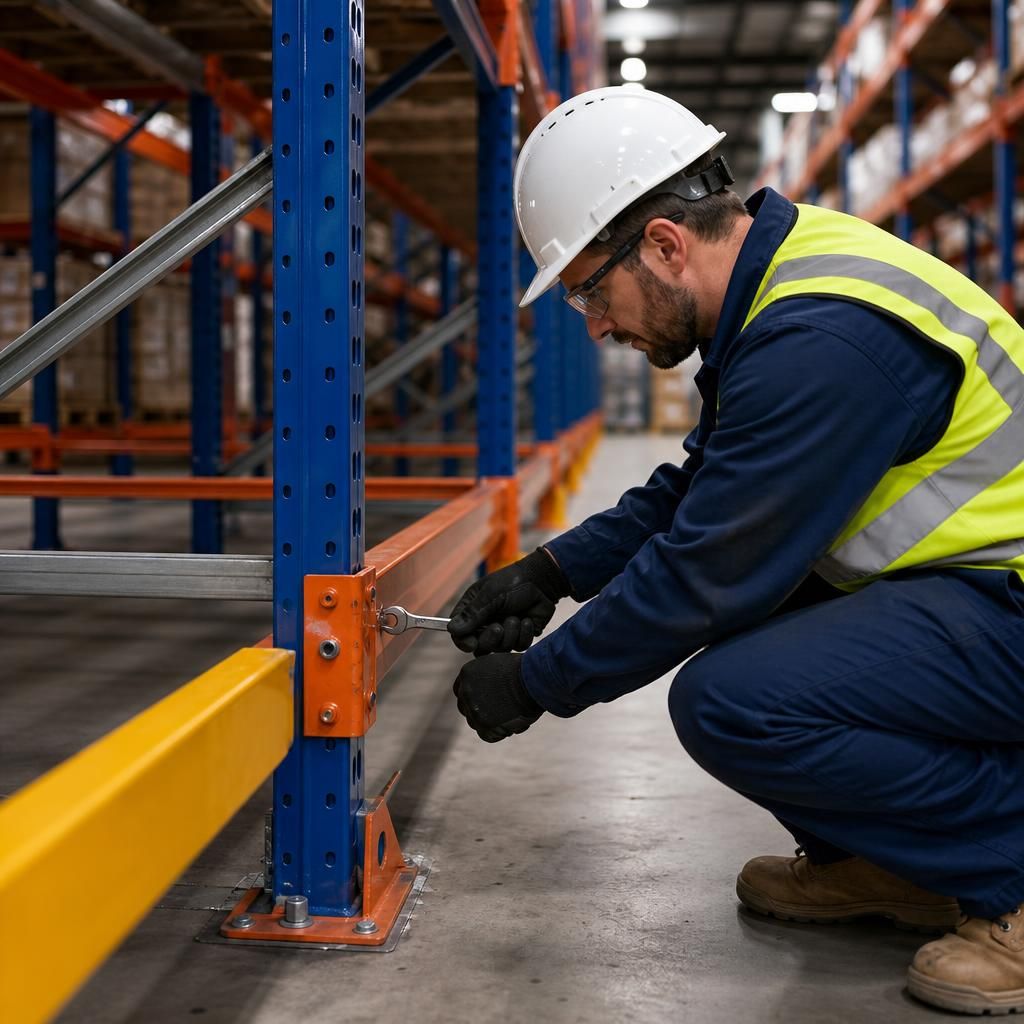
Planned repairs prevent operational disruption by dealing with warehouse racking defects before they develop into failures or require an urgent area closure. Maintenance should follow a clear process: report the defect, assess its risk, isolate the affected location where necessary, complete suitable repairs and verify the work before the storage position is returned to use.
Maintenance records should identify the affected location, defect, date reported, action taken and completion date. Reviewing these records can highlight recurring impacts, unsuitable traffic routes or loading practices that need attention. Coordinating repairs with warehouse management also allows stock movements and handling activities to be adjusted safely, limiting avoidable delays while keeping the warehouse racking system available and reliable.
Arrange a warehouse racking maintenance assessment
Arrange a warehouse racking maintenance assessment with Able Racking to identify defects, prioritise repairs and help prevent avoidable operational disruption.