
What role does corner protection play in preventing warehouse racking damage?
Corner protection helps prevent warehouse racking damage by absorbing or deflecting impacts from forklifts, pallet trucks and other handling equipment before they reach vulnerable upright frames. Correctly selected and securely installed protection reduces the risk of distortion, maintains safe operation and can help limit repair requirements.
Corner protection prevents warehouse racking damage by absorbing, deflecting or restricting impacts before they reach vulnerable upright frames. Correctly selected and securely installed protection helps reduce contact from forklifts, pallet trucks and other materials-handling equipment, limiting distortion and supporting the safe, compliant operation of the storage system.
Warehouse racking uprights are particularly exposed at aisle ends, corners, transfer points and other areas where vehicles manoeuvre. Even a low-speed contact can damage paintwork, loosen fixings or deform the upright, baseplate or surrounding components. Protection creates a sacrificial barrier between the equipment and the frame, so the impact is taken by the guard rather than directly by the warehouse racking.
How corner protection reduces damage
- Absorbing impact: Polymer, rubber or suitably designed steel guards can absorb part of the impact energy and reduce the force transmitted to the upright.
- Deflecting vehicles: Angled or rounded surfaces can guide a forklift or pallet truck away from the corner instead of allowing it to strike the frame directly.
- Creating a visible boundary: High-visibility guards make the limits of the aisle and storage system easier for operators to judge, particularly in busy or restricted areas.
- Protecting vulnerable locations: End-of-aisle uprights, exposed corners, cross-aisle positions and areas beside loading or dispatch routes can receive additional protection where the risk of impact is greatest.
- Reducing repeat damage: A guard can prevent minor, recurring contacts from progressively weakening or deforming the same part of the warehouse racking.
Protection is most effective when it is matched to the traffic, equipment and layout of the workplace. A guard intended for occasional pallet truck contact may not be suitable for an area used by counterbalance forklifts or reach trucks. The likely direction, height and force of impact should be considered alongside the available aisle width and the manoeuvring space required by vehicle operators.
Common forms of protection
Upright guards are fitted around or in front of exposed vertical members and are commonly used at aisle ends and corners. End-of-aisle barriers can protect a wider section of the frame, including lower beams and nearby components, where vehicles may approach from more than one direction. Fixed steel barriers or bollards may be appropriate where there is a higher likelihood of substantial vehicle impact, provided they are designed and positioned so that they do not create a separate hazard.
Some guards are attached to the floor, while others are designed to fit around the upright without transferring damaging forces into the frame. The fixing method matters. Protection should not be drilled, welded or otherwise altered in a way that compromises the upright, baseplate, floor slab or manufacturer’s design. Floor fixings must be suitable for the substrate, correctly installed and maintained so that the guard remains stable after impact.
Protection must not conceal damage
A guard reduces the likelihood and severity of contact, but it does not make warehouse racking immune to damage. A protector can itself become bent, cracked, displaced or detached. It may also hide damage to the upright if it is not checked properly after an impact. Operators should report any contact, even where there is no obvious structural distortion, so the affected area can be assessed.
During an inspection, the protection and the warehouse racking behind it should both be examined. Checks normally include the condition and position of the guard, floor fixings, upright alignment, baseplates, anchors, beams, bracing and nearby components. Paint loss, buckling, twisting, open joints, damaged welds or displaced fixings may indicate that the storage system has absorbed an impact. A competent person should determine whether the area can remain in service, requires immediate unloading or needs repair or replacement.
Installation and positioning considerations
- Identify locations with frequent vehicle movements, restricted visibility or limited turning space.
- Use protection that is compatible with the design and dimensions of the warehouse racking.
- Allow enough clearance for vehicles, loads and safe pedestrian movement without narrowing the working aisle unnecessarily.
- Position guards so they protect the frame without obstructing load placement, inspections, emergency access or routine maintenance.
- Secure the protection to an appropriate surface and check that fixings remain tight and undamaged.
- Use conspicuous markings where they improve visibility, while keeping the guard clean and identifiable.
- Review the arrangement if the warehouse layout, vehicle type, pallet size or traffic route changes.
Corner protection should be part of a wider damage-prevention system. Good vehicle segregation, clearly defined routes, suitable operator training, adequate lighting, sensible speed control and well-maintained floors all reduce the likelihood of impact. Load placement also matters: overhanging or unstable loads can strike uprights even when the vehicle is being operated correctly.
Where damage has already occurred, installing a guard should not be treated as a repair. The damaged warehouse racking should be assessed first, and any unsafe section should be isolated or unloaded in line with the site’s emergency procedure. Repairs or replacement components should be specified and completed by suitably competent operatives, using methods that restore the system without introducing additional weaknesses.
Regular inspections confirm whether corner protection is still performing its intended function. They also show whether the selected protection is suitable for actual working conditions. Repeated marks, bent guards or frequent reports of contact may indicate a layout, visibility or traffic-management problem rather than a need for a stronger guard alone. Reviewing these findings helps prevent recurring damage and supports a more efficient maintenance plan.
In practical terms, corner protection is a preventative control rather than a substitute for careful operation, inspection or repair. When it is properly specified, installed and maintained, it provides a valuable first line of defence for exposed warehouse racking, helps limit the consequences of vehicle contact and supports continued workplace safety and compliance.
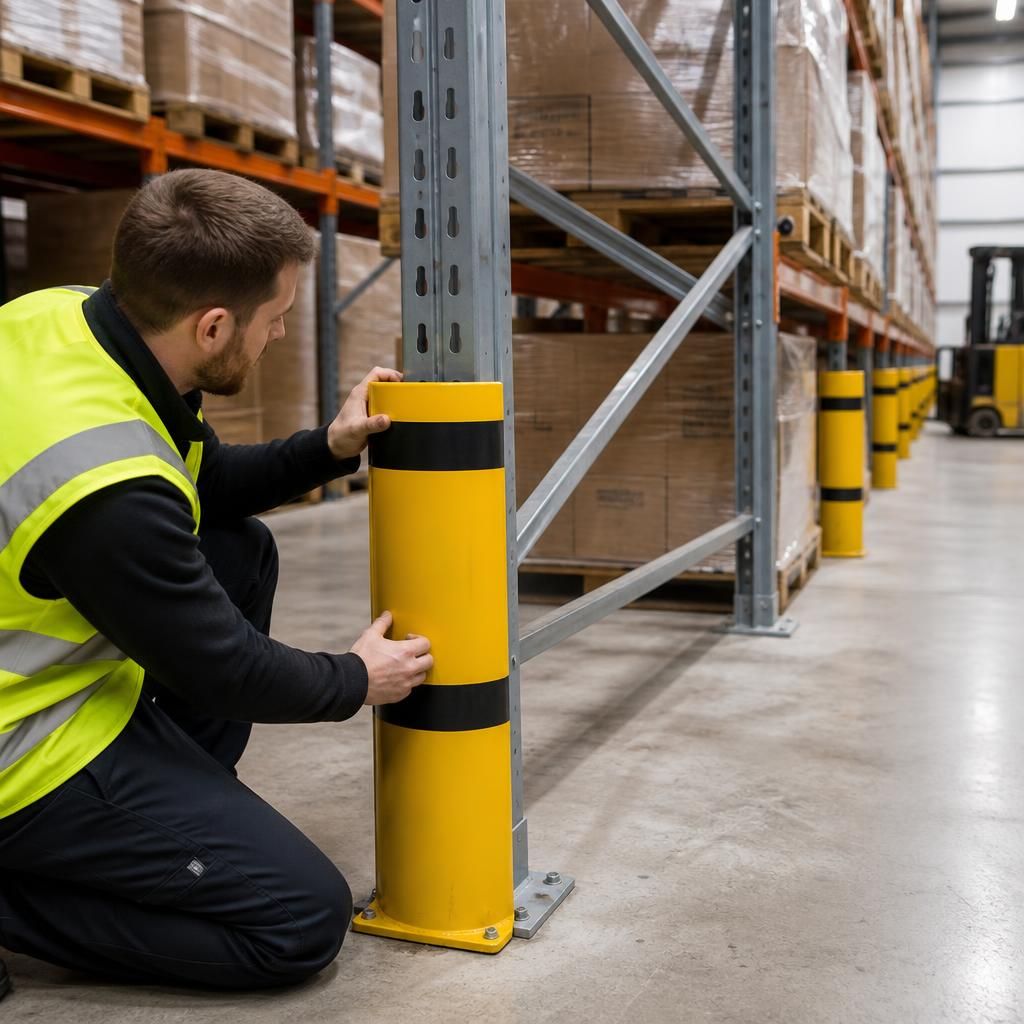
Corner protection acts as a sacrificial barrier, taking contact from handling equipment before it reaches an exposed warehouse racking upright. It can reduce impact damage at aisle ends and corners, but it must be inspected alongside the warehouse racking after any collision.
Check that the guard remains correctly positioned, securely fixed and free from cracks, distortion or displacement. Inspect the upright, baseplate, anchors and nearby components for bending, twisting, damaged fixings or other signs of impact. Protection should never be used to conceal damage or treated as a repair; any affected warehouse racking should be assessed by a competent person before the area returns to normal use.
Request Expert Advice on Corner Protection
Contact Able Racking for expert advice on selecting, positioning and maintaining corner protection for your warehouse racking. Our experienced team can assess vulnerable areas and recommend practical measures to help prevent impact damage.