
What is the role of regular inspections in maintaining warehouse racking safety and efficiency?
Regular warehouse racking inspections identify damage, instability and compliance issues before they lead to accidents, product loss or operational disruption. They also help maintain efficient storage by ensuring warehouse racking remains suitable for its intended loads and use.
Regular warehouse racking inspections maintain safety and efficiency by identifying damage, instability, overloading and poor operating practices before they cause injury, product loss or disruption. They provide a structured way to confirm that warehouse racking remains suitable for its loads, layout and day-to-day use, while ensuring defects are recorded and dealt with promptly.
Inspection is a preventative process, not simply a response to visible failure. Warehouse racking can be weakened by forklift impacts, altered layouts, incorrect loading, missing components or gradual deterioration. Some defects may not be obvious to busy warehouse staff, particularly where damage affects upright frames, beams, fixings or floor connections. A competent inspection can identify these issues at an early stage.
What regular warehouse racking inspections check
- Uprights, beams, bracing and connections for bending, cracking, distortion or other damage.
- Base plates, anchors and floor fixings for movement, looseness or deterioration.
- Beam locking devices, safety pins and other components that prevent accidental disconnection.
- Load notices and configuration details to confirm that the system is being used within its intended capacity.
- Evidence of overloading, uneven loading, poor pallet placement or goods projecting into access routes.
- Clearance around aisles, emergency routes, fire protection equipment and operational areas.
- Protection systems, including barriers and guards, where these are installed to reduce the risk of impact damage.
- Changes to the warehouse racking layout or components that may affect its design assumptions.
Inspections should be carried out at several levels. Warehouse staff should report impacts, visible defects and unsafe loading as soon as they are noticed. Supervisors should make regular checks as part of normal warehouse controls, particularly in areas with frequent vehicle movement. A competent person should also carry out a formal expert inspection at planned intervals. UK warehousing guidance recommends that this expert inspection takes place at intervals of no more than twelve months, with shorter intervals considered where the environment, traffic levels or damage history justify them.
Why inspections improve safety
Early identification reduces the likelihood that a minor defect will develop into a structural failure. For example, a damaged upright may initially appear to be a local issue, but continued loading can increase the stress on connected frames and beams. A missing locking device can also allow a beam to become displaced during handling. Finding these conditions promptly allows the affected area to be made safe while an appropriate repair or further assessment is arranged.
Inspections also help prevent secondary risks. Damaged warehouse racking may cause pallets to sit unevenly, goods to fall into aisles or operatives to work around restricted access. These conditions can increase the chance of collisions, manual handling injuries and blocked emergency routes. Removing the underlying defect supports safer working practices across the whole storage area.
How inspections support efficiency
Safe warehouse racking is more reliable and easier to operate. Inspections can reveal conditions that cause delays, such as obstructed aisles, poorly positioned pallets, damaged guides or repeated vehicle impacts. Correcting these problems helps vehicles manoeuvre safely, reduces avoidable product damage and limits unplanned closures of storage locations.
Planned inspections are also more efficient than waiting for a serious failure. They enable repairs and replacement components to be considered during planned maintenance, rather than during an emergency. Inspection records can identify recurring damage in particular aisles or loading areas, helping warehouse managers review traffic routes, protection measures, training or loading procedures.
What happens when damage is found
Any suspected structural damage should be reported immediately and the affected warehouse racking should be assessed before normal use continues. Depending on the severity and location of the defect, the area may need to be unloaded, isolated or clearly marked. Damaged components should not be straightened, welded, removed or altered without an appropriate technical assessment, as an unsuitable repair can affect the system’s strength and design.
Inspection findings should be recorded clearly, including the location, type and seriousness of each defect. Photographs, system references and details of temporary controls can make the record more useful. Actions should then be assigned, completed and checked rather than simply noted as outstanding. A competent specialist can advise whether the correct response is monitoring, unloading, component replacement, a designed repair or further investigation.
When additional inspections are needed
- After a forklift or other vehicle impact.
- After warehouse racking has been altered, relocated or reconfigured.
- When load types, pallet sizes or operating methods change.
- Following unusual loading, overloading or a dropped pallet.
- After building work, floor movement, flooding or another event that could affect stability.
- When staff report movement, unusual noise, leaning, damaged components or recurring loading problems.
- When inspection records show repeated damage in the same location.
Regular inspections do not replace good warehouse controls, correct installation or competent repairs. They work alongside load management, operator training, impact protection, housekeeping and prompt reporting. A consistent inspection programme gives warehouse managers reliable information about the condition of their warehouse racking and helps demonstrate that safety risks are being actively managed.
For existing customers, the most useful approach is to keep inspection records alongside repair and maintenance information, review recurring findings and make sure every identified defect has a documented outcome. This creates a practical audit trail and supports decisions that keep warehouse racking safe, compliant and effective throughout its working life.
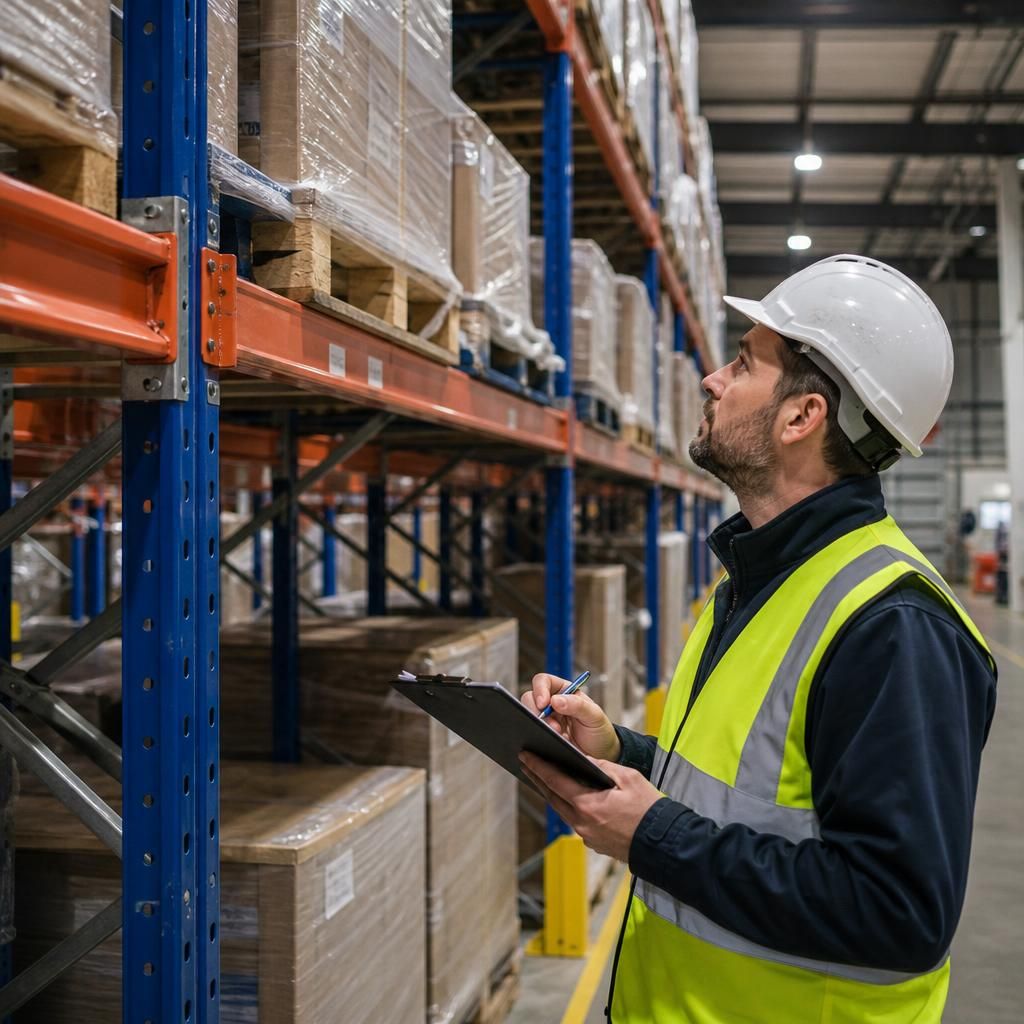
Regular warehouse racking inspections improve safety by identifying defects before they develop into structural failures or operational hazards. Inspectors check uprights, beams, bracing, connections, floor fixings, locking devices and load notices, as well as signs of overloading, impact damage or unsafe loading.
When damage is found, the affected area should be reported, assessed and controlled promptly. It may need to be unloaded, isolated or clearly marked until a competent specialist confirms whether monitoring, component replacement or a designed repair is required. Keeping clear inspection records also helps identify repeated damage and improve traffic routes, protection measures and working practices.
Arrange a warehouse racking inspection
Arrange a warehouse racking inspection with Able Racking to identify defects early and keep your storage system safe, compliant and efficient.