
What are the most common types of warehouse racking damage that require repairs?
The most common warehouse racking damage requiring repairs includes bent or twisted upright frames, damaged bracing, dislodged or distorted beams, damaged beam connectors, missing safety pins and impact damage to guards or floor fixings. Any damage that affects the system’s alignment, stability, load-bearing capacity or safe operation should be isolated and assessed by a competent warehouse racking specialist before use continues.
The most common types of warehouse racking damage requiring repairs are bent or twisted upright frames, damaged bracing, distorted beams, failed beam connectors, missing safety pins, damaged baseplates or floor fixings, and impact damage to guards. Damage should be assessed according to its effect on alignment, stability, load-bearing capacity and safe operation, rather than appearance alone. Any warehouse racking that may be unsafe should be isolated from use and inspected by a competent warehouse racking specialist before loads are reinstated.
Damaged upright frames
Uprights are particularly vulnerable to forklift and handling-equipment impacts. Common defects include dents, bends, twists, buckling, splits, tears around connection points and deformation near the base of the frame. Even apparently minor damage can reduce the frame’s ability to carry vertical and horizontal loads, especially where the upright is no longer straight or its profile has been compressed.
Repairs may involve replacing the damaged upright or an affected frame section, subject to a suitable repair assessment and manufacturer-compatible method. Straightening a damaged upright on site is not normally an acceptable substitute for a properly designed repair, because the original strength and geometry may not be restored.
Deformed or damaged bracing
Horizontal and diagonal bracing helps maintain the shape, rigidity and stability of a warehouse racking frame. Bracing can be bent, torn, disconnected or damaged at its connection points following an impact. Missing or loose bracing is also a concern, even where the upright itself appears undamaged.
Damaged bracing should be replaced or repaired using compatible components. Improvised alterations, drilled modifications or components that do not match the original system can affect the frame’s structural performance and should not be used without competent technical approval.
Bent, twisted or displaced beams
Beams may be damaged when a pallet is placed incorrectly, struck by handling equipment or loaded in a way that causes impact or excessive stress. Typical defects include visible bending, twisting, dents, local buckling, damaged beam ends and beams that have moved out of their intended position.
A distorted beam may have reduced load capacity and may no longer provide reliable support for pallets or decking. It should not be unloaded, repositioned or returned to service without assessment. In many cases, replacement is more appropriate than attempting to straighten the beam, particularly where the section or beam end has been permanently deformed.
Damaged beam connectors and locking devices
Beam connectors transfer loads into the upright frames. Damage may include cracked or distorted connector components, torn connection points, incomplete engagement, excessive movement or separation from the upright. A connector that is not fully engaged can allow a beam to become unstable or dislodge during use.
All locking devices should be present, correctly fitted and compatible with the warehouse racking system. A missing safety pin, damaged locking mechanism or incorrectly seated connector requires prompt attention. Loads should be removed from an affected level where the connection cannot be confirmed as secure.
Missing or damaged safety pins
Safety pins and other locking devices prevent beam connectors from lifting out of the upright during normal use or accidental contact. They can be lost during alterations, dislodged by impact or damaged when a beam is moved.
A missing safety pin should not be treated as a minor maintenance issue. The correct replacement must be fitted, and the beam connector and upright should be checked for related damage. Substituting unsuitable fixings, wire or other temporary materials does not provide a reliable repair.
Damaged baseplates and floor fixings
Baseplates spread loads from the uprights into the floor, while floor fixings help prevent unwanted movement. Damage can include cracked or distorted baseplates, pulled-out anchors, loose fixings, elongated fixing holes and deterioration of the surrounding concrete.
These defects can affect the alignment and stability of the whole frame. Repairs may require replacement baseplates or fixings, correction of the frame position and assessment of the floor condition. The cause of any movement should be established before the warehouse racking is put back into service.
Impact damage to protection equipment
End-of-aisle guards, upright guards, column protection and other protective equipment are intended to absorb or deflect impacts before they reach the main structure. A guard can therefore be damaged even when the protected upright looks serviceable.
Crushed, detached, displaced or cracked protection should be replaced or repaired as necessary. Protective equipment must remain securely fixed and correctly positioned. It should not be relied upon if it has been pushed away from the area it is intended to protect.
Damaged decking, support bars and pallet supports
Decking and support components can be bent, cracked, displaced or punctured by poorly positioned pallets, falling goods or handling equipment. Timber or board decking may split or deteriorate, while steel components can suffer local deformation or corrosion.
Damaged decking should be removed from use and replaced with a component suitable for the intended load. Support bars must be correctly seated and adequately supported at both ends. A pallet should never be stored on visibly damaged or incomplete support equipment.
Corrosion, cracking and material deterioration
Corrosion can reduce the effective thickness and strength of steel components, particularly where warehouse racking is exposed to moisture, chemicals, condensation or repeated damage to its protective coating. Check for rust around bases, joints, welds, fixing points and areas where water or debris collects.
Surface marking is not automatically a structural failure, but deep corrosion, flaking material, cracking or perforation requires competent assessment. Painting over corrosion without dealing with the underlying deterioration can conceal the defect rather than repair it.
Damage caused by overloading or incorrect loading
Warehouse racking can be damaged when loads exceed the stated capacity, are concentrated unevenly, project into adjacent positions or are placed on unsuitable pallets. Signs may include bent beams, excessive deflection, displaced components, damaged decking and repeated contact with frames.
Repairs should be accompanied by a review of the load arrangement, capacity information, pallet condition and operating practices. Replacing a visibly damaged component without addressing overloading or poor loading technique may allow the same problem to recur.
What to do when damage is found
- Stop using the affected warehouse racking position and prevent further access where necessary.
- Unload the area only where this can be done safely and without creating additional instability.
- Record the location, component affected and apparent cause, with photographs where appropriate.
- Check adjacent frames, beams, connections, guards and fixings for related damage.
- Arrange an assessment by a competent warehouse racking inspector or repair specialist.
- Keep the area out of service until the repair has been completed, checked and formally cleared for use.
Not every mark requires immediate component replacement, but no structural damage should be dismissed without assessment. Repairs must restore the system’s intended geometry, connections and load capacity, using compatible parts and a controlled method. Following repair, the affected area should be rechecked and any required load notices, protection or operating controls reinstated.
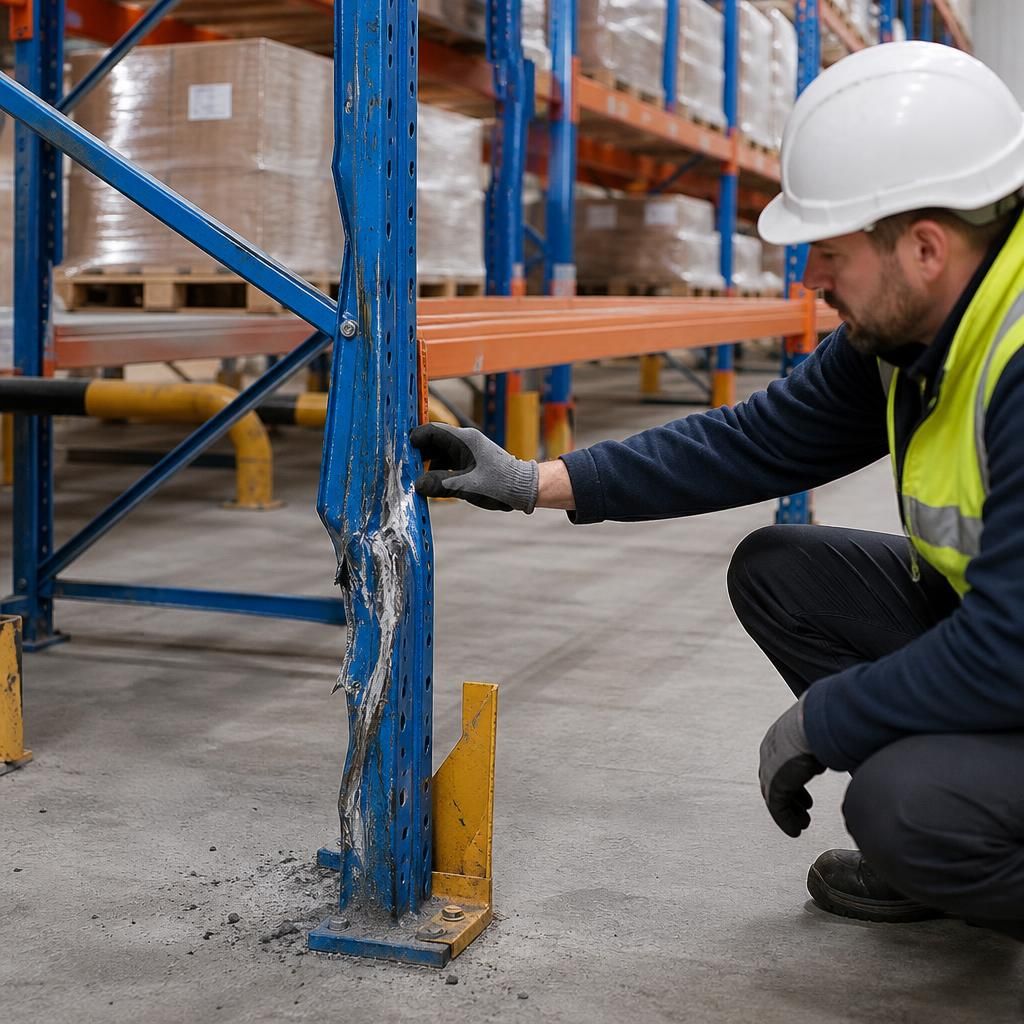
Damage to upright frames is one of the most serious forms of warehouse racking damage because it can reduce the frame’s strength, alignment and stability. Forklift impacts commonly cause dents, bends, twists, buckling or deformation near the base, even when the damage initially appears minor.
An affected frame should be isolated and assessed by a competent warehouse racking specialist. Straightening a damaged upright does not reliably restore its original performance; replacement of the affected component or frame section is often the appropriate repair. Adjacent bracing, beams, connectors, baseplates and floor fixings should also be checked before the area is returned to service.
Arrange a warehouse racking damage assessment
Arrange a warehouse racking damage assessment with Able Racking to identify affected components, establish the appropriate repair method and confirm when the area can safely return to service.