
How does corner protection help maintain warehouse racking compliance?
Corner protection helps maintain warehouse racking compliance by absorbing or deflecting impacts from vehicles and handling equipment, reducing damage to uprights and frames. It supports a preventative safety strategy but does not replace regular inspections, prompt reporting or repairs when damage is identified.
Corner protection helps maintain warehouse racking compliance by reducing the likelihood and severity of impact damage to upright frames, end frames and other vulnerable components. It absorbs, deflects or spreads the force of contact from forklifts, pallet trucks and other handling equipment, helping the warehouse racking remain within its designed condition. However, corner protection is a preventative measure, not a substitute for inspections, safe working practices or professional repairs.
Uprights positioned at aisle ends, access points and vehicle routes are particularly exposed to impact. Even a relatively low-speed collision can bend an upright, damage its baseplate or loosen an anchoring connection. Where protection is not installed, the impact force is transferred directly into the warehouse racking frame. A suitable guard creates a physical barrier between the equipment and the frame, giving operators a clearer indication of the safe approach distance and reducing direct contact.
Effective corner protection supports compliance in several ways:
- It helps prevent structural damage. Guards can reduce marking, distortion and localised impact damage to uprights and frame components.
- It protects critical areas. Base sections, end frames, corners and aisle-facing uprights are often the first parts to be struck and should be assessed when selecting protection.
- It supports safer traffic management. Clearly visible protection can help define vehicle routes, turning areas and exclusion zones around the warehouse racking.
- It reduces avoidable disruption. Preventing minor impacts can reduce the need for emergency isolation, unloading, repair work and replacement components.
- It provides evidence of preventative control. Properly selected and maintained protection forms part of a wider risk-control system for warehouse racking safety.
Protection must be suitable for the specific warehouse racking and the type of traffic operating nearby. Important considerations include the guard’s height, width, fixing method, impact resistance, visibility and position in relation to the frame. It should protect the upright without restricting access to baseplates, anchors, beam connections or other areas that need to be inspected. The protection should also remain stable after contact and should not create a trip hazard, obstruct escape routes or interfere with pallets and handling equipment.
Installation quality is also relevant to compliance. A guard that is poorly positioned, inadequately fixed or too close to the frame may provide limited protection. It can also make damage harder to see during routine checks. The installation should therefore follow the manufacturer’s instructions and take account of the floor condition, vehicle movements, pallet dimensions and the clearances required around the warehouse racking.
Corner protection should be included in the site’s inspection and maintenance arrangements. During routine visual checks, look for:
- cracks, splits, dents or distortion in the guard;
- loose, missing or damaged fixings;
- movement, leaning or separation from the floor;
- damage to the upright, baseplate, anchor or surrounding floor;
- obscured safety markings or reduced visibility; and
- new collision marks, even where the guard itself appears intact.
A guard may absorb an impact while concealing damage behind it. For this reason, any significant contact should be reported and assessed rather than dismissed because the protection appears to have worked. If an upright is bent, twisted, split, displaced or showing signs of connection damage, the affected area should be controlled in accordance with the site’s warehouse racking safety procedure. This may involve preventing access, removing loads where safe to do so and arranging an assessment by a competent warehouse racking specialist.
Corner protection does not make damaged warehouse racking compliant. Compliance depends on the complete system being installed correctly, used within its design parameters, inspected at appropriate intervals and repaired or replaced when defects are identified. Protection should work alongside trained operators, defined vehicle routes, suitable loading practices, visible load information and prompt reporting of impacts.
Where protection is repeatedly struck, this is useful evidence that the underlying risk has not been fully controlled. The site may need to review aisle layouts, vehicle speeds, visibility, reversing arrangements, pallet positioning, pedestrian segregation or operator training. Repositioning the guard alone may not prevent further warehouse racking damage.
At Able Racking, inspection findings are considered in the context of the complete storage system and its working environment. This helps distinguish cosmetic damage to protection from defects that could affect structural performance, and identifies when a repair, replacement or change to traffic controls is necessary. Maintaining corner protection in good condition, recording impacts and acting promptly on inspection findings provides a practical way to support ongoing warehouse racking compliance and safe operation.
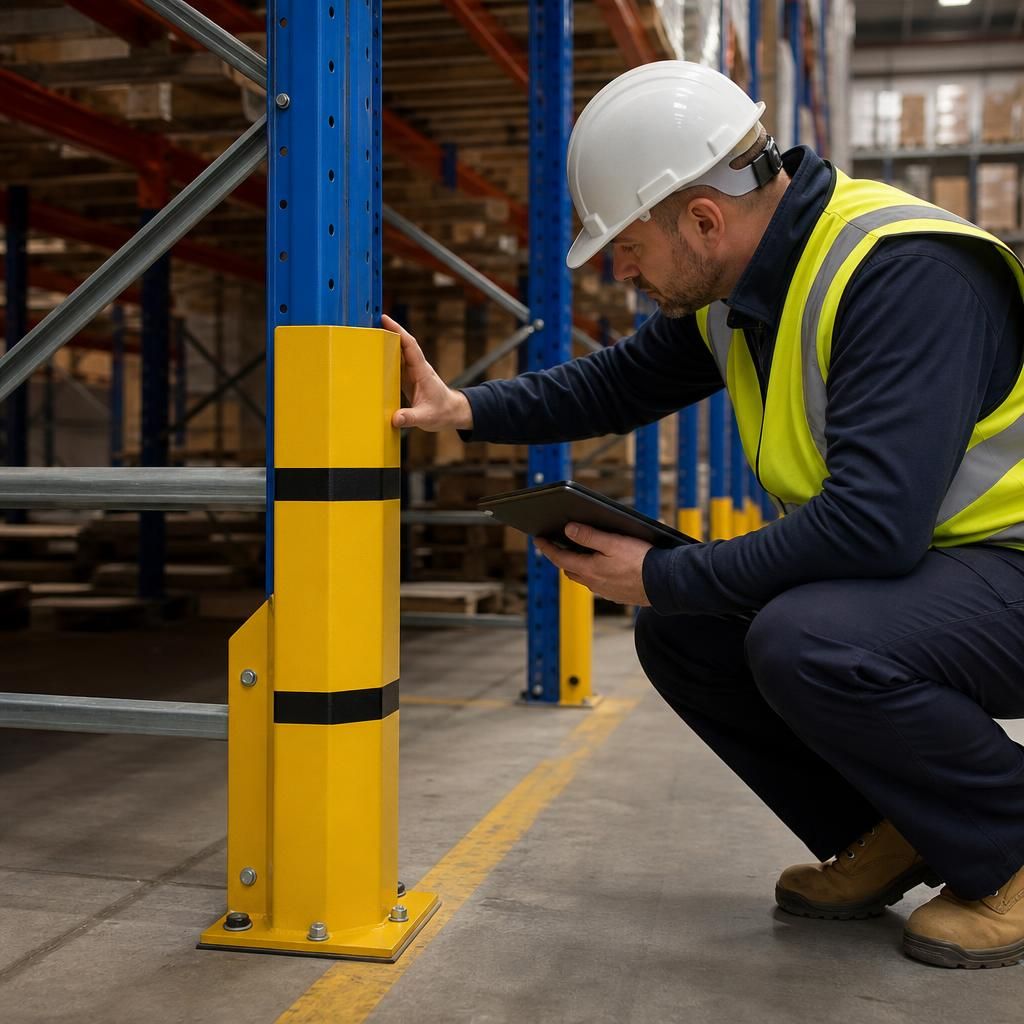
Corner protection helps maintain warehouse racking compliance by reducing direct impact to aisle-facing uprights, baseplates and frame corners. It acts as a physical barrier between the storage system and handling equipment, but it does not make damaged warehouse racking safe or compliant on its own.
Protection should be checked during routine inspections and after any significant contact. Look for movement, damaged fixings, distortion, floor damage and signs that the upright behind the guard has been affected. Any suspected structural damage should be reported promptly so the area can be controlled and assessed by a competent warehouse racking specialist.
Book a warehouse racking safety inspection
Book a warehouse racking safety inspection with Able Racking to identify damage behind corner protection and confirm that your storage system remains safe and compliant.