
What are the most common types of warehouse racking systems and their applications? Common systems include adjustable pallet racking, drive-in racking, push-back racking, cantilever racking, mobile racking and carton live storage, each suited to different stock types, access requirements, available space and stock rotation methods.
The most common warehouse racking systems are adjustable pallet racking, drive-in racking, push-back racking, cantilever racking, mobile racking and carton live storage. Each suits different goods, access requirements, available space and stock rotation methods, so the correct choice depends on your operational needs and warehouse layout.
The most common warehouse racking systems are adjustable pallet racking, drive-in racking, push-back racking, cantilever racking, mobile racking and carton live storage. Each system is designed for different goods, handling methods, access requirements and stock rotation patterns, so the most suitable option depends on the warehouse layout and how inventory moves through the operation.
Adjustable pallet racking
Adjustable pallet racking is the most widely used warehouse racking system because it provides direct access to every pallet position. The beam levels can be altered to accommodate different pallet heights, making the system adaptable when stock profiles change. It is suitable for general warehouses, distribution centres, manufacturing facilities and storage areas handling a broad range of palletised goods.
This system works well where operators need to select individual pallets rather than load or unload complete batches. It can be served by counterbalance or reach forklift trucks, depending on aisle widths and building constraints. Accessories such as pallet supports, back protection, mesh decking and loading guides can be added where the stored goods or operating conditions require them.
The main benefit is selectivity: every pallet can be accessed without moving another pallet first. The trade-off is that the system normally requires wider operating aisles than higher-density solutions, so the available floor area and handling equipment must be considered during the design.
Drive-in racking
Drive-in racking is a high-density storage system in which forklift trucks enter the structure to place pallets on supported rails. It is generally used for large quantities of the same product where there are relatively few product lines and stock rotation is less frequent.
Because the system reduces the number of access aisles, it can make efficient use of available floor space. It is particularly suited to products stored in batches, including temperature-controlled goods, raw materials and uniform manufactured products. However, access is usually more limited than with adjustable pallet racking. Drive-in systems are commonly operated on a last-in, first-out basis, so they must be matched carefully to the required stock rotation method.
Push-back racking
Push-back racking provides higher storage density while retaining access from the front of each lane. Pallets are loaded onto wheeled or guided carriers, and placing a new pallet into a lane moves the existing pallets backwards. When a pallet is removed, the pallets behind it move forward towards the operator.
This arrangement is useful where several pallets of the same product need to be stored together but direct access to every pallet is not essential. It can reduce the number of aisles required and is often suitable for warehouses holding reserve stock or products with moderate stock rotation. Push-back racking is normally operated on a last-in, first-out basis, so the loading sequence and product requirements should be reviewed before installation.
Cantilever racking
Cantilever racking is designed for long, bulky or irregularly shaped items that cannot be stored efficiently on conventional pallet beams. It uses upright columns with projecting arms, allowing goods to be loaded from the front without vertical uprights obstructing the storage position.
Typical applications include timber, steel sections, pipes, plastic profiles, sheet materials, carpets, furniture components and other long loads. The arms can often be adjusted to suit different product dimensions, while the system may be installed as single-sided or double-sided storage depending on the available space.
Load dimensions, weight distribution and the way goods are handled are particularly important when specifying cantilever racking. Long products must be supported correctly to prevent sagging, rolling or unstable loading. Forklift access, end clearances and protection from vehicle impact should also be included in the design.
Mobile racking
Mobile racking is mounted on powered or mechanically assisted bases that move along floor tracks. The storage rows can be closed together when access is not required and opened to create an operating aisle when goods need to be retrieved. This can provide a high storage capacity while maintaining direct access to the required row.
Mobile racking is useful where floor space is limited, land or building expansion is impractical, or the stored goods require controlled access. It is used in archives, stockrooms, specialist storage areas and warehouses where available space needs to be used efficiently. The design must account for floor loading, track installation, emergency access, operator controls and safety sensors.
Carton live storage
Carton live storage is a flow-based system for cartons, totes and small cases. Gravity rollers or wheels allow goods to move from the replenishment side towards the picking side, creating a clear first-in, first-out flow. It is commonly used for order picking, spare parts, e-commerce stock, food distribution and other operations with frequent piece-picking activity.
The system separates replenishment from picking, which can help reduce congestion and make stock locations easier to manage. It is most effective when cartons are reasonably consistent in size and weight and when products are picked regularly. Dividers, brakes, labels and end stops can be used to maintain orderly presentation and safe movement of stock.
How the systems compare
- For maximum selectivity: adjustable pallet racking normally provides the simplest access to individual pallets.
- For high-density batch storage: drive-in or push-back racking can reduce aisle space and group similar products together.
- For long loads: cantilever racking is generally more suitable than standard pallet storage.
- For limited floor space: mobile racking can increase capacity by reducing the number of permanently open aisles.
- For carton picking: carton live storage supports organised, accessible stock flow and frequent order selection.
Factors that determine the right application
The stored goods should be assessed before choosing a warehouse racking system. Important information includes pallet dimensions, load weights, item fragility, product packaging, stock quantities, turnover rates and whether goods must be handled on a first-in, first-out basis. The number of product lines and the need for individual pallet access are equally important.
The warehouse itself also affects the choice. Available height, floor condition, column positions, door locations, fire protection, lighting, sprinkler clearances and vehicle routes all need to be considered. The handling equipment must be compatible with the proposed aisle widths, lift heights and loading method. A design that maximises storage positions but restricts safe vehicle movement will not provide an effective long-term solution.
Safety and compliance considerations
Every warehouse racking system should be designed for its intended loads and operating conditions, then installed and inspected by competent people. Load notices should clearly state the permitted configuration and capacities. Uprights, beams, bracing, locking devices, rails, decks and protective components should be checked for damage, displacement and unauthorised alteration.
Site procedures should control vehicle speeds, loading practices, pedestrian movements and reporting of damage. Any impact or suspected structural problem should be reported promptly and the affected area should be assessed before it is returned to service. Regular inspections help identify developing defects, but they do not replace good housekeeping, operator training or immediate action following an impact.
For most general-purpose operations, adjustable pallet racking is the starting point, while higher-density, flow-based or specialist systems may provide better performance for particular stock profiles. The correct solution is the one that balances capacity, access, stock rotation, handling equipment, safety and future operational changes rather than focusing on storage density alone.
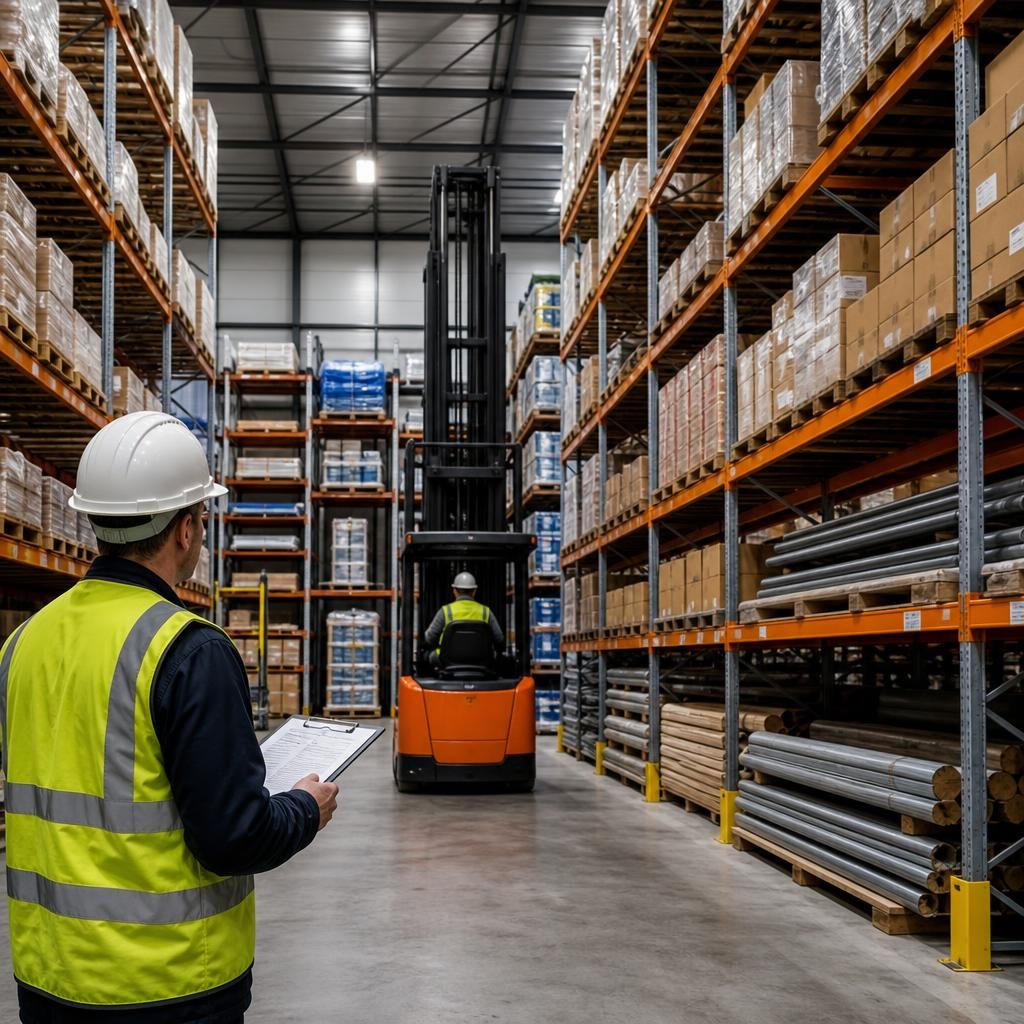
Adjustable pallet racking is usually the most versatile choice where operators need direct access to individual pallets. Its beam levels can be repositioned to suit changing load heights, making it practical for warehouses handling varied products, pallet sizes and stock quantities.
The main consideration is selectivity versus space efficiency. Every pallet position can be reached without moving another load, but the system may require wider forklift aisles than denser alternatives. A suitable design must therefore balance access requirements, available floor area, vehicle type, load capacity and future changes to stock profiles.
Discuss your warehouse racking requirements
Discuss your warehouse racking requirements with Able Racking for practical guidance on selecting a system that suits your stock, handling equipment, available space and operational needs.