
How does the selection of materials affect warehouse racking installation?
The materials selected for warehouse racking affect its load capacity, structural strength, durability, installation method and long-term maintenance requirements. Choosing suitable steel sections, finishes, fixings and protective components ensures the system is compatible with the building, intended loads and applicable safety standards.
Material selection directly affects the safety, load capacity, durability, installation method and ongoing maintenance of warehouse racking. The correct choice depends on the stored goods, bay dimensions, working environment, building structure, intended load configuration and applicable safety requirements. Materials should therefore be specified as part of a complete design, rather than selected on price alone.
Steel quality and section design
Most warehouse racking is manufactured from formed or rolled steel sections. The steel grade, thickness and profile influence how much load the uprights, beams and bracing can safely support. Stronger or heavier sections may be required for high loads, tall installations, wide bays or areas exposed to frequent forklift activity.
Profiles also affect the way the system is assembled. The shape and gauge of an upright determine how bracing connects, how beams engage with the frame and how the structure responds to impact or movement. Components from different systems should not be mixed unless their compatibility and structural performance have been properly verified.
Protective finishes and the working environment
Painted steel is widely used in dry internal warehouses because it provides a practical protective coating and makes damage easier to identify during inspections. Galvanised finishes can offer improved resistance in damp, humid or corrosive environments, although the correct specification depends on the site conditions and the complete system design.
Where the warehouse contains chemicals, moisture, salt, food products or abrasive materials, the finish and maintenance plan need particular attention. A suitable coating can slow corrosion, but it does not replace inspections. Rust, flaking, coating failure and section deformation should be recorded and assessed by a competent person.
Fixings, anchors and connections
Anchors transfer forces from the warehouse racking into the floor. Their type, size, embedment and spacing must suit the base material, slab condition and loads imposed by the installation. A fixing that is suitable for one concrete floor may not be appropriate for another, particularly where the slab is thin, damaged or contains reinforcement and services.
Beam connectors, locking devices, bolts and bracing components must also be compatible with the selected frames and beams. Correct installation is essential because an unsuitable or incorrectly tightened connection can affect the stability of the complete structure. Installers should follow the manufacturer’s instructions and check every connection during handover.
Decking and load-supporting components
The choice of decking affects both capacity and the way goods are stored. Steel panels, timber-based boards and other approved surfaces have different load limits, spans, fire characteristics and resistance to damage. The decking must support the planned pallet or product loads without excessive deflection and must be securely seated on the supporting beams.
Open or mesh-style surfaces may be useful where visibility, light or sprinkler discharge is important. Solid surfaces may be more suitable for particular goods, but can change the weight carried by the structure and may affect fire engineering considerations. The selected decking should be assessed with the full load arrangement, not as an isolated component.
Protection against impact
Protective components are commonly made from steel or other impact-resistant materials. Upright guards, end-of-aisle barriers and column protection help reduce damage caused by handling equipment, but their performance depends on their design, positioning and secure attachment.
Protection should be specified around the areas most exposed to vehicle movements, taking account of aisle widths, turning movements and traffic routes. Damaged guards must be repaired or replaced promptly. Protection is an additional control and does not make it acceptable to continue using damaged frames or beams.
How materials affect the installation process
Material choice affects component weights, lifting requirements, access arrangements and the sequence in which the warehouse racking is assembled. Heavier frames may require suitable mechanical handling equipment and additional planning to protect the floor and nearby operations. Coated components may also need careful handling to prevent damage during transport and installation.
The installation team must confirm that the floor is suitable, the layout matches the approved design and the materials delivered correspond with the specification. Any damaged, altered or incorrectly sized component should be quarantined rather than fitted. After assembly, the system should be checked for plumb, alignment, secure connections, correct bracing and adequate anchorage.
Balancing durability and cost
The lowest-cost material is not necessarily the most economical choice over the life of the installation. A lighter section may reduce initial expenditure but could be unsuitable for the intended loads or more vulnerable to damage. Conversely, specifying unnecessarily heavy components can increase material, transport and installation costs without providing a practical benefit.
A suitable specification balances structural capacity, environmental resistance, impact exposure, maintenance access and future changes to storage requirements. It should also allow for the actual loads, including pallets, decking and any accessories attached to the structure.
What to confirm before installation
- Confirm the weight, dimensions and distribution of every load type.
- Check the required bay widths, clearances, working heights and access routes.
- Assess the floor condition and select anchors that are suitable for the slab.
- Consider moisture, temperature, chemicals, dust and other environmental conditions.
- Specify compatible beams, frames, bracing, decking, fixings and protection.
- Check whether the installation must integrate with existing storage equipment.
- Allow for inspection, repair and future changes when selecting finishes and components.
Professional installers can review the proposed materials against the layout, load requirements and site conditions before work starts. This helps identify incompatible components, unsuitable fixings or inadequate protection early, reducing the risk of alterations after installation. Once the system is in use, regular inspections and prompt repairs remain necessary, regardless of the material specification.
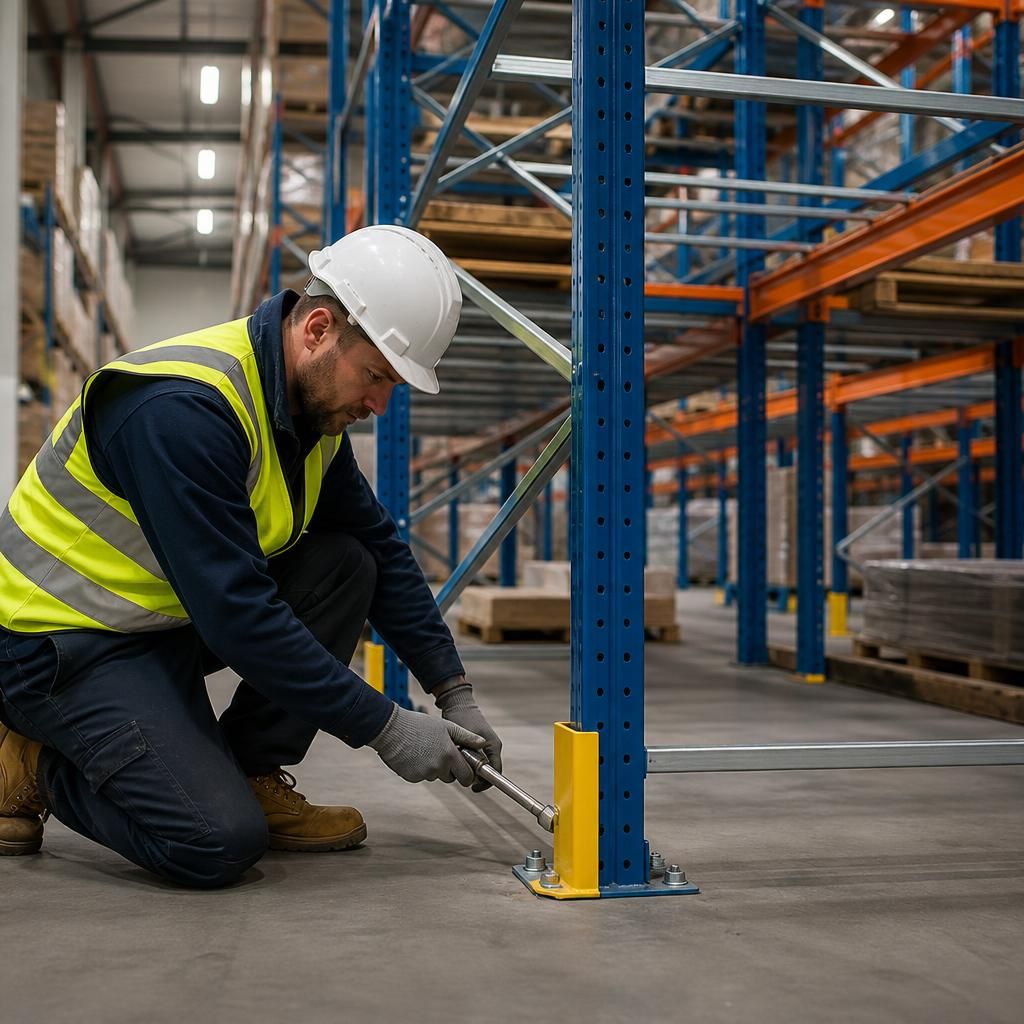
Material selection affects warehouse racking installation by determining how components are handled, connected, anchored and checked on site. The selected steel sections, fixings, decking and protective elements must be compatible with the intended loads, floor condition, working environment and approved design.
For example, heavier frames may require mechanical handling equipment and additional planning, while the anchor type must suit the concrete slab and the forces transferred through the structure. Coated components also need careful handling to prevent damage that could reduce corrosion resistance. Before installation, our team checks that delivered materials match the specification, are undamaged and can be assembled correctly. This helps prevent unsuitable components being fitted and supports a safe, durable installation.
Discuss Your Warehouse Racking Material Requirements
Discuss your warehouse racking material requirements with our experienced team before installation begins. We can review the proposed components against your loads, floor condition, working environment and approved design.