
Can I install warehouse racking systems myself, or should I hire professionals?
Although warehouse racking systems can sometimes be assembled by an in-house team, installation should normally be carried out by trained professionals to ensure the layout, components, fixings and load capacities are correct. Professional installation reduces the risk of instability, damage and non-compliance, while ensuring the completed system is ready for safe use and inspection.
Warehouse racking systems can sometimes be assembled by an in-house team, but installation should normally be completed by trained and competent professionals. The work involves more than connecting frames and beams: the system must be correctly designed, positioned, fixed, protected and checked against its intended load capacity. A professional installation helps reduce the risk of collapse, impact damage, unsafe access and non-compliance.
When self-installation may be suitable
In-house installation may be considered where the system is straightforward, the team has suitable training and experience, and the manufacturer’s instructions can be followed precisely. The business must still be able to assess the building, confirm the floor is suitable, use the correct components and fixings, and verify that the completed installation is safe for its intended use.
Assembly experience alone is not enough. A person may be able to construct a frame but still lack the knowledge needed to identify compatibility issues, incorrect beam levels, damaged components, inadequate anchoring or a layout that creates unsafe working clearances. If the system is large, complex, modified, relocated or being installed in an active warehouse, professional support is the safer option.
Why professional installation is recommended
- Correct system configuration: Installers check that frames, beams, bracing, decking, guards and other components match the approved design and manufacturer’s specifications.
- Accurate positioning: The layout is set out to maintain suitable aisles, access routes, emergency clearances and safe operating space for handling equipment.
- Secure fixing: Frames are anchored using suitable fixings for the floor and checked for stability. The floor condition, level and load-bearing capacity must be considered before installation.
- Load capacity control: Beam levels and component choices are installed to reflect the intended loads. Load notices can then be displayed so warehouse operatives understand the system’s limits.
- Damage prevention: Protection such as frame guards, end-of-aisle barriers and column protection can be positioned where vehicle movements create a foreseeable impact risk.
- Completion checks: A competent installer can inspect the finished system, identify defects and provide the relevant handover information before it is put into service.
Key risks of installing warehouse racking without suitable expertise
Incorrect installation can result in missing or unsuitable fixings, loose connections, inadequate bracing, uneven frames and beams installed at the wrong levels. These faults may not be obvious during assembly but can reduce stability when the system is loaded or struck by materials handling equipment.
Other risks include exceeding the capacity of the floor, obstructing fire protection equipment, reducing escape routes and creating unsafe access to stored goods. A poorly planned layout can also encourage overloading, uneven loading or unsafe loading practices. These issues can expose people to falling goods and make the warehouse more difficult to operate safely.
What professional installation normally involves
- Reviewing the requirements: The installer considers the goods, pallet dimensions, expected loads, handling equipment, available space and proposed operating arrangements.
- Checking the site: The floor, building structure, access routes, obstructions, lighting and working conditions are assessed before work begins.
- Confirming the design: The proposed arrangement is checked against the manufacturer’s information and relevant technical requirements, including the intended load capacities.
- Setting out the layout: Frame positions, aisle widths, protection equipment and access points are marked accurately to prevent avoidable changes during construction.
- Assembling and fixing the system: Components are erected in the correct sequence, connected properly and anchored where required. Damaged or incompatible parts should not be used.
- Checking and handing over: The completed installation is examined, load information is made available and any outstanding actions are recorded before the system is used.
Responsibilities after installation
Professional installation does not remove the warehouse operator’s responsibility for safe use. Loads must remain within the stated capacities, goods should be positioned correctly, and damage must be reported promptly. Staff should understand the operating rules and know not to alter the layout, remove protection or replace components without approval.
Warehouse racking should also be subject to regular visual checks and a formal inspection programme appropriate to the risks and working environment. The guidance in BS EN 15635 is commonly used for the safe application and maintenance of storage systems, alongside the manufacturer’s instructions and applicable health and safety duties. Any impact damage, distortion, missing components or unusual movement should be treated seriously and assessed by a competent person.
When to use a professional installer
Professional installation is particularly important where the system is being designed or altered, the warehouse is busy, powered handling equipment will operate nearby, the floor or building presents uncertainties, or the installation includes unusual loads or specialist components. It is also advisable when an existing system is being extended, relocated or combined with components from different sources.
For a simple system, an experienced in-house team may be able to assist with preparation or supervised assembly. However, the final arrangement should still be checked by someone competent to confirm that the installation is stable, correctly fixed, suitable for its intended use and ready for inspection. Able Racking can advise on the practical requirements, complete professional installations and identify issues that may not be apparent to an untrained installer.
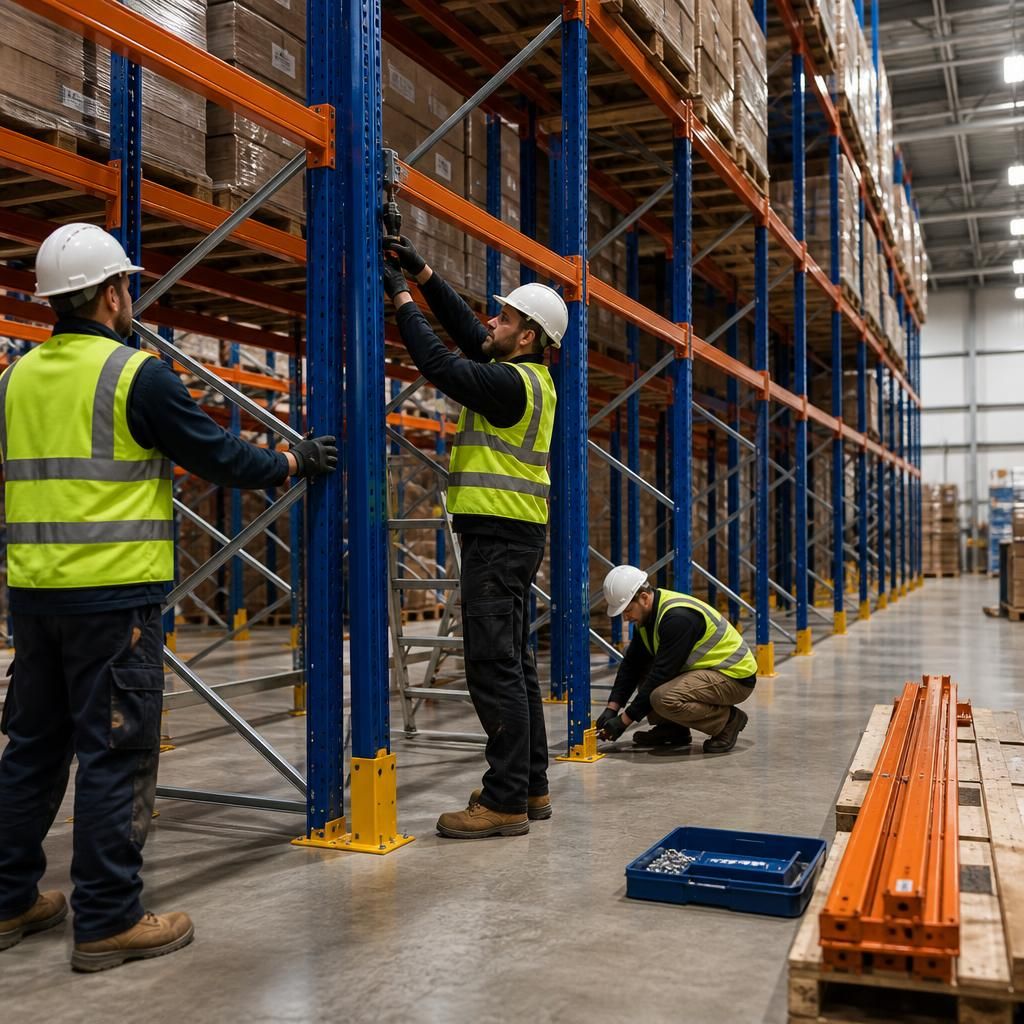
Warehouse racking installation involves more than assembling frames and beams. The system must be configured for its intended loads, positioned with suitable aisles and access routes, securely fixed to the floor and checked before use.
An experienced in-house team may assist with a straightforward installation, but a competent professional should verify the completed system. This helps identify incorrect components, inadequate anchoring, unsafe clearances or damage that may not be obvious during assembly.
Talk to Able Racking About Your Warehouse Racking Installation
Contact Able Racking to discuss your warehouse racking installation requirements and arrange advice from an experienced professional team. We can help confirm the system is correctly configured, securely installed and ready for safe use.