
What is the difference between selective and push-back pallet racking systems?
Selective pallet racking provides direct access to every pallet position, making it suitable for warehouses handling many product lines. Push-back pallet racking stores pallets more densely on inclined rails, with pallets loaded and retrieved from the same aisle, but offers less direct access and stock rotation flexibility.
Selective pallet racking and push-back pallet racking differ mainly in accessibility, storage density and stock rotation. Selective pallet racking gives direct access to every pallet position from the aisle, whereas push-back pallet racking stores pallets on inclined rails or carts at greater depth, with loading and retrieval carried out from the same aisle. Selective systems are usually more flexible; push-back systems generally provide higher-density storage where individual pallet access is not required at all times.
Selective pallet racking is arranged in single- or double-depth rows with aisles between them. Each pallet position can be reached without moving other pallets, allowing warehouse operatives to select a specific product, batch or pallet immediately. This makes the system well suited to warehouses holding many stock-keeping units, products with varied demand, or goods that must be rotated and monitored closely.
Selective systems also make stock visibility straightforward. Pallet locations can be clearly identified, and damaged, quarantined or short-dated stock can be accessed without disturbing adjacent positions. The trade-off is that the aisles and access spaces required for direct access can reduce the number of pallet positions available within a fixed floor area.
Push-back pallet racking uses inclined rails or moving carts within each bay. A pallet is placed at the front position and is pushed backwards as further pallets are loaded behind it. When the front pallet is removed, the stored pallets move forward under gravity or controlled movement, ready for the next retrieval. Loading and unloading generally take place from one face of the system, which can reduce the number of aisles needed compared with a selective layout.
This arrangement is particularly useful for storing larger quantities of the same product or a smaller range of stock-keeping units. It can increase storage density by using the available depth of each lane, but the rear pallets are not directly accessible while the front positions are occupied. The system therefore requires more careful location control and is less suitable where every pallet must be selected independently.
The main differences can be summarised as follows:
- Access: selective pallet racking provides direct access to every pallet location; push-back pallet racking provides access through the front of each lane.
- Storage density: push-back pallet racking normally stores pallets more densely because it uses deeper lanes and can require fewer operating aisles.
- Stock rotation: selective systems support straightforward first-in, first-out processes when locations and handling procedures are managed correctly. Push-back systems generally operate on a last-in, first-out basis within a lane, although the precise outcome depends on how the system is loaded and unloaded.
- Product variety: selective pallet racking is better suited to many different products and frequent individual pallet selection. Push-back pallet racking is more effective when several pallets of the same product can be stored together.
- Handling: push-back systems require operators to load and retrieve pallets in a controlled sequence, while selective systems allow more independent access to each position.
- Flexibility: selective systems are usually easier to reconfigure for changing product ranges, pallet quantities and access requirements.
Stock rotation is an important consideration when choosing between the two systems. If products have expiry dates, batch controls or a strict first-in, first-out requirement, selective pallet racking may be the more suitable option because each pallet can be accessed directly. Push-back pallet racking can still be appropriate for date-controlled goods when lanes are allocated carefully and operating procedures prevent newer stock from being placed in front of older stock, but it should not be selected without checking that the required rotation method can be maintained in practice.
Forklift requirements also influence the decision. Selective pallet racking can be designed around the available truck type and the aisle width needed for safe operation. Push-back pallet racking needs sufficient clearance and accurate pallet placement so that pallets, rails and carts are not damaged during loading. Pallet dimensions, weight, condition and consistency should be checked before installation, as poorly maintained or incompatible pallets can affect both systems but may create particular problems in deeper push-back lanes.
The best choice depends on the warehouse’s product range, throughput, stock rotation requirements, available floor area, handling equipment and need for future change. Selective pallet racking is generally the stronger choice where accessibility and flexibility are priorities. Push-back pallet racking is generally more suitable where storage density is important and products can be grouped into dedicated lanes with less frequent individual selection. Some warehouses use both systems, reserving selective locations for high-turnover or mixed stock and push-back lanes for bulk quantities of consistent products.
Whichever system is installed, the layout must be designed for the intended loads, equipment and operating conditions. Pallet positions, frames, beams, rails, guards and floor fixings should be checked as part of regular warehouse racking inspections. Any impact damage, missing components, displaced protection or change in loading should be reported and assessed promptly. A competent inspection and maintenance process helps ensure that the chosen system continues to operate safely and supports the warehouse’s storage requirements.
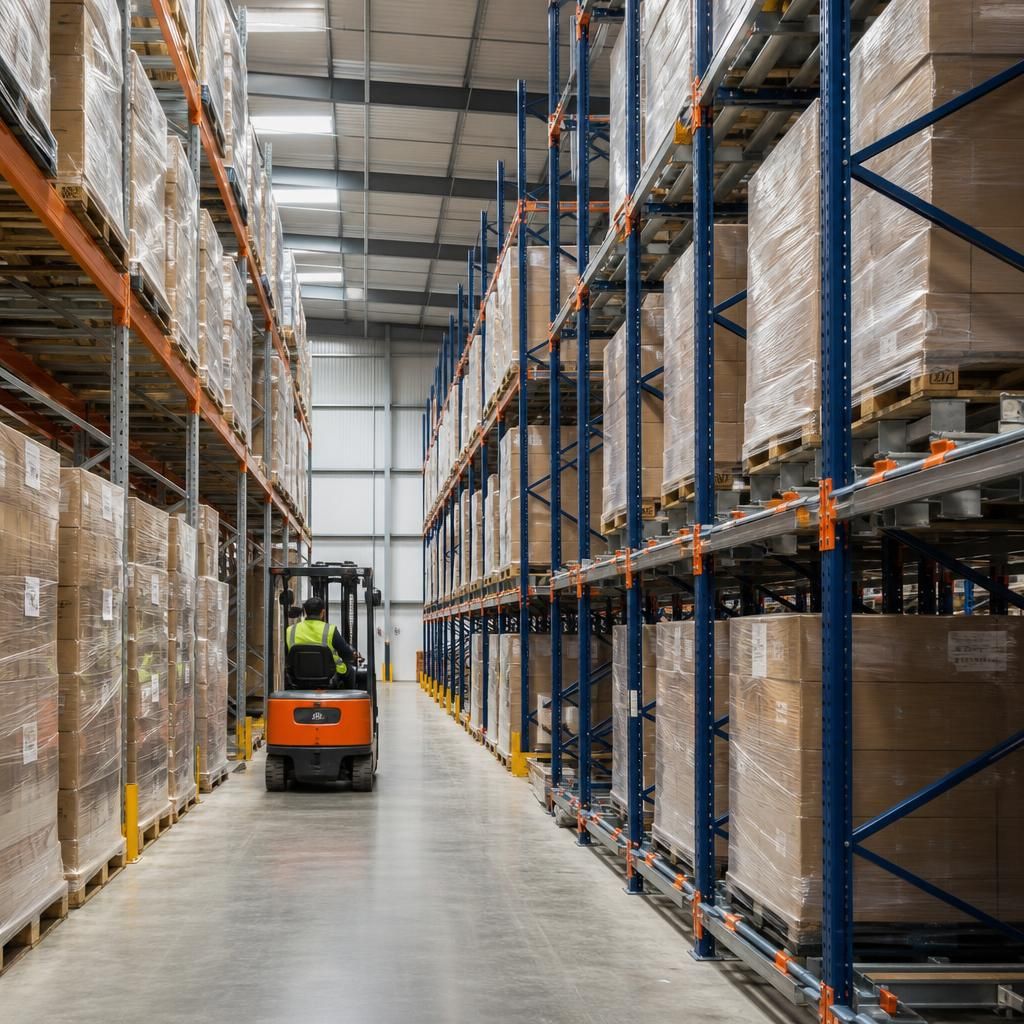
Selective pallet racking provides direct access to every pallet position, while push-back pallet racking stores pallets in deeper lanes accessed from one aisle. The main trade-off is between accessibility and storage density: selective systems suit varied stock and frequent individual pallet selection, whereas push-back systems make better use of space when several pallets of the same product can be stored together.
Push-back pallet racking normally requires pallets to be loaded and retrieved in sequence, with stored pallets moving forward as the front position is emptied. This can support efficient stock handling, but it may not suit strict first-in, first-out rotation or stock that must be selected independently. Selective pallet racking is generally more appropriate where product variety, batch control or immediate access is the priority.
Discuss the right pallet racking system for your warehouse
Discuss your warehouse’s product range, access requirements and storage density with Able Racking to identify whether selective or push-back pallet racking is the better fit. Our experienced team can also advise on layout, loading and safe operation.