
What equipment is necessary for operating very narrow aisle racking systems?
Operating very narrow aisle racking systems requires specialised very narrow aisle turret trucks or articulated forklift trucks, suitable pallets, aisle guidance equipment and trained operators. Appropriate safety equipment, including pedestrian protection, warning systems and inspection arrangements, is also essential to keep the warehouse racking safe, compliant and efficient.
Operating very narrow aisle racking systems safely and efficiently requires specialised materials-handling equipment, compatible pallets, aisle-guidance technology, suitable warehouse racking protection and properly trained operators. The central equipment choice is usually a very narrow aisle turret truck or an articulated forklift designed to place and retrieve loads at the required height without leaving the aisle.
Specialised forklift trucks
Conventional counterbalance trucks are generally unsuitable for very narrow aisles because they require more operating clearance and may not provide the reach, manoeuvrability or visibility needed for high-level storage. Depending on the layout, load profile and storage height, suitable options may include:
- Turret trucks, which rotate the forks to either side and allow pallets to be handled while the truck remains aligned within the aisle.
- Articulated forklifts, which use a jointed mast or chassis to manoeuvre in restricted spaces and may also operate in wider warehouse areas.
- Reach or specialised reach trucks, where the aisle width and storage arrangement allow their use.
The truck must be suitable for the pallet dimensions, load weight, lift height, floor condition and clearances specified in the warehouse racking design. Mast height, residual capacity, turning envelope, battery duration, visibility and the manufacturer’s operating restrictions should all be checked before procurement. A truck that can lift the required load in open space may have a lower effective capacity when operating at height or with the mast extended.
Aisle guidance and positioning equipment
Very narrow aisles commonly require a defined guidance system to keep the truck correctly aligned and reduce the risk of contact with the warehouse racking. Depending on the installation, this may include:
- Floor-mounted guide rails or channels.
- Inductive wire guidance installed in the floor.
- Laser, camera or sensor-based positioning systems.
- End-of-aisle markers, rack-location signs and clearly visible bay identification.
- Truck-mounted cameras, height indicators and load-positioning displays.
Guidance equipment should be maintained as part of the normal warehouse safety programme. Damaged rails, inaccurate sensors, poor aisle markings or defective cameras can affect positioning and increase the likelihood of impact. Operators should also know when to stop and report a guidance fault rather than attempting to continue manually.
Compatible pallets and load-handling accessories
Pallets must be the correct type and condition for the warehouse racking system and the selected truck. They should be dimensionally consistent, structurally sound and suitable for the intended load. Broken boards, protruding fasteners, excessive distortion, contamination and unstable loads can create problems when pallets are placed into narrow storage positions.
Depending on the goods, additional equipment may include fork extensions approved for the truck, load backrests, clamps, specialised fork arrangements or attachments for non-standard loads. Attachments alter the truck’s capacity and load centre, so their use must be approved by the truck manufacturer or a competent person and reflected in the operating instructions.
Battery, charging and communications equipment
Very narrow aisle trucks need a reliable power supply for the planned operating pattern. This may involve suitable batteries, approved chargers, battery-changing equipment and a designated charging area with appropriate ventilation and protection. Battery condition should be monitored because reduced power can affect lifting performance, braking, guidance functions and availability during a shift.
Two-way communication equipment, warehouse management system terminals and truck-mounted scanners can also help operators confirm locations and load movements. These systems support accuracy, but they do not replace clear bay labelling, physical checks or the operator’s responsibility to confirm that the location is safe before placing a load.
Warehouse racking protection and pedestrian controls
Protection should be selected for the actual truck movements and the points most exposed to impact. Depending on the layout, this may include upright guards, end-of-aisle barriers, guide rails, column protection, bollards and impact-resistant barriers. Protection must not reduce the clearances required by the truck or obstruct access to pallets, fire equipment or escape routes.
Where pedestrians work near the aisles, physical segregation is preferable to relying only on warning signs. Suitable controls may include pedestrian barriers, controlled crossing points, warning lights, audible alarms, mirrors and traffic-management signs. Emergency stops and other safety devices should be accessible, tested and clearly identified.
Inspection and maintenance equipment
Safe operation also depends on equipment used to identify defects. A daily truck check should cover tyres or wheels, forks, mast components, chains, brakes, steering, warning devices, lights, guards, batteries and guidance systems. Defects affecting safety should be reported immediately and the truck taken out of service where necessary.
The warehouse racking itself requires routine checks for impact damage, displaced components, missing safety pins, overloaded beams, damaged pallets and changes to the original configuration. A formal inspection by a competent person should be arranged at appropriate intervals, with findings recorded and corrective work prioritised. Repairs should use approved components and be completed by suitably qualified personnel; damaged warehouse racking should not simply be straightened or reused without assessment.
Operator training and personal protective equipment
Only operators who have received suitable training, undergone an assessment and been authorised for the specific truck should operate very narrow aisle equipment. Training should cover the truck controls, guidance system, load handling, operating clearances, pedestrian interaction, battery procedures, emergency arrangements and the limits of the warehouse racking system. Familiarisation is also needed when operators move between different truck types or materially different warehouse layouts.
Personal protective equipment is a supporting control rather than a substitute for good design and safe procedures. Depending on the risk assessment, this may include safety footwear, high-visibility clothing, head protection and task-specific gloves or eye protection. The required equipment should be kept in good condition and used in accordance with the site’s rules.
Before introducing or changing very narrow aisle equipment, confirm that the truck, guidance system, pallets, floor, warehouse racking and traffic arrangements work together as one system. Review clearances and load capacities, provide operator training, establish daily checks and maintain a documented process for reporting damage. This approach helps preserve warehouse racking safety, reduce avoidable interruptions and support ongoing compliance with applicable workplace transport, lifting equipment and storage-system requirements.
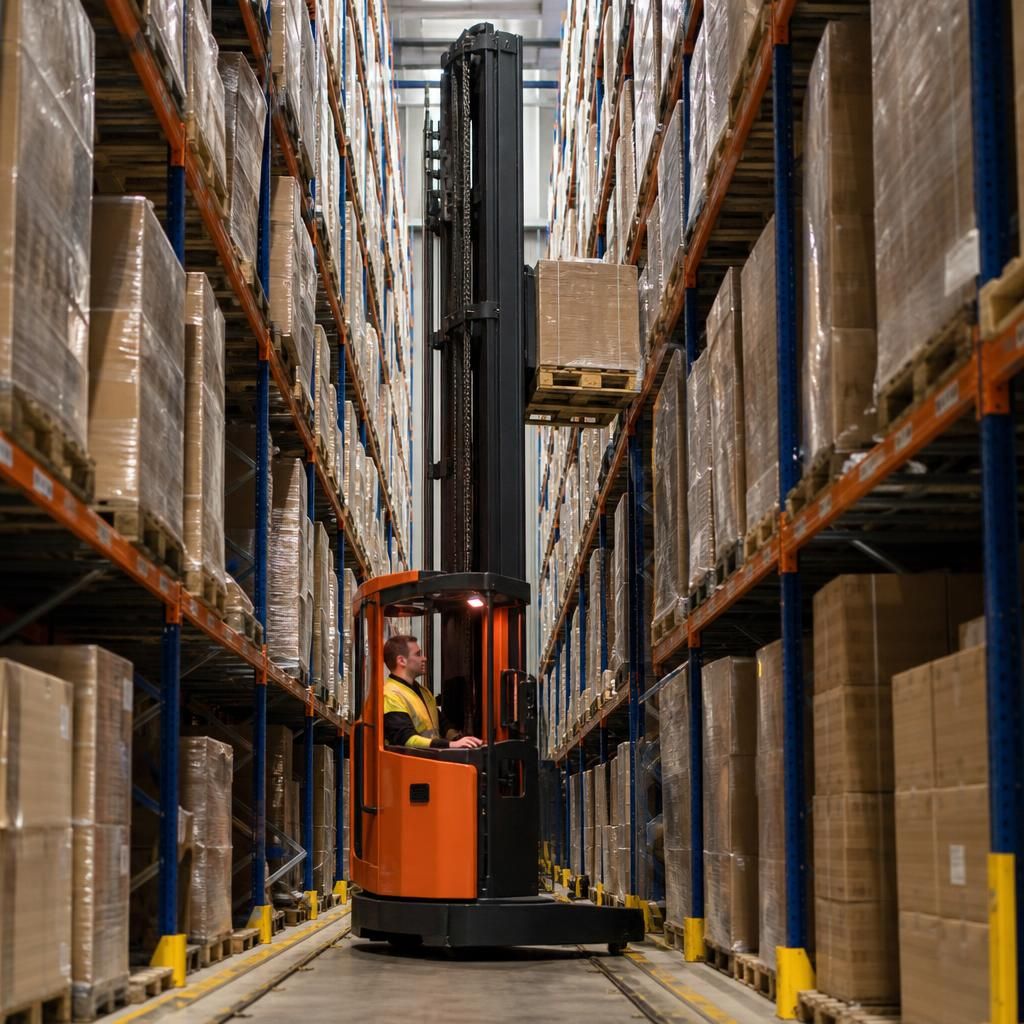
Very narrow aisle racking systems require a forklift truck designed for restricted clearances, high-level pallet handling and the specific aisle-guidance arrangement. Turret trucks and suitable articulated forklifts can keep the truck aligned while placing or retrieving pallets, whereas conventional counterbalance trucks may not have the necessary manoeuvrability or visibility.
Before selecting equipment, check its capacity at the intended lift height, load centre, pallet dimensions, turning envelope, floor conditions and aisle clearances. The truck, guidance system and warehouse racking must be assessed as one arrangement. Operators should also be trained to recognise damaged guide rails, inaccurate sensors, poor visibility or any change in clearance, and stop work until the fault has been reported and resolved.
Arrange a very narrow aisle racking safety review
Arrange a very narrow aisle warehouse racking safety review with Able Racking to check equipment suitability, clearances, protection and inspection arrangements. Contact our expert team to identify issues early and support safe, compliant warehouse operations.