
What equipment is necessary for operating narrow aisle and very narrow aisle racking systems effectively?
Narrow aisle and very narrow aisle warehouse racking systems require specialist lift trucks, such as reach trucks and articulated or turret trucks, matched to the aisle width, lift height and load requirements. Operators also need suitable pallets, battery-charging equipment, pedestrian protection, aisle guidance and safety inspection tools to keep the system efficient and compliant.
Operating narrow aisle and very narrow aisle warehouse racking systems effectively requires more than a suitable forklift. The equipment must be matched to the aisle width, storage height, pallet type, load weight, floor condition and method of operation. In practice, this usually includes reach trucks for narrow aisles, specialist turret or articulated trucks for very narrow aisles, compatible pallets, aisle guidance, battery-charging equipment, load protection and suitable inspection and maintenance tools.
Specialist lift trucks
The lift truck is the most important item of equipment because its dimensions and manoeuvrability determine whether operators can place and retrieve loads safely without striking the warehouse racking. The truck should be selected using the complete storage design rather than aisle width alone. Important considerations include:
- overall truck width and turning requirements;
- maximum lift height and the available building clearance;
- rated capacity at the required lift height and load centre;
- pallet dimensions, condition and entry direction;
- mast design, visibility and residual capacity;
- travel speed, braking performance and steering response; and
- the operator’s need to work from ground level or at height.
Equipment for narrow aisle systems
Reach trucks are commonly used in narrow aisle warehouse racking because their mast and forks can extend into the storage position while the truck remains within the aisle. They are suitable where the operator needs to collect and place pallets at different levels while retaining reasonable flexibility between aisles.
When choosing a reach truck, check that the manufacturer’s specifications reflect the actual pallet load, lift height and load centre. A truck that can lift a load in open space may have a lower effective capacity when the mast is raised or the load is positioned further forward. Visibility through the mast, fork adjustment and side-shift capability should also be assessed, as these features affect placement accuracy and the risk of contact with beams or frames.
Equipment for very narrow aisle systems
Very narrow aisle warehouse racking normally requires a truck designed to operate with limited lateral clearance. Turret trucks use rotating fork assemblies to place pallets on either side of the aisle without requiring the whole truck to turn towards the storage position. Articulated trucks use a jointed body and fork arrangement to achieve similar access in confined areas.
Some very narrow aisle operations use man-up trucks, where the operator’s position rises with the forks. These trucks can improve visibility and picking access at elevated levels, but they require suitable operator training, fall-protection arrangements and operating procedures. The truck must be compatible with the aisle layout, floor tolerances, guidance system and any pedestrian exclusion arrangements.
Very narrow aisle trucks should not be introduced simply because they are physically narrower. Their steering, guidance, lift controls and operating clearances must be assessed as part of the complete warehouse racking design. A competent supplier or warehouse designer should confirm the truck’s required aisle width and clearance before installation or alteration work begins.
Compatible pallets and load-handling equipment
Pallets must be suitable for both the warehouse racking and the selected truck. They should be strong enough for the intended load and supported correctly by the beams or other storage components. Damaged, distorted or incompatible pallets can create instability during travel and placement, particularly at higher storage levels.
Useful load-handling equipment may include adjustable forks, fork extensions where specifically permitted, clamps or other approved attachments, pallet positioners and containers designed for the stored goods. Attachments alter a truck’s capacity, visibility and load centre, so the truck data plate and operating instructions must reflect the configuration in use. Improvised extensions or attachments should never be used.
Loads should be evenly distributed, secured where necessary and kept within the pallet footprint. The load should not obscure the operator’s view or project into the travel path. Where visibility is restricted, the operating procedure should define the direction of travel, use of a trained banksman where appropriate and controls for pedestrian movements.
Aisle guidance and floor requirements
Very narrow aisle trucks often need a guidance system to maintain their position and prevent contact with the warehouse racking. Guidance may be provided by floor rails, wires or another system specified by the truck and warehouse design. The correct choice depends on the truck type, aisle arrangement, floor construction and required operational controls.
Guidance is only effective when the floor is suitable. Uneven surfaces, joints, damage, contamination or changes in floor level can affect truck stability, steering and braking. Before commissioning the system, the floor should be checked against the tolerances required by the truck manufacturer and the storage design. Any defects should be corrected or managed before routine operation.
Physical protection may also include end-of-aisle barriers, upright guards, column protection, guide rails and impact protection at vulnerable locations. These items should be positioned so that they protect the warehouse racking without creating additional trip hazards, obstructing fire routes or reducing the truck’s usable clearance.
Battery-charging and energy equipment
Electric trucks are widely used in narrow aisle and very narrow aisle environments because they produce no exhaust emissions inside the warehouse and can be controlled precisely. The charging arrangement must be suitable for the truck battery and the operating pattern. It may include:
- an appropriately rated charger and compatible connectors;
- a designated charging area with adequate ventilation and protection from vehicle impact;
- safe cable management to prevent trip and collision hazards;
- equipment for battery handling where batteries require removal; and
- procedures for charging, isolation, inspection and dealing with damaged batteries.
Charging areas should be kept clear of stored goods and ignition sources, with suitable emergency arrangements in place. Operators should follow the battery and charger manufacturer’s instructions rather than relying on a generic charging routine.
Safety and protection equipment
Effective operation also depends on equipment that controls interaction between trucks, pedestrians and stored loads. Depending on the site assessment, this may include pedestrian barriers, protected crossing points, mirrors, warning lights, audible reversing alarms, speed-control systems, traffic signs and clearly marked exclusion zones.
Warehouse racking protection should be selected for the likely impact points and maintained after installation. Upright guards, frame protectors, end barriers and backstops can reduce the consequences of minor contact, but they do not make collisions acceptable. Any impact should be reported and the affected area assessed before it is returned to service.
Operators should have suitable personal protective equipment for the task and environment, such as safety footwear and high-visibility clothing where required by the site assessment. Personal protective equipment is a final control and must not replace traffic management, truck training or physical separation.
Inspection, communication and maintenance equipment
Sites need a reliable way to identify defects and take equipment out of use. This can include daily truck checklists, pre-use inspection records, defect tags, isolation signage and a formal damage-reporting process. Defects may relate to forks, wheels, brakes, steering, mast components, guards, batteries, alarms or guidance equipment.
Warehouse racking should be subject to regular user checks, recorded formal inspections and prompt action where damage or unsafe conditions are found. Inspection equipment may include suitable lighting, access equipment and measuring tools, but inspections at height must be planned and carried out using safe access methods. Employees should not climb storage structures or use truck forks as an improvised platform.
Preventative maintenance should cover trucks, guidance systems, charging equipment, barriers and warehouse racking protection. Maintenance intervals should follow the manufacturer’s instructions, the operating environment and the findings from inspections. Repairs and adjustments should be completed by suitably competent people, with records retained.
Operator competence and system controls
The right equipment will not provide safe performance without trained operators and clear procedures. Operators should be trained and authorised for the specific truck type, attachments, working height and site layout. Additional instruction may be needed for very narrow aisle trucks, man-up operation, battery charging, pedestrian controls and emergency procedures.
Before the system is put into regular use, confirm that the truck, guidance equipment, pallets, floor, warehouse racking protection and traffic controls work together as intended. A practical commissioning check should cover aisle entry, pallet placement, retrieval, emergency stopping, pedestrian restrictions, visibility and access to escape routes.
Under UK workplace requirements, employers must ensure that work equipment is suitable, maintained and used by people with appropriate information, instruction and training. Lift trucks must be examined and maintained as required, while warehouse racking should be managed through a documented inspection and repair process. Keeping records of training, maintenance, examinations, damage reports and repairs provides evidence that the system is being actively controlled.
In summary, narrow aisle systems generally depend on correctly specified reach trucks and compatible pallets, while very narrow aisle systems usually require turret or articulated trucks with suitable guidance and tighter control of floor tolerances. Both arrangements also need load protection, pedestrian management, charging facilities, inspection processes and competent operators. Selecting each item as part of one integrated warehouse racking system is the most reliable way to maintain safe access, accurate pallet handling and efficient daily operation.
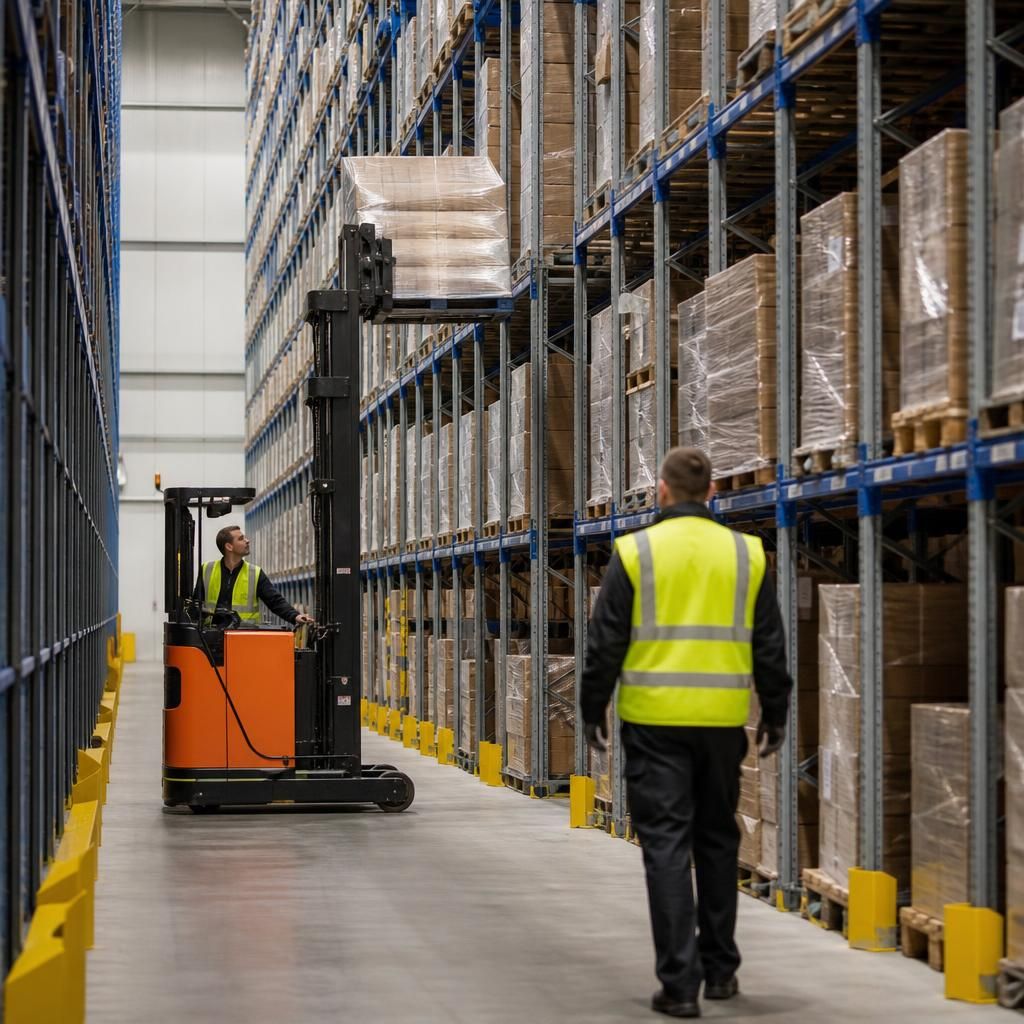
Very narrow aisle warehouse racking depends on accurate truck guidance and a floor that meets the equipment manufacturer’s specified tolerances. Floor rails, wire guidance or other approved systems help keep the truck correctly aligned, reducing the risk of contact with frames, beams and stored loads during travel and pallet placement.
Before operation begins, check the floor for uneven areas, damaged joints, contamination and changes in level that could affect steering, braking or stability. Guidance equipment, aisle barriers, upright protection and end-of-aisle protection should also be inspected regularly. Any impact or defect must be reported, assessed and repaired by a competent person before the affected area or truck is returned to service.
Arrange an expert narrow aisle equipment assessment
Arrange an expert narrow aisle equipment assessment with Able Racking to confirm that your trucks, guidance systems, pallets, floor and warehouse racking protection are correctly matched. Our experienced team can identify risks and recommend practical improvements for safer, more efficient operation.