
What factors should be considered when choosing between Drive-In, Push-Back, and Pallet Flow racking systems for your warehouse?
Choose between Drive-In, Push-Back and Pallet Flow racking by assessing available space, stock rotation requirements, selectivity, load characteristics, handling equipment, access needs and budget. Drive-In suits high-density storage of uniform products, Push-Back provides greater selectivity with efficient use of space, while Pallet Flow supports FIFO stock rotation and frequent loading and unloading.
The right choice depends on the balance between storage density, stock rotation, pallet selectivity, handling speed, available space and total operating cost. Drive-In warehouse racking is generally suited to high-density storage of large quantities of similar products. Push-Back warehouse racking offers better access to different stock lines while still using depth efficiently. Pallet Flow warehouse racking is usually the strongest option where stock must move on a first-in, first-out (FIFO) basis and pallets are loaded and retrieved frequently.
The most suitable system should be selected after considering how the warehouse operates in practice, rather than choosing solely on storage capacity. Product characteristics, order patterns, handling equipment, building constraints and safety requirements all affect the outcome.
Stock rotation and product life
Stock rotation is one of the clearest points of difference between the three systems.
- Drive-In warehouse racking typically operates on a last-in, first-out (LIFO) basis because pallets are loaded and retrieved from the same access point. This can work well for durable, non-perishable products where the order of retrieval is not critical.
- Push-Back warehouse racking also generally follows a LIFO process, with pallets stored at different depths and moved forwards as the front pallet is removed. It is useful where stock rotation matters less than storage density and product variety.
- Pallet Flow warehouse racking is designed to support FIFO operation. Pallets enter from the loading side, travel along flow lanes and are retrieved from the opposite side. This helps maintain rotation for products with expiry dates, batch controls or defined shelf lives.
Where products have strict date, batch or lot requirements, the consequences of choosing a LIFO system should be assessed carefully. A FIFO system may provide better control, but it requires suitable building access and a layout that separates loading and unloading activities.
Required selectivity
Selectivity means how easily an operator can reach a particular pallet without moving other stock. Drive-In warehouse racking provides lower selectivity because pallets are stored in lanes and access is generally limited to the lane ends. It is most effective when each lane contains the same product or a consistent batch.
Push-Back warehouse racking gives greater selectivity than Drive-In because several product lines can be held within the same run, with pallets positioned at different depths. However, the pallet at the front must normally be removed before those behind it can be accessed.
Pallet Flow warehouse racking provides direct access to the unloading face of each lane and supports a clear separation between replenishment and retrieval. It can therefore be particularly useful for busy picking operations or products that need a controlled rotation sequence.
Product range and pallet quantities
Consider both the number of stock-keeping units and the number of pallets held for each line. Drive-In warehouse racking is generally most productive where there are relatively few product lines with several pallets of each. Using a separate lane for each product or batch reduces the risk of mixing stock.
Push-Back warehouse racking is often more adaptable where there are more product lines and several pallets are held for each. It can accommodate a broader range of stock while retaining a compact footprint.
Pallet Flow warehouse racking works well where there is a steady replenishment and despatch cycle. The number and length of lanes should reflect actual demand, as oversized lanes can reduce clarity and smaller lanes may limit capacity.
Available floor area and building layout
Storage density is affected by more than the footprint of the warehouse. A proper assessment should include aisle widths, access routes, fire precautions, pedestrian segregation, loading areas, dispatch space, sprinkler clearances and the position of doors, columns and other obstructions.
Drive-In warehouse racking can reduce the number of access aisles, making efficient use of floor space. It requires a layout that allows handling equipment to enter the storage lanes safely and manoeuvre without damaging the structure or stored loads.
Push-Back warehouse racking also makes good use of depth while retaining dedicated loading faces. Pallet Flow warehouse racking may need access on both the loading and retrieval sides, which can increase the space required for circulation but can improve the movement of goods through the warehouse.
Handling equipment and operator working practices
The warehouse vehicles already in use, or planned for the future, must be compatible with the chosen system. Drive-In warehouse racking requires equipment and operators capable of entering storage lanes and positioning pallets accurately. Visibility, turning space, mast height, pallet condition and floor quality should all be checked.
Push-Back warehouse racking can reduce the need for vehicles to enter the structure, but operators still need accurate positioning when loading pallets onto the moving rails or carts. Pallet Flow warehouse racking generally allows loading and retrieval from separate faces, although the equipment must be suitable for the lane design and pallet specification.
Training is essential for every system. Operators should understand entry and exit procedures, loading limits, pallet placement, damage reporting and the site’s traffic management arrangements. Written procedures should reflect the actual equipment and layout rather than relying on generic guidance.
Pallet and load characteristics
Check that the pallets, loads and packaging are suitable for the proposed system. Important considerations include pallet dimensions, pallet quality, load weight, load stability, overhang, shrink-wrapping and the consistency of the underside of the pallet.
Drive-In warehouse racking places particular demands on pallet positioning because support rails and guide components must remain clear and correctly engaged. Push-Back warehouse racking depends on reliable movement of the carts or rails and consistent loading. Pallet Flow warehouse racking requires pallets to travel smoothly through the lanes without snagging, leaning or stopping unexpectedly.
Loads that are unstable, irregular or prone to deformation may need additional controls or a different storage approach. The system designer should verify the load data before installation and ensure that safe working load information is clearly displayed.
Throughput and operating priorities
Throughput is not simply a question of how many pallets can be stored. It also includes how quickly pallets can be replenished, picked, checked and dispatched without creating congestion.
- Choose Drive-In warehouse racking where the priority is dense bulk storage and stock is moved in planned batches.
- Choose Push-Back warehouse racking where the operation needs a balance between density and access to multiple stock lines.
- Choose Pallet Flow warehouse racking where goods move regularly from replenishment to despatch and controlled rotation is important.
Peak periods should be considered as well as average activity. A system that appears suitable during normal conditions may create queues or unsafe vehicle movements when inbound deliveries and outbound orders coincide.
Safety, inspection and maintenance
All warehouse racking should be designed, installed, used and maintained in accordance with applicable UK requirements and the supplier’s instructions. The assessment should cover structural capacity, impact protection, access controls, pallet condition, load signage and the condition of beams, frames, rails, guides, carts and other components.
Drive-In warehouse racking needs particular attention to upright frames, guide rails, entry points and damage caused by vehicle contact. Push-Back warehouse racking should be checked for the condition and movement of carts, rails, stops and loading components. Pallet Flow warehouse racking should be inspected for roller performance, lane alignment, brakes, separators and any obstruction that could prevent controlled pallet movement.
Damage should be reported immediately, affected areas isolated where necessary and repairs completed by competent personnel. Routine visual checks by trained employees should support, not replace, a properly managed inspection programme.
Budget and whole-life value
Initial purchase and installation cost is only one part of the decision. Compare the expected costs of handling equipment, floor preparation, protection, inspections, repairs, replacement components, training and future alterations.
A high-density system may reduce the building area needed for storage but increase the complexity of loading and retrieval. A system with better selectivity may use more space or require additional equipment while reducing handling time and stock-control issues. The most economical option is the one that supports the required operation safely over its working life, not necessarily the one with the lowest initial price.
A practical selection process
- List the products, pallet dimensions, load weights, batch controls and stock rotation requirements.
- Review inbound and outbound volumes, order profiles and periods of peak activity.
- Measure the usable building area, clear height, floor condition, obstructions and available access routes.
- Confirm the handling equipment, aisle requirements and operator competencies.
- Compare the storage density, selectivity, FIFO capability and expected throughput of each option.
- Assess protection, inspection, maintenance, repair and future expansion requirements.
- Obtain a layout and design checked against the actual loads, vehicles and working practices.
In broad terms, Drive-In warehouse racking is the better fit for dense, uniform stock with limited selectivity requirements. Push-Back warehouse racking is more appropriate where product variety and accessible depth need to be balanced. Pallet Flow warehouse racking is preferable where FIFO, regular movement and separate loading and retrieval faces are central to the operation. Where the warehouse handles different product groups, combining systems can be effective, provided each area has clear operating rules, suitable protection and an inspection and maintenance routine matched to its use.
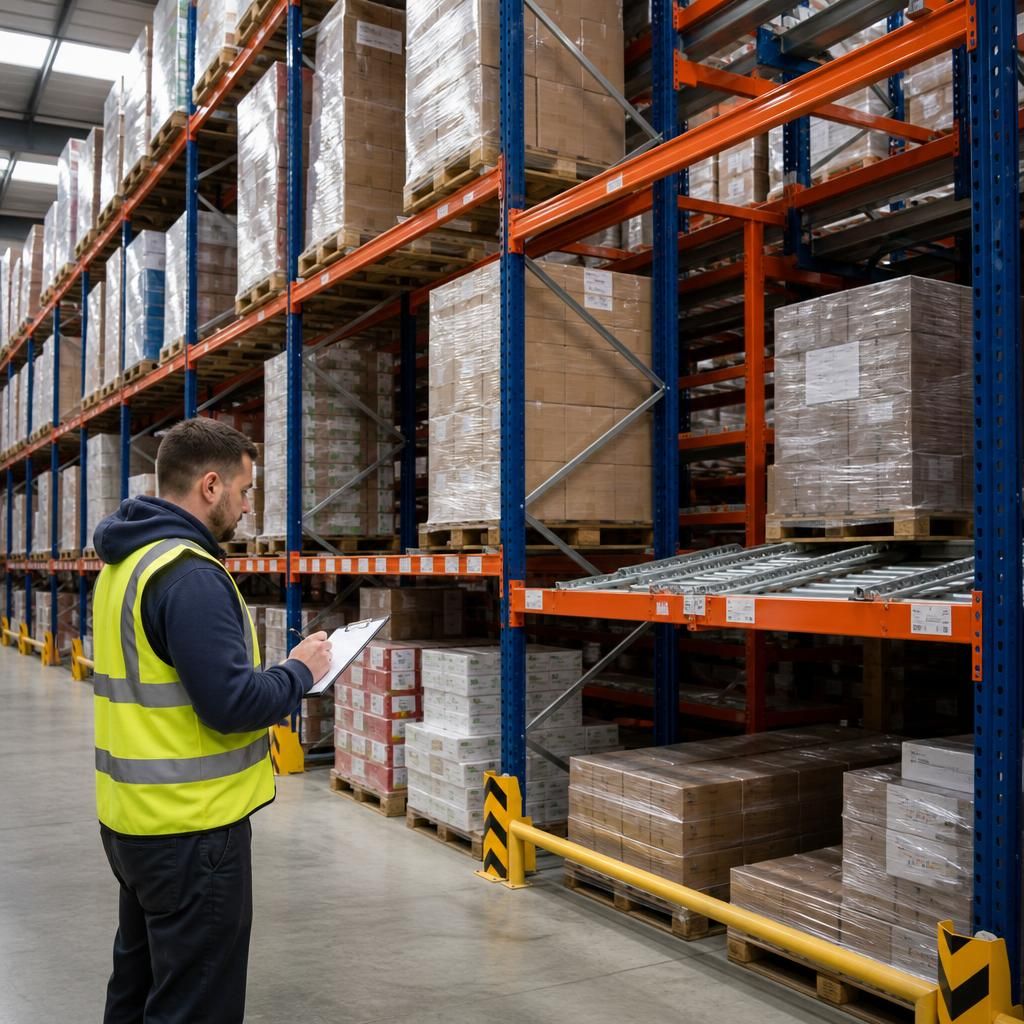
Stock rotation is a primary factor when choosing between Drive-In, Push-Back and Pallet Flow warehouse racking. Drive-In and Push-Back warehouse racking generally support last-in, first-out handling, while Pallet Flow warehouse racking is designed for first-in, first-out movement.
Choose Pallet Flow warehouse racking when products have expiry dates, batch controls or a defined shelf life and must be dispatched in sequence. Drive-In warehouse racking can be suitable for durable, uniform products stored in larger quantities, while Push-Back warehouse racking provides greater access to different product lines without requiring a separate aisle for every pallet position. Confirm the required rotation method against actual loading and despatch procedures before selecting the system.
Speak to Our Experts About Your Warehouse Racking Requirements
Speak to our experts about your warehouse racking requirements and receive practical guidance on selecting a system that suits your stock, handling equipment, available space and operating priorities.