
What considerations should be made when choosing between Push-Back and Pallet Flow racking systems?
Choosing between Push-Back and Pallet Flow warehouse racking depends on stock rotation requirements, pallet access, storage density, throughput and available budget. Push-Back suits dense storage where last-in, first-out access is acceptable, while Pallet Flow is preferable for first-in, first-out stock rotation and efficient loading and unloading.
Choosing between Push-Back and Pallet Flow warehouse racking depends mainly on stock rotation, pallet access, storage density, throughput, product characteristics and available space. Push-Back warehouse racking is generally suited to high-density storage where last-in, first-out access is acceptable, whereas Pallet Flow warehouse racking is designed for first-in, first-out rotation and a more controlled movement of pallets through each lane.
Stock rotation and product age
The most important consideration is whether stock must be picked in the order it arrives. Pallet Flow warehouse racking uses inclined roller tracks so pallets loaded at the replenishment side move towards the picking side. This supports first-in, first-out stock rotation, provided the system is loaded and picked correctly. It is particularly suitable for dated, batch-controlled, perishable or time-sensitive goods where older stock should be dispatched before newer stock.
Push-Back warehouse racking normally operates on a last-in, first-out basis. Each new pallet is loaded into the front of a lane and pushes the existing pallets further back. This makes it appropriate for products with a longer shelf life, consistent demand or no strict dispatch sequence. It may be unsuitable where pallets must be selected by age, batch or receipt date unless the operating process provides an alternative method of control.
Stock rotation should be assessed at SKU level rather than across the warehouse as a whole. Some product lines may require first-in, first-out handling, while others can be stored using last-in, first-out principles. In these circumstances, using both systems in clearly defined areas may provide a more practical solution than applying one system throughout the facility.
Storage density and available space
Both systems can provide denser storage than conventional selective warehouse racking because they reduce the number of individual access aisles required. Push-Back warehouse racking can make effective use of warehouse depth by storing multiple pallets behind the front position. It is often considered where floor space is limited and the business wants to increase pallet capacity without creating a separate picking aisle for every pallet position.
Pallet Flow warehouse racking also uses deep lanes, but the layout must accommodate separate loading and unloading faces. This can require more carefully planned floor space than a Push-Back arrangement, particularly where loading and picking activities need to take place simultaneously. The additional space may be justified where stock rotation and consistent goods movement are more important than achieving the highest possible density.
The available clear height, column positions, fire protection arrangements, door locations, pedestrian routes and vehicle manoeuvring areas should all be considered during the design. A system that appears suitable based only on pallet capacity may not work effectively if it restricts access, creates awkward traffic routes or leaves insufficient room for safe handling.
Access requirements and operating methods
Push-Back warehouse racking provides access from the front of each lane, with the stored pallets arranged behind one another. This can reduce travel between locations, but the operator may need to move the front pallet before reaching stock positioned further back. It is therefore best suited to environments where several pallets of the same product are stored together and complete lane access is not required at all times.
Pallet Flow warehouse racking separates replenishment from picking. This can support a one-way workflow, with pallets loaded at one side and retrieved from the other. It may help reduce congestion where replenishment and order picking are carried out by different teams or during different operating periods. The arrangement must, however, be supported by clear location labelling and disciplined loading practices so that the correct stock enters and leaves each lane.
Consider how often individual pallets need to be accessed, whether full pallets or cases are picked, and whether operators need access to several SKUs within the same lane. If individual pallet selectivity is more important than density, a different warehouse racking layout may be more appropriate for those products.
Throughput and handling equipment
Expected pallet movements should be compared with the operating characteristics of each system. Pallet Flow warehouse racking can support a steady flow between replenishment and dispatch areas, which may be beneficial for high-volume operations with predictable movement patterns. Flow tracks, rollers, guides and braking components must be selected for the pallet type, load weight and operating conditions.
Push-Back warehouse racking can offer efficient storage for multiple pallets of the same SKU, but loading and retrieval require the handling equipment to enter the front of the lane. The equipment type, lift height, turning space and mast clearance must be checked against the proposed layout. The system should not be selected without confirming that the trucks and attachments used on site can safely operate within the available clearances.
Where powered handling equipment is used, the design should account for operator visibility, impact risk and the need to keep vehicles away from pedestrian routes. Safe working procedures, suitable training and clearly defined traffic controls remain necessary regardless of which system is installed.
Pallet and product suitability
Pallet quality is especially important for Pallet Flow warehouse racking. Pallets must be compatible with the roller tracks and capable of travelling consistently without catching, tilting or stopping. Variations in pallet construction, damaged boards, protruding loads and inconsistent load distribution can affect performance. Product packaging should also withstand controlled movement through the lane.
Push-Back warehouse racking is similarly dependent on stable, correctly loaded pallets. Loads must remain secure when pushed into position and retrieved from the lane. Any overhang, damaged pallet or unstable load can increase the risk of obstruction or impact. A review should consider pallet dimensions, load weights, load centres and whether the stored goods can tolerate being positioned behind other pallets.
Safety, inspection and maintenance
Both systems require a suitable risk assessment, competent installation and planned inspection. Warehouse racking should be checked for impact damage, distorted frames, damaged beams, displaced components, missing safety pins and problems with guides, rollers, carts or braking equipment. Any defect that could affect structural integrity or safe operation should be reported and controlled promptly.
Pallet Flow warehouse racking needs particular attention to the condition and alignment of rollers, lane components, stops and speed-control devices. Push-Back warehouse racking requires checks on rails, carts, guides, retaining components and the condition of the working clearances. These checks should complement formal warehouse racking inspections and the site’s daily reporting arrangements.
Operators should know the correct loading and unloading sequence, the maximum permitted load, the approved pallet type and the action to take when a pallet does not move as expected. Unauthorised alterations, forcing pallets through a lane or using incompatible pallets can create avoidable risks and may affect the system’s performance.
Cost and whole-life value
The initial purchase price should not be the only financial consideration. Compare the cost of the structure, flow components, installation, handling equipment, floor preparation, protective measures, inspections, maintenance and any future changes to the operation. Pallet Flow warehouse racking may involve more specialist components, while Push-Back warehouse racking may offer a simpler arrangement for suitable products. The most cost-effective option is the one that meets the required stock rotation and throughput without creating inefficient handling or excessive maintenance demands.
It is also worth considering how easily the system can adapt to changes in SKU range, pallet dimensions, demand patterns and order profiles. A highly dense layout may provide good capacity but become less effective if product variety increases or if individual pallet access becomes more important.
How to reach the right decision
- Identify which products require first-in, first-out rotation and which can be managed on a last-in, first-out basis.
- Review pallet dimensions, weights, condition, load stability and compatibility with the proposed system.
- Measure required pallet capacity, current and expected throughput, access frequency and order profiles.
- Map vehicle movements, pedestrian routes, loading faces, picking faces, doors and emergency access.
- Confirm that existing handling equipment can operate safely within the proposed clearances and heights.
- Allow for inspection, maintenance, impact protection, operator training and future changes.
- Use a site-specific design review before committing to the final warehouse racking arrangement.
In practical terms, choose Push-Back warehouse racking when dense storage and front access are the priority and last-in, first-out handling is acceptable. Choose Pallet Flow warehouse racking when first-in, first-out rotation, separated loading and picking and controlled pallet movement are more important. Where product requirements differ, a carefully planned combination of both systems can provide the necessary balance between capacity, access and stock control.
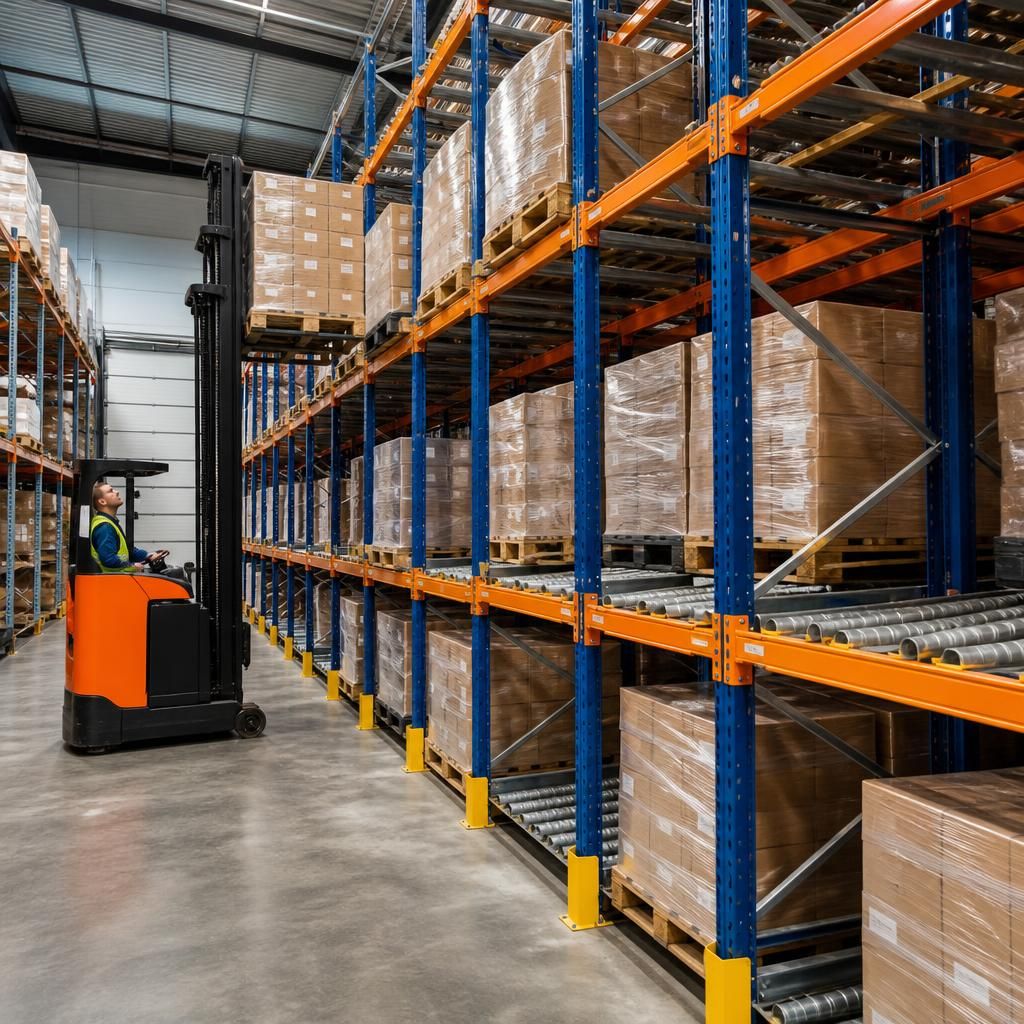
The main consideration when choosing between Push-Back and Pallet Flow warehouse racking is the required stock rotation method. Pallet Flow is designed for first-in, first-out movement, with pallets loaded at one end and retrieved from the other. This makes it suitable for dated, batch-controlled or time-sensitive goods where older stock should be dispatched first.
Push-Back warehouse racking normally provides last-in, first-out access, as newly loaded pallets move existing pallets further into the lane. It is often appropriate for products with a longer shelf life or consistent demand. Assess rotation requirements at SKU level, as using Pallet Flow and Push-Back in separate areas may provide better control than applying one system across the entire warehouse.
Discuss your Push-Back or Pallet Flow requirements
Discuss your Push-Back or Pallet Flow warehouse racking requirements with Able Racking to review stock rotation, access needs, pallet compatibility and available space. Our team can help assess the most suitable system for your operation.