
What are the key differences between Drive-In and Push-Back racking systems in warehouse management?
Drive-In racking prioritises maximum storage density by allowing forklifts to enter storage lanes, making it suited to high-volume products with limited variety and last-in, first-out (LIFO) stock rotation. Push-Back racking stores pallets on wheeled carts within each lane, offering faster access to multiple product lines, easier loading and unloading, and LIFO rotation with less forklift travel inside the system.
Drive-In and Push-Back racking systems both provide high-density warehouse storage, but they achieve it in different ways. Drive-In racking allows forklift trucks to enter storage lanes and place pallets on fixed rails, maximising capacity where there are relatively few product lines and stock rotation is less critical. Push-Back racking uses wheeled carts or platforms within each lane, allowing pallets to be loaded and unloaded from a single aisle while providing quicker access to several product lines. Both systems generally support last-in, first-out (LIFO) stock rotation, although their operating methods, access arrangements and suitability differ.
Storage design and operating principle
Drive-In racking creates deep lanes rather than individual pallet locations separated by multiple aisles. The forklift enters the lane, travels along the supporting rails and places the pallet in the furthest available position. When pallets are removed, the forklift normally retrieves the most recently loaded pallet first, working from the front of the lane backwards. This arrangement reduces the amount of aisle space required, but access inside the lane must be carefully controlled.
Push-Back racking also stores pallets several positions deep, but each lane contains carts or platforms that move along inclined rails. The forklift places a pallet on the front cart and gently pushes it backwards as further pallets are added. During unloading, the front pallet is removed and the remaining pallets roll forward into the available position. The forklift remains in the aisle rather than entering the storage lane, which can simplify daily handling and reduce travel inside the system.
Access and selectivity
The most significant practical difference is pallet selectivity. Drive-In racking is designed for dense storage of the same or similar stock, so the operator may need to remove pallets at the front of a lane before reaching a pallet further inside. This makes it less suitable where individual pallets from many product lines must be picked regularly.
Push-Back racking gives each lane a more distinct product allocation and allows several pallets of the same product to be stored behind one another. It remains a deep-storage solution, but operators can access the front pallet in a lane without driving into the structure. This generally makes it more suitable for warehouses handling a broader range of stock while still requiring high storage density.
Neither system provides the same individual pallet access as a selective pallet storage layout. The correct choice therefore depends on whether the priority is maximum density, product variety, handling speed or direct access to every pallet.
Storage density and aisle requirements
Drive-In racking can provide particularly high storage density because it reduces the number of aisles and uses the available height and depth of the building efficiently. It is often considered where floor space is restricted and large quantities of similar goods need to be held together.
Push-Back racking also reduces aisle demand compared with many conventional storage arrangements, although its carts, rails and operating clearances occupy space within each lane. The system can offer a useful balance between density and accessibility. The actual capacity depends on the building layout, pallet dimensions, load weights, forklift specification, clearances and the required number of product lines.
A layout should not be selected on theoretical capacity alone. The available aisle width, turning space, fire protection provisions, loading patterns and room for safe pedestrian movement all affect how much usable capacity the warehouse achieves in practice.
Stock rotation and product suitability
Drive-In racking normally operates on a LIFO basis. This can suit durable, non-perishable products, seasonal goods, batch storage and stock that is moved in relatively large quantities. It is less suitable where the oldest pallet must be picked first, unless the layout and operating process are specifically designed to support a different rotation method.
Push-Back racking also normally follows LIFO because the last pallet loaded is positioned at the front of the lane. It can be effective for products with a reasonable shelf life, reserve stock and operations where batch control is more important than strict first-in, first-out (FIFO) rotation. If stock age, expiry dates or batch sequence must be controlled closely, the storage method should be reviewed before installation rather than relying on warehouse staff to compensate for a system’s natural operating pattern.
Forklift movement and handling
Drive-In racking requires forklift operators to enter the structure. This calls for accurate positioning, suitable truck dimensions, controlled speeds and consistent loading procedures. Operators need clear visibility of the rails and uprights, particularly when working at height or placing pallets in deep lanes. Poor alignment can damage supporting components or pallets and may obstruct subsequent handling.
With Push-Back racking, the forklift operates from the aisle and pushes pallets along the carts. This can reduce the amount of truck movement within the storage structure and may make loading and unloading quicker for suitable products. However, operators must place pallets centrally, avoid sudden impacts and ensure that loads are compatible with the cart and rail arrangement. Incorrect loading can affect pallet movement and create unsafe conditions.
Safety and maintenance considerations
Both systems require a properly engineered design, suitable load information and disciplined operating controls. The structure must be protected from impact wherever forklift traffic creates a foreseeable risk. Clear load notices should identify the permitted configuration, and any change to beam levels, pallet type, load weight or equipment should be assessed before it is introduced.
Drive-In systems require particular attention to rail condition, upright frames, bracing, entry guides and damage caused by forklift contact inside the lanes. The condition and positioning of pallets also matter because damaged pallets may not sit securely on the rails.
Push-Back systems require checks of the carts, wheels, rails, stops, guides and the condition of the loading surfaces. These moving components should remain free from obstructions and operate smoothly. In both systems, damaged components should be reported promptly, the affected location should be made safe and repairs should be completed by a competent person. Warehouse teams should carry out regular visual checks, supported by a more detailed scheduled inspection and a documented repair process.
Cost and installation factors
The purchase and installation cost of either system depends on its dimensions, load requirements, number of lanes, protection measures, access equipment and the complexity of the building. Drive-In racking may have a simpler storage mechanism, but it can require more careful operational control because forklifts enter the lanes. Push-Back racking includes carts and moving components, which can increase the initial specification and introduce additional maintenance requirements.
The meaningful comparison is the total operating value rather than the equipment price alone. Consider the cost of lost capacity, forklift travel, handling time, product damage, stock rotation errors, inspections, repairs and any disruption during installation. A system that offers slightly less theoretical density may be more efficient if it gives operators safer and faster access to the stock they handle most often.
Which system is usually the better choice?
- Choose Drive-In racking when maximum density is the main objective, product variety is limited, pallets are stored in substantial batches and LIFO rotation is acceptable.
- Choose Push-Back racking when high density is still important but the warehouse needs easier access to multiple product lines, less forklift travel within the structure and more flexible lane-by-lane handling.
- Review another storage arrangement when every pallet needs direct access, strict FIFO rotation is essential or stock is frequently picked in small quantities.
The final decision should be based on a survey of the warehouse rather than on system names alone. Review pallet sizes and weights, product turnover, batch requirements, forklift characteristics, available height, aisle constraints, expected future changes and the condition of any existing storage equipment. A competent design and installation team can then confirm the appropriate layout, protection and operating requirements.
For an existing installation, a warehouse racking inspection can identify damage, overloading, unsuitable alterations and defects affecting safe use. Routine reporting, prompt repairs and refresher training for forklift and warehouse staff are particularly important for deep-storage systems, where damage or poor loading can affect more than one pallet position. This preventative approach helps maintain compliance, protect stock and keep the selected warehouse racking system performing as intended.
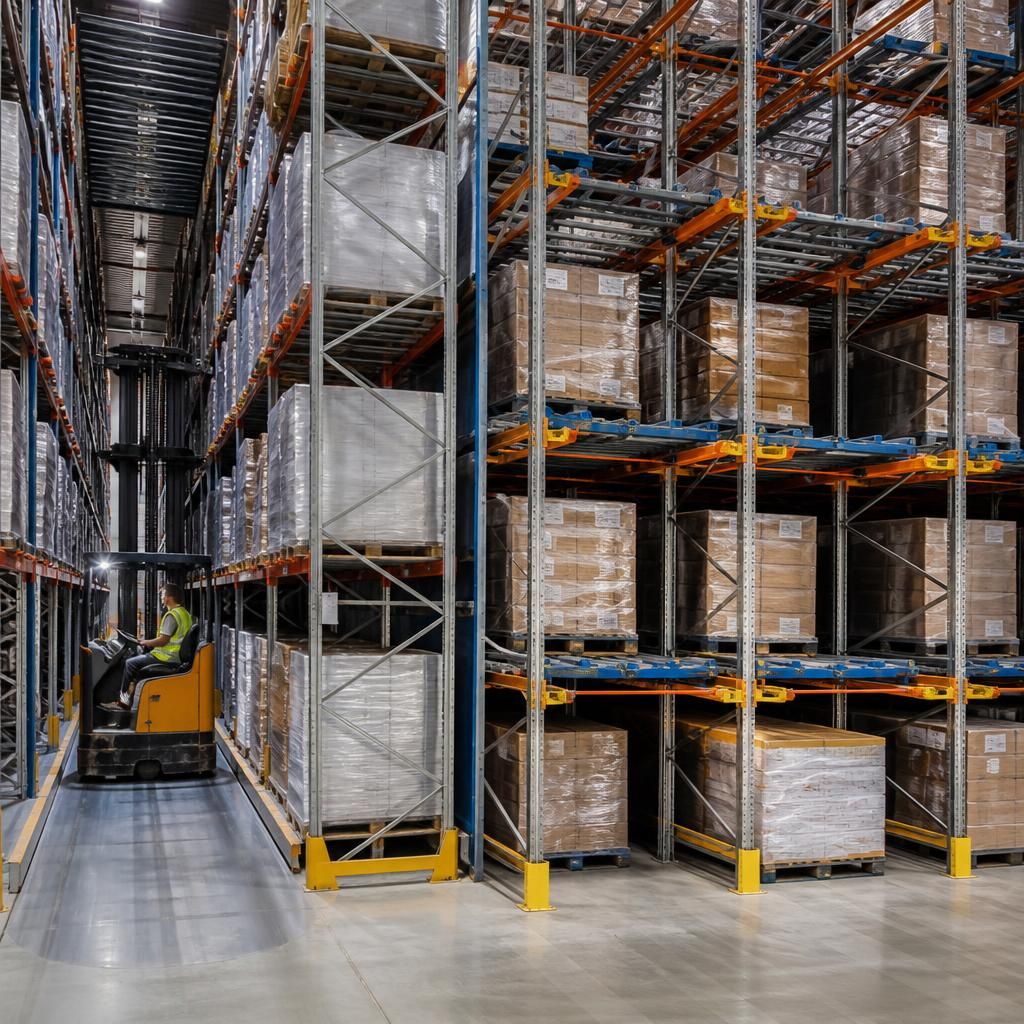
Drive-In and Push-Back warehouse racking systems both provide high-density pallet storage, but their operating methods differ. Drive-In storage allows forklift trucks to enter deep lanes, making it suitable for large quantities of similar products where maximum capacity is the priority. Push-Back storage uses carts on inclined rails, so forklifts remain in the aisle while pallets are pushed into position.
This difference affects access, handling and maintenance. Drive-In systems require accurate forklift movement inside each lane and careful checks of rails, entry guides, uprights and pallet condition. Push-Back systems offer easier front access to each lane, but carts, wheels, rails and stops must remain clear and operate correctly. Both systems generally use LIFO stock rotation, so neither is ideal where strict FIFO control or direct access to every pallet is essential.
The most suitable option depends on pallet dimensions, product variety, turnover, load weights, available aisle space and handling equipment. A warehouse racking survey can confirm whether the proposed layout, protection and operating controls are appropriate before installation or alteration.
Arrange a Warehouse Racking Assessment
Arrange a warehouse racking assessment to review whether your Drive-In or Push-Back system is correctly configured, safely maintained and suitable for your stock and handling requirements. Our experienced team can identify damage, loading concerns and practical improvements before they affect operations.