
How does combining Drive-In, Push-Back, and Pallet Flow racking systems enhance warehouse efficiency?
Combining Drive-In, Push-Back and Pallet Flow racking systems enhances warehouse efficiency by matching each storage method to the product’s turnover rate, stock volume and rotation requirements. This approach maximises available space while supporting high-density bulk storage, accessible last-in-first-out stock and first-in-first-out stock flow, reducing unnecessary handling and travel.
Combining Drive-In, Push-Back and Pallet Flow racking systems enhances warehouse efficiency by assigning each storage method to the stock profile it handles best. Drive-In supports high-density storage of larger quantities of similar products, Push-Back provides selective access with efficient last-in, first-out movement, and Pallet Flow supports controlled first-in, first-out rotation. Used as part of one warehouse racking strategy, these systems can increase space utilisation, reduce unnecessary handling and improve stock flow without forcing every product into the same storage format.
Match the system to the stock profile
The main efficiency gain comes from separating products according to demand, quantity, rotation requirements and handling frequency. A warehouse can reserve Drive-In racking for stable, high-volume stock where many pallets of the same product are stored together. Push-Back racking is more suitable where several product lines need compact storage but operators still require access to individual stock lanes. Pallet Flow racking is appropriate for products with defined dates, batches or expiry considerations, where the oldest suitable pallet should be presented for picking first.
- Drive-In racking: high-density storage for relatively uniform products, particularly where stock variety is limited and frequent direct access is not required.
- Push-Back racking: compact, multi-pallet storage that allows products to be loaded and retrieved from the same aisle while maintaining access to separate lanes.
- Pallet Flow racking: dynamic storage in which pallets move through the lane under controlled conditions, supporting first-in, first-out stock rotation.
This division prevents inefficient use of accessible storage positions. Fast-moving or date-sensitive goods do not need to be placed in a dense system designed for bulk holding, while slower-moving reserve stock does not occupy premium locations intended for regular picking.
Improve space utilisation
Drive-In racking can reduce the amount of aisle space required because operators enter the storage structure to load and retrieve pallets. This makes it valuable for bulk storage and helps a warehouse use its available footprint more effectively. Push-Back racking also uses depth to store several pallets behind one another, but it generally offers greater product selectivity than Drive-In because separate lanes can be allocated to different stock lines.
Pallet Flow racking uses gravity-assisted movement to bring pallets towards the picking face. Although it requires suitable lane design and clear access for loading and unloading, it can reduce the need for repeated forklift travel into the storage structure. Combining these systems means that high-density areas can be used for reserve stock while the most frequently accessed products remain positioned where replenishment and picking are straightforward.
Space planning must consider more than the number of pallet positions. The design should account for aisle widths, forklift movements, loading and unloading points, pedestrian routes, fire protection requirements, stock visibility and safe working clearances. A layout that maximises theoretical capacity but creates congestion or difficult access will not deliver genuine operational efficiency.
Separate reserve storage from picking activity
A combined warehouse racking layout can establish a clear relationship between reserve stock and picking stock. Drive-In racking may hold larger reserve quantities, while Push-Back or Pallet Flow racking can position selected products closer to the dispatch or order assembly area. Replenishment can then take place according to defined triggers rather than through ad hoc movements across the warehouse.
For example, a business may use Drive-In racking for full-pallet reserve stock, Push-Back racking for products requiring access to several batches or lines, and Pallet Flow racking for order-picking stock that must rotate in date order. This arrangement can reduce double-handling and make it easier for operators to understand where each category of product belongs.
Support the correct stock rotation method
Stock rotation is a key reason to combine these systems rather than rely on one format throughout the warehouse. Drive-In and Push-Back racking commonly operate on a last-in, first-out basis because pallets are loaded and retrieved from the same side. This is suitable only where product characteristics, batch controls and business procedures allow that sequence.
Pallet Flow racking is designed for first-in, first-out movement. Pallets are loaded at the replenishment side and travel towards the picking side, helping the earlier pallet reach the collection point first. The system can therefore support goods that have shelf-life restrictions or where batch rotation is important. It does not remove the need for correct labelling, date checks and disciplined loading procedures, but it provides a physical flow that reinforces those controls.
Where stock must follow a specific rotation rule, the warehouse process should make that rule clear. Product identification, location coding, warehouse management system records and operator training should all reflect whether each lane is being managed as first-in, first-out or last-in, first-out storage.
Reduce travel and handling
Efficiency is also affected by how far operators travel and how often pallets are moved. Frequently picked products should be located according to demand and order profiles, with Pallet Flow racking often suited to orderly picking faces. Push-Back racking can hold reserve or secondary lines where compact access is useful. Drive-In racking can be positioned for planned bulk movements rather than routine individual-pallet picking.
Clear allocation reduces unnecessary transfers between storage areas. It also helps operators choose the appropriate equipment and handling method for each task. Loading a deep Drive-In lane, replenishing a Pallet Flow lane and retrieving from Push-Back racking each require different operating techniques. Standard work instructions should cover approach, pallet placement, speed, braking, lane capacity and the sequence for removing stock.
Coordinate the systems through warehouse procedures
The three systems work most effectively when they are managed as one stock-flow plan. Location codes should identify the storage type, product category and rotation requirement. A warehouse management system can help direct put-away, replenishment and picking, but the digital instruction must match the physical characteristics of each lane.
- Assign products to storage based on demand, volume, rotation and handling requirements.
- Set clear replenishment rules for moving stock from dense reserve areas to picking locations.
- Use location labels and product identification that are visible from the relevant operating aisle.
- Keep first-in, first-out lanes supplied from the correct end and prevent mixed or incorrectly sequenced pallets.
- Review locations when product demand, packaging, pallet dimensions or order profiles change.
Good coordination also prevents a common source of lost efficiency: using a storage system outside its intended purpose. A high-density Drive-In lane may become difficult to manage if too many product lines are mixed within it. A Push-Back lane may lose its benefit if operators continually relocate pallets to reach stock. A Pallet Flow lane may not perform correctly if pallets are damaged, incompatible with the rollers or loaded without regard to the lane sequence.
Protect efficiency through safe operation and maintenance
Warehouse efficiency depends on safe, reliable equipment. Damage to frames, beams, guides, rails, rollers, bracing or protective components can restrict access, slow movements and create a serious risk of collapse or falling loads. Each system should therefore be included in the warehouse’s inspection and maintenance arrangements, with damage reported immediately and affected locations controlled until they have been assessed.
Operators should carry out routine visual checks and follow the site’s reporting procedure, while a competent person should complete formal warehouse racking inspections at the required intervals. Inspections should consider impact damage, deflection, missing components, loose fixings, loading signs, pallet condition, lane obstructions and evidence that the system is being used outside its design parameters. Repairs should be completed using suitable components and methods rather than improvised alterations.
Training should be specific to the equipment in use. Forklift operators and warehouse teams need to understand the differences between entering Drive-In lanes, loading Push-Back positions and replenishing or picking from Pallet Flow lanes. They should also know the safe working load limits, permitted pallet types, pedestrian controls and emergency reporting process. Consistent training reduces avoidable damage and helps preserve the capacity and flow built into the layout.
Measure the combined layout against operational requirements
The right assessment is not simply how many pallets the warehouse can hold. Review whether orders are picked in the required sequence, whether replenishment keeps pace with demand, whether forklifts can move without congestion, whether stock remains traceable and whether operators can work safely. It is also useful to review empty locations, blocked lanes, repeated pallet movements, product damage and stock rotation errors.
Where the balance between systems is no longer suitable, the remedy may be to reallocate products rather than replace the entire warehouse racking installation. Changes in demand can make a former reserve location a picking location, or make a Pallet Flow lane unsuitable for a product with a different pallet specification. Periodic reviews, supported by inspection findings and operational data, allow the storage plan to remain aligned with the business.
In practice, the most efficient combination is the one that gives each product a clear home, a suitable rotation method and a safe, repeatable movement route. Drive-In, Push-Back and Pallet Flow racking are complementary systems: together they can balance density, selectivity and stock flow, provided the layout, procedures, equipment, inspections and training are designed around the way the warehouse actually operates.
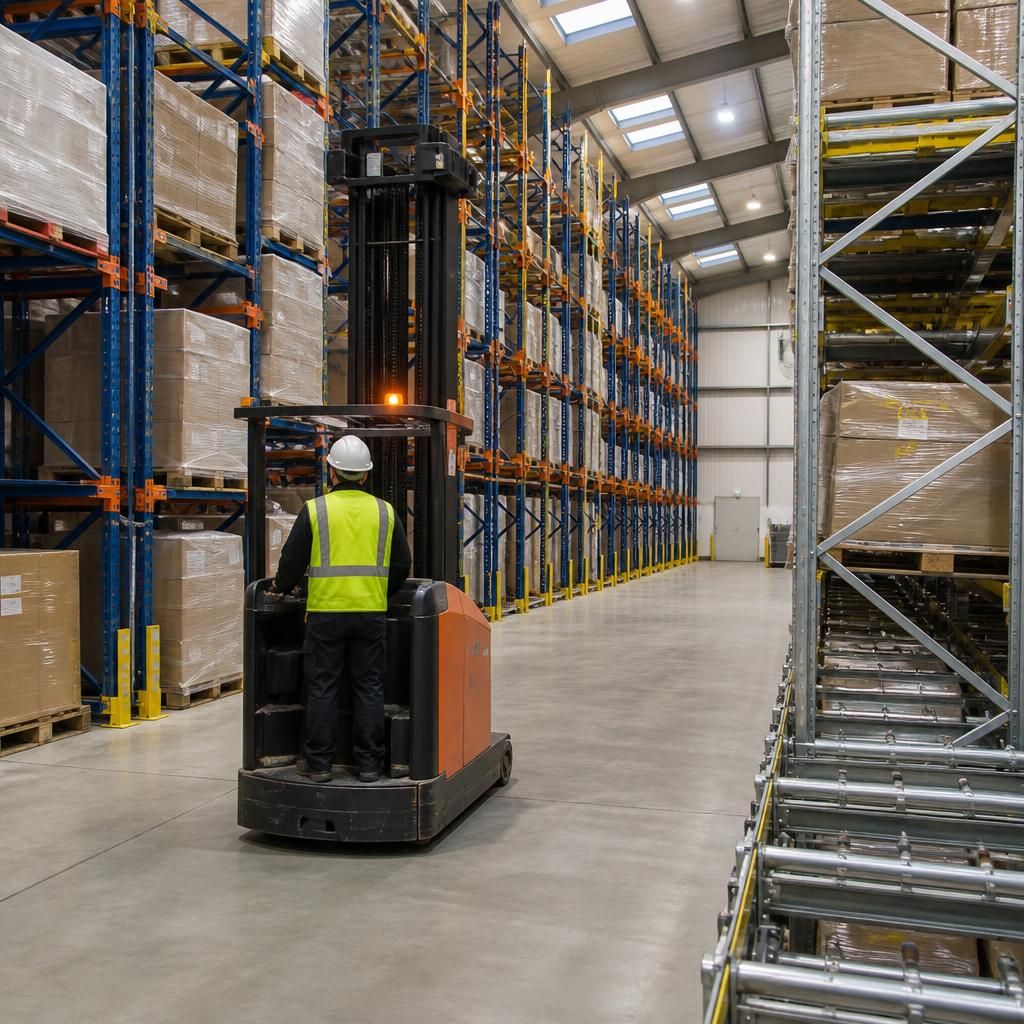
Combining Drive-In, Push-Back and Pallet Flow warehouse racking systems improves efficiency by assigning each product to the storage method that matches its volume, access and rotation requirements. Drive-In is suited to dense bulk storage, Push-Back provides compact access to multiple product lines, and Pallet Flow supports controlled first-in, first-out movement.
This planned division reduces unnecessary pallet movements and helps keep picking activity separate from reserve stock. It also gives operators clearer loading, replenishment and retrieval procedures, provided that pallet compatibility, safe working loads, location labels and inspection requirements are managed consistently across the warehouse racking layout.
Plan a more efficient warehouse racking layout
Review your combined Drive-In, Push-Back and Pallet Flow warehouse racking layout with Able Racking to confirm that storage density, stock rotation, access and safe working requirements remain properly aligned. Contact our experienced team to arrange an expert inspection or discuss practical improvements to your warehouse racking systems.