
What are the primary advantages of implementing automated racking systems in a warehouse?
Automated racking systems use powered equipment and control software to store and retrieve goods with limited manual handling. Their primary advantages include higher storage capacity, improved stock accuracy, faster warehouse operations and enhanced workplace safety when properly designed, installed and maintained.
Automated racking systems combine warehouse racking, powered handling equipment and control software to store and retrieve goods with limited manual intervention. Their primary advantages are increased storage capacity, more efficient use of floor space, faster and more consistent throughput, improved stock accuracy, reduced manual handling and stronger control over warehouse safety. These benefits depend on selecting a system that suits the building, inventory and operating processes, then maintaining it correctly.
Better use of available space
Automation allows goods to be stored at greater height and in more densely arranged storage locations than may be practical with manually operated systems. Automated vehicles, cranes or shuttle equipment can work within narrower operating aisles, reducing the amount of floor area allocated to access routes. This can create additional capacity within an existing warehouse and may delay the need to expand or relocate.
Space efficiency is not simply a matter of fitting in more pallet positions. The system must account for building height, floor tolerances, fire protection, loading requirements, access for maintenance and the dimensions and weights of the goods. A properly designed solution balances storage density with safe access, reliable operation and future flexibility.
Faster and more consistent handling
Automated equipment can carry out repetitive storage and retrieval movements at a predictable pace. The control system directs each transaction, helping to reduce delays caused by searching for stock, travelling between locations or relying on manual decisions. This is particularly useful where the warehouse processes frequent pallet movements, operates extended hours or handles goods that must be picked in a consistent sequence.
Automation can also support more orderly goods-in and despatch processes. Stock can be directed to defined locations, retrieved according to agreed rules and presented at a workstation or transfer point. However, the achievable throughput must be calculated from actual operating requirements, including peak demand, goods presentation, equipment travel times and the number of loading and unloading points.
Improved inventory accuracy and traceability
Automated systems record where goods are placed and retrieved, linking movements with warehouse management or inventory control software. This reduces dependence on handwritten records and memory, while making it easier to identify stock locations and review transaction histories. Accurate location data can reduce search time, picking errors and unnecessary stock adjustments.
These advantages are strongest when product identification, labelling, scanning and system rules are reliable. Automation cannot correct inaccurate master data or poorly controlled processes by itself. Stock dimensions, weights, batch information and handling restrictions must be maintained accurately so that the system can make safe and appropriate storage decisions.
Reduced manual handling and improved working conditions
Automated storage and retrieval can remove people from repetitive travel, lifting and work in high-level or restricted-access areas. This may reduce exposure to vehicle movements, awkward handling tasks and other avoidable workplace risks. Operators can instead work at controlled goods presentation points or manage system functions from safer locations.
Automation does not remove the need for competent personnel. Safe operating procedures, access controls, emergency arrangements and suitable training remain essential. Any area where people and automated equipment may interact requires carefully designed guarding, interlocks and isolation procedures. Staff must understand how to respond to faults without entering hazardous areas or bypassing protective systems.
More predictable use of labour and operating resources
By taking over repetitive movements, an automated system can help a warehouse deploy its people towards tasks that require judgement, quality checking, exception handling or customer service. It can also provide a more consistent operating pattern during busy periods, although labour is still required for goods-in, despatch, replenishment, system supervision, maintenance and resolving exceptions.
The financial case should therefore consider the complete operation rather than equipment alone. Energy consumption, software integration, service agreements, spare parts, training, planned downtime and contingency arrangements all affect the long-term value of the installation.
Greater control over safety and system performance
A designed automated environment can restrict unauthorised access, control movement through defined zones and provide alarms when an abnormal condition is detected. Sensors and software may identify blocked locations, equipment faults or load-related issues before normal operation continues. This creates useful operational visibility, but electronic monitoring must complement physical inspections and competent safety checks.
Warehouse racking remains a safety-critical structure even when access and handling are automated. Loads must be compatible with the design, components must be protected from damage and any impact, deformation or unusual movement must be reported promptly. Regular inspections, planned maintenance and documented repairs help preserve the structural and operational integrity of the installation. Changes to loads, layout, equipment or software settings should be assessed before implementation rather than treated as routine adjustments.
Important implementation conditions
The advantages of automation are most likely to be achieved when the project begins with a detailed assessment of:
- the quantity, dimensions, weights and turnover of the goods;
- required storage capacity, throughput and peak operating demand;
- building height, floor condition, environmental conditions and available services;
- integration with warehouse management, enterprise and identification systems;
- fire safety, guarding, emergency access and maintenance requirements;
- future changes in product range, order profiles and operating hours; and
- inspection, training, repair and business-continuity arrangements.
Automation is not automatically the best choice for every warehouse. A system may be unsuitable where product profiles change frequently, demand is highly irregular or the required flexibility outweighs the benefits of density and repeatability. A detailed operational and technical review should compare automated and conventional options before a commitment is made.
In summary, automated warehouse racking can provide more usable capacity, controlled stock movements, reliable inventory information, reduced manual handling and consistent throughput. Its performance and safety depend on sound design, accurate data, trained operators, compatible loads and continuing inspection and maintenance. Treating automation as an ongoing warehouse system rather than a one-off equipment purchase is essential to protecting these advantages.
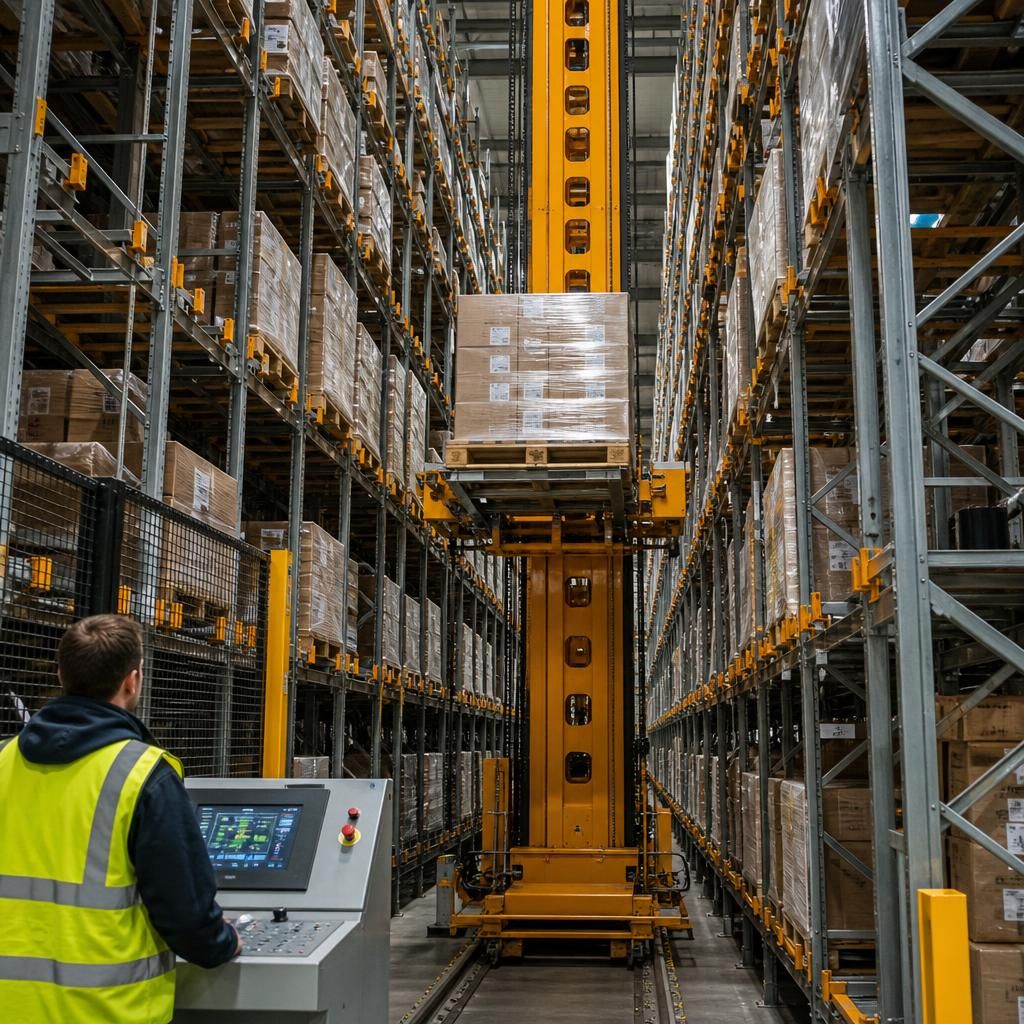
One of the main advantages of automated racking systems is reduced manual handling. Powered cranes, shuttles or transfer equipment can move goods between storage locations and controlled workstations, limiting the need for operators to travel through aisles, lift loads repeatedly or work at height.
This can improve working conditions and help reduce exposure to vehicle movements and other handling risks. It does not remove the need for competent staff: guarding, access controls, emergency procedures, isolation arrangements and regular inspections remain essential. Loads, components and protective systems must be checked routinely so that faults or damage are identified before they affect safe operation.
Review Your Automated Racking Requirements
Review your automated warehouse racking requirements with Able Racking to confirm that the proposed system supports your storage capacity, throughput, safety and maintenance needs.