
What are the main types of automated racking systems?
The main types of automated warehouse racking systems are automated storage and retrieval systems (ASRS), shuttle racking, automated mobile racking and automated pallet handling systems. Each uses powered equipment, controls or software to store and retrieve goods with less manual handling, and the right option depends on load type, throughput, available space and operational requirements.
The main types of automated warehouse racking systems are automated storage and retrieval systems (ASRS), shuttle racking, automated mobile warehouse racking and integrated automated pallet-handling systems. These solutions use powered machinery, sensors, control software or a combination of these technologies to store and retrieve goods with less manual intervention. The most suitable system depends on the load, storage density, throughput, building layout, stock rotation and level of integration required.
Automation does not describe one standard warehouse racking arrangement. It can range from powered movement of warehouse racking through automated mobile bases to a fully integrated system in which software directs cranes, shuttles, conveyors and picking equipment. Understanding the differences is important when planning a new installation or upgrading an existing operation.
Automated storage and retrieval systems
Automated storage and retrieval systems, commonly called ASRS, use computer-controlled equipment to place goods into storage locations and retrieve them when required. A typical pallet-based ASRS uses stacker cranes operating in the aisles of high-bay warehouse racking. The crane travels vertically and horizontally, collects a pallet and delivers it to an input or output point.
ASRS can also be designed for smaller loads. Mini-load systems use cranes or shuttles to handle totes, cartons, trays or other containers. These systems are often used where a business needs accurate, repeatable access to a large number of individual stock-keeping units rather than full pallets.
Key features of ASRS include:
- Computer-controlled storage and retrieval movements.
- High-density use of available warehouse height and floor space.
- Stock location tracking through warehouse control or warehouse management software.
- Consistent handling, reducing reliance on manual travel and searching.
- Defined input and output points for pallet, tote or carton movement.
ASRS is suited to operations with regular throughput, controlled stock profiles and a clear requirement for traceability. It requires careful planning because the warehouse racking, loads, cranes, conveyors, software and safety systems must operate as one coordinated installation. Load dimensions, pallet quality, floor tolerances, clearances and access for maintenance all need to be assessed before installation.
Shuttle warehouse racking systems
Shuttle warehouse racking uses powered shuttle units to move pallets or containers within storage lanes. Instead of a forklift entering every lane, a shuttle travels along rails inside the lane and places or retrieves the load. The shuttle is normally instructed by a remote control system or warehouse software, while a forklift or conveyor transfers loads to and from the lane entrance.
Pallet shuttle systems are particularly useful for high-density storage and operations handling repeated groups of the same or similar products. They can be configured for first-in, first-out stock rotation where access from both ends is available, or last-in, first-out storage where goods are loaded and retrieved from the same side. The required stock rotation method should be established during the design stage.
Shuttle warehouse racking can reduce forklift travel inside storage lanes and may improve use of the available storage footprint. However, it remains important to consider pallet condition, lane depth, load compatibility, battery management, radio communication, access for inspection and the consequences of equipment downtime. The warehouse racking must be checked for suitability, including rail alignment, beam condition, clearances and protection from impact.
Automated mobile warehouse racking
Automated mobile warehouse racking is built on powered bases that move along floor rails. The system opens an access aisle only where it is needed, allowing warehouse racking runs to be positioned closely together when access is not required. This can increase storage density compared with fixed aisle layouts, although the final capacity depends on the building, load dimensions, fire strategy, access requirements and operating procedures.
Mobile warehouse racking may be controlled from a local panel, remote device or warehouse management system. Some installations simply automate aisle positioning, while others connect the movement of the bases with picking, access control and inventory software. It is therefore useful to distinguish between powered movement and full storage automation: mobile warehouse racking can reduce manual effort without independently retrieving every load.
Safety controls are central to this type of system. Emergency stops, presence detection, light barriers, interlocks and controlled access help prevent movement when a person or obstruction is detected. Safe operating procedures, routine inspections and planned maintenance are also necessary, particularly where the system is used continuously or in areas with frequent forklift traffic.
Automated pallet-handling systems
Automated pallet-handling systems combine warehouse racking with conveyors, transfer cars, pallet lifts, robotic vehicles or other powered equipment. Their purpose is to move pallets between receiving, storage, production, picking and despatch areas with limited manual handling.
A pallet-handling installation may include:
- Conveyors that transfer pallets between process areas.
- Vertical lifts that move pallets between levels.
- Transfer cars that move loads across warehouse aisles.
- Automated guided vehicles or autonomous mobile robots that transport loads.
- Robotic palletisers and depalletisers for repetitive handling tasks.
- Barcode, radio-frequency identification or vision systems for load identification.
These systems are often integrated with pallet warehouse racking and an automated control system. Software determines where a load should go, confirms whether the route is available and records the movement. Integration can improve visibility and reduce unnecessary travel, but the interfaces between equipment need to be tested carefully. A fault in a conveyor, sensor or software connection can affect several connected processes, so contingency procedures and maintenance access should be designed from the outset.
Robotic and goods-to-person warehouse racking systems
Goods-to-person systems bring stock to a picking station instead of requiring an operative to walk to each storage location. They may use shuttle technology, robotic vehicles, automated lifts, tote storage or a combination of these arrangements. The operative works at a controlled station while the system presents the required carton, tote or container.
This approach is different from goods-to-person pallet storage, where full pallets are automatically delivered to a production or despatch point. The correct design depends on the unit load, order profile, picking accuracy requirements and replenishment process.
Goods-to-person automation can be effective where there are many small items, frequent order lines or a need to reduce walking distances. It must still provide suitable access for replenishment, stock checks, cleaning, fault recovery and planned maintenance. Storage locations should be clearly identified, and software settings must match the physical arrangement of the warehouse racking.
How the main types compare
- ASRS: Best suited to highly controlled, repeatable storage and retrieval, often involving high-bay pallet warehouse racking or tote storage.
- Shuttle warehouse racking: Suited to dense lane storage where repeated pallet movements are required and forklift entry into lanes should be limited.
- Automated mobile warehouse racking: Suitable where space efficiency is important and access aisles need to be created only when required.
- Automated pallet handling: Suitable for linking storage with receiving, production, picking and despatch processes.
- Goods-to-person systems: Suitable for smaller items and order-picking operations where reducing operative travel is a priority.
These categories are not mutually exclusive. A warehouse may use automated mobile warehouse racking for dense reserve storage, shuttle equipment for fast-moving pallets and conveyors or robotic vehicles to connect storage with despatch. The system should be designed around the complete material flow rather than selected solely on storage density.
Important design and safety considerations
Before choosing an automated warehouse racking system, assess the characteristics of the goods and the way they move through the operation. Relevant factors include pallet and container dimensions, maximum load weight, stock rotation, temperature, product fragility, order frequency and required access. The anticipated throughput should be compared with the capacity of the equipment, software and operator interfaces.
The existing building also requires a detailed review. Floor condition and levelness, clear heights, column positions, fire protection, lighting, loading access and pedestrian routes can all affect the design. Any connection to existing warehouse racking must be checked by a competent person to confirm that the structure, clearances and protection arrangements remain appropriate.
Automation introduces additional safety considerations, including moving machinery, restricted access zones, stored energy, emergency recovery and interaction with forklifts or pedestrians. Risk assessments, guarding, interlocks, emergency stops, isolation procedures and operator training should be in place before the system is used. Regular inspections and preventative maintenance help identify damage, misalignment, wear or control faults before they affect safe operation.
The best automated warehouse racking system is therefore the one that matches the complete operational requirement, not simply the system offering the highest theoretical density. A detailed site assessment can establish whether the priority is storage capacity, retrieval speed, stock accuracy, reduced travel, labour efficiency or improved process control, and can identify the warehouse racking inspections, maintenance and training needed to support safe long-term performance.
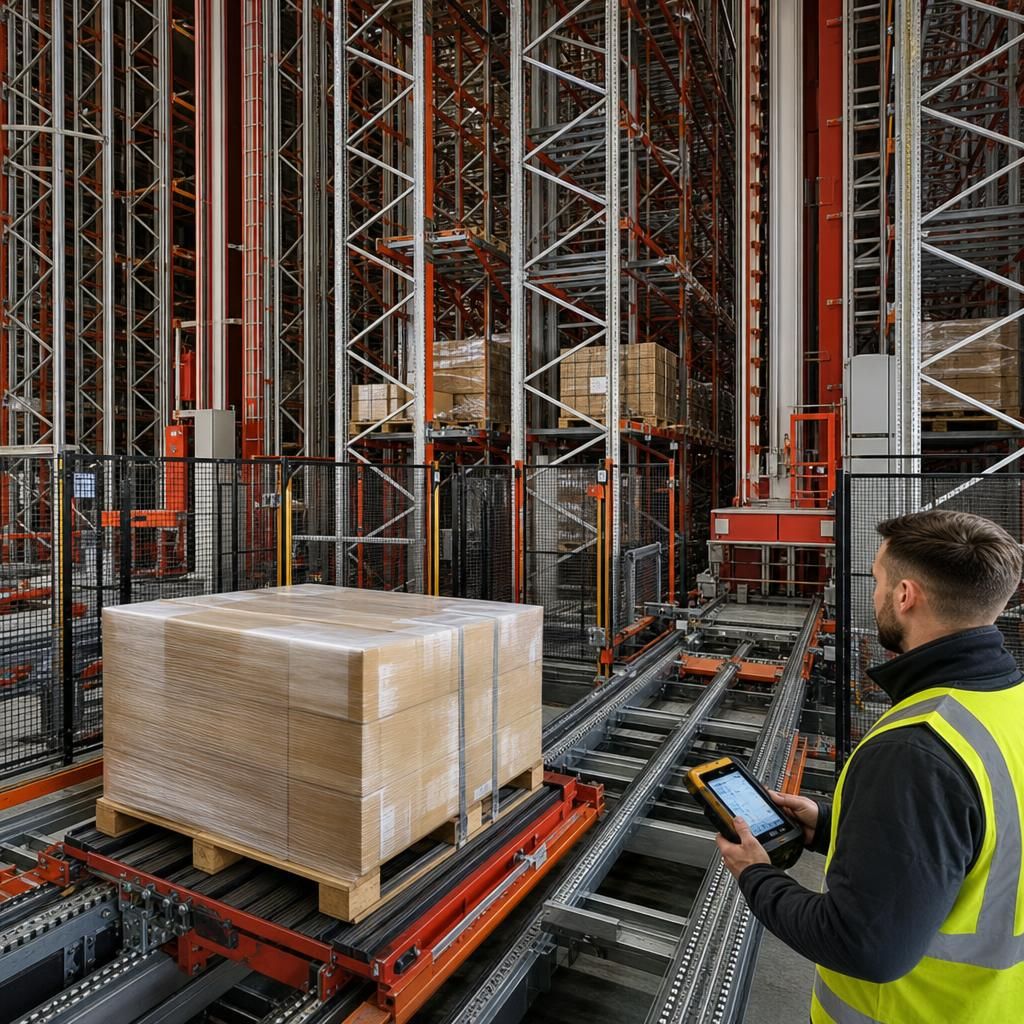
Automated warehouse racking systems combine storage structures with powered equipment and control software to move goods with limited manual handling. The main options include crane-based storage and retrieval, shuttle warehouse racking, powered mobile warehouse racking and integrated pallet-handling systems.
The appropriate system depends on the load, required throughput, stock rotation, available space and the level of integration needed with conveyors or warehouse software. Safety must also be considered from the design stage, including guarding, emergency stops, access controls, isolation procedures and safe routes for people and vehicles.
Before installation or modification, the building, floor condition, clearances, pallet quality and existing warehouse racking should be assessed by a competent person. Planned inspections and preventative maintenance help identify impact damage, wear, misalignment and control faults before they affect safe operation.
Discuss your automated warehouse racking requirements
Discuss your automated warehouse racking requirements with Able Racking to review your storage layout, load types, operating processes and safety needs.