
What are the key considerations when implementing automated racking systems?
Implementing automated racking systems requires careful assessment of warehouse layout, storage requirements, load characteristics, safety controls, system integration, maintenance needs and whole-life costs. A suitable solution should improve space use and handling efficiency while remaining compliant, accessible for servicing and compatible with your existing warehouse operations.
Choosing and implementing automated racking systems requires a structured assessment of your storage requirements, warehouse building, handling processes, safety controls, software, maintenance arrangements and whole-life costs. The right system should improve space utilisation and throughput without creating access, compliance or serviceability problems.
Automation is not a single solution. Depending on the operation, it may involve automated storage and retrieval equipment serving pallet racking, shuttle technology, conveyors, cranes, robotic vehicles or a combination of systems. The most suitable arrangement depends on the goods being stored, the required operating speed and how the warehouse needs to function now and in the future.
Define the operational objective first
Begin by identifying the problem the automated racking system must solve. This may be a shortage of floor space, a requirement for higher throughput, reduced manual handling, improved stock accuracy or more consistent order fulfilment. Establishing the objective prevents automation from being selected simply because it is technically available.
- Assess current and expected pallet movements, order profiles and peak demand.
- Identify whether the priority is dense storage, rapid access, accurate stock control or a balance of these requirements.
- Consider operating hours, shift patterns and the level of resilience required if part of the system is unavailable.
- Allow for future changes in product range, volumes, packaging and customer service expectations.
Analyse the goods and load characteristics
Automated equipment must be compatible with the loads it handles. Review pallet dimensions, weights, condition, stability and consistency. Loads that vary significantly may require different storage locations, additional restraints or manual intervention. Damaged pallets, overhanging products and unstable wrapping can affect equipment reliability and create safety risks.
Products should also be assessed for their handling characteristics. Temperature, moisture, dust, corrosive substances, fragile packaging and hazardous classifications can influence the specification of the equipment, sensors and protective measures. Stock rotation requirements are important too, as first-in, first-out and last-in, first-out processes place different demands on the system.
Check the warehouse layout and building suitability
The available building envelope must be surveyed before a design is confirmed. Floor condition, level tolerances, clear height, columns, doors, loading areas, escape routes and existing services can all affect the layout. Automated equipment generally requires accurate alignment and predictable travel paths, so floor flatness and load-bearing capacity need to be verified rather than assumed.
- Confirm that the proposed system fits within the usable height and footprint.
- Review floor loading, slab condition and any restrictions affecting foundations or fixing points.
- Allow clear space for installation, inspection, repairs and the safe removal of components.
- Protect fire exits, emergency routes, electrical equipment and other essential building services.
- Consider vehicle movements, pedestrian segregation and the relationship between storage, picking and dispatch areas.
Building alterations, planning requirements, fire precautions and landlord restrictions should be identified early. A design that maximises storage density but prevents safe access to equipment or compromises emergency arrangements is not a practical solution.
Select the appropriate automation method
The choice between automated pallet storage, shuttle-based systems, crane-served storage, conveyors, robotic vehicles or a hybrid arrangement should be based on the operating profile rather than on equipment type alone. High-density systems may suit products held in larger quantities, while systems requiring frequent individual access may need a different configuration.
Compare each option against access selectivity, storage density, throughput, flexibility, recovery procedures and maintenance requirements. It is also important to establish what happens when the system is operating at peak capacity, when a particular location is inaccessible or when a manual override is needed.
Plan software and system integration
Automated racking systems depend on reliable communication between warehouse management software, warehouse control software and the mechanical equipment. Before implementation, define how stock is received, identified, stored, retrieved, counted and released for despatch.
- Confirm the required interfaces with existing warehouse, enterprise resource planning and order management systems.
- Define data ownership, stock-location rules and procedures for correcting discrepancies.
- Check barcode, label, scanner and sensor compatibility.
- Test exception handling, including damaged loads, failed scans, blocked locations and urgent retrievals.
- Establish cybersecurity, user permissions, backup and business continuity arrangements.
Integration should be tested using realistic operating scenarios before the system goes live. A technically sound installation can still underperform if the software rules do not reflect actual warehouse processes.
Build safety into the design
Safety must be considered at the design stage, not added after installation. The completed system should have suitable guarding, access controls, emergency stops, interlocks, warning signs and safe isolation arrangements. The design should also separate people from moving equipment wherever reasonably practicable.
A suitable risk assessment should consider normal operation, loading and unloading, cleaning, inspection, fault recovery, planned maintenance and foreseeable misuse. Operators and maintenance personnel need clearly defined procedures for entering restricted areas, isolating energy sources and responding to alarms.
The warehouse racking itself must remain suitable for the applied loads and operating conditions. Load notices, protection, visible damage reporting and inspection arrangements remain important even when retrieval and handling are automated. Automation does not remove the need for competent warehouse racking inspections or prompt action when damage is identified.
Design and installation should be reviewed against applicable UK legislation, relevant guidance and the manufacturer’s instructions. Depending on the system, this may include requirements relating to work equipment, machinery safety, workplace transport, fire safety, electrical installations and safe access. Competent specialists should confirm the precise obligations for the site and equipment selected.
Consider maintenance, inspection and availability
Automated systems contain mechanical, electrical and software components that require planned care. Obtain a clear maintenance schedule before committing to the installation. It should identify inspection tasks, service intervals, consumable parts, software support, response arrangements and the competence required for each activity.
- Confirm how faults will be diagnosed and how quickly support can be provided.
- Identify critical components and their expected availability.
- Provide safe access for engineers without exposing them to unnecessary risks.
- Set out procedures for isolating equipment and returning it to service.
- Continue periodic warehouse racking inspections and damage reporting alongside equipment maintenance.
Planned preventive maintenance is generally easier to manage than relying on reactive repairs. Maintenance records should be retained, and recurring faults should be investigated rather than repeatedly reset. The service plan should also explain the expected operating condition of the system after maintenance and who is responsible for verification.
Prepare employees and operating procedures
Automation changes how warehouse teams receive goods, respond to faults and carry out routine checks. Operators should be trained in normal controls, alarms, emergency procedures, safe access restrictions and manual recovery processes. Supervisors need to understand system limitations and escalation arrangements.
Written procedures should cover receiving, storage, retrieval, stock discrepancies, damaged loads, equipment isolation, emergency access and restart after a stoppage. Training should be refreshed when software, equipment or working practices change. Clear communication is particularly important during commissioning, when temporary manual processes may operate alongside the new system.
Assess total cost rather than purchase price
The financial assessment should include the complete life-cycle cost of the solution. In addition to equipment, installation and software, allow for surveys, building works, electrical supplies, safety measures, testing, training, maintenance, spare parts, energy use and future modifications.
Compare the likely benefits with the costs of operating the current arrangement. Consider released floor space, labour requirements, stock accuracy, throughput, damage reduction and the financial effect of downtime. A lower initial cost may not represent better value if the system is difficult to maintain, cannot be expanded or is poorly matched to the load profile.
Use a controlled implementation process
A reliable implementation normally includes a site survey, requirements specification, concept design, risk assessment, detailed design, installation plan, testing, operator training and handover. Responsibilities should be agreed between the equipment supplier, software provider, building owner, warehouse operator and any specialist contractors.
- Validate the operational data and confirm the design assumptions.
- Survey the building and existing warehouse racking before finalising the layout.
- Agree safety controls, interfaces and acceptance criteria.
- Test software and equipment using representative loads and operating scenarios.
- Complete commissioning, documentation and training before normal operation.
- Monitor performance after launch and correct emerging issues promptly.
Where possible, plan installation work around warehouse activity and define temporary storage and traffic arrangements. The handover should include drawings, load information, operating instructions, inspection records, maintenance schedules and details of approved modifications.
Finally, review the system regularly after implementation. Changes to pallet types, product weights, software, traffic routes or warehouse racking can affect safety and performance. Ongoing inspections, competent maintenance and accurate records help ensure the automated racking system remains safe, compliant and effective throughout its working life.
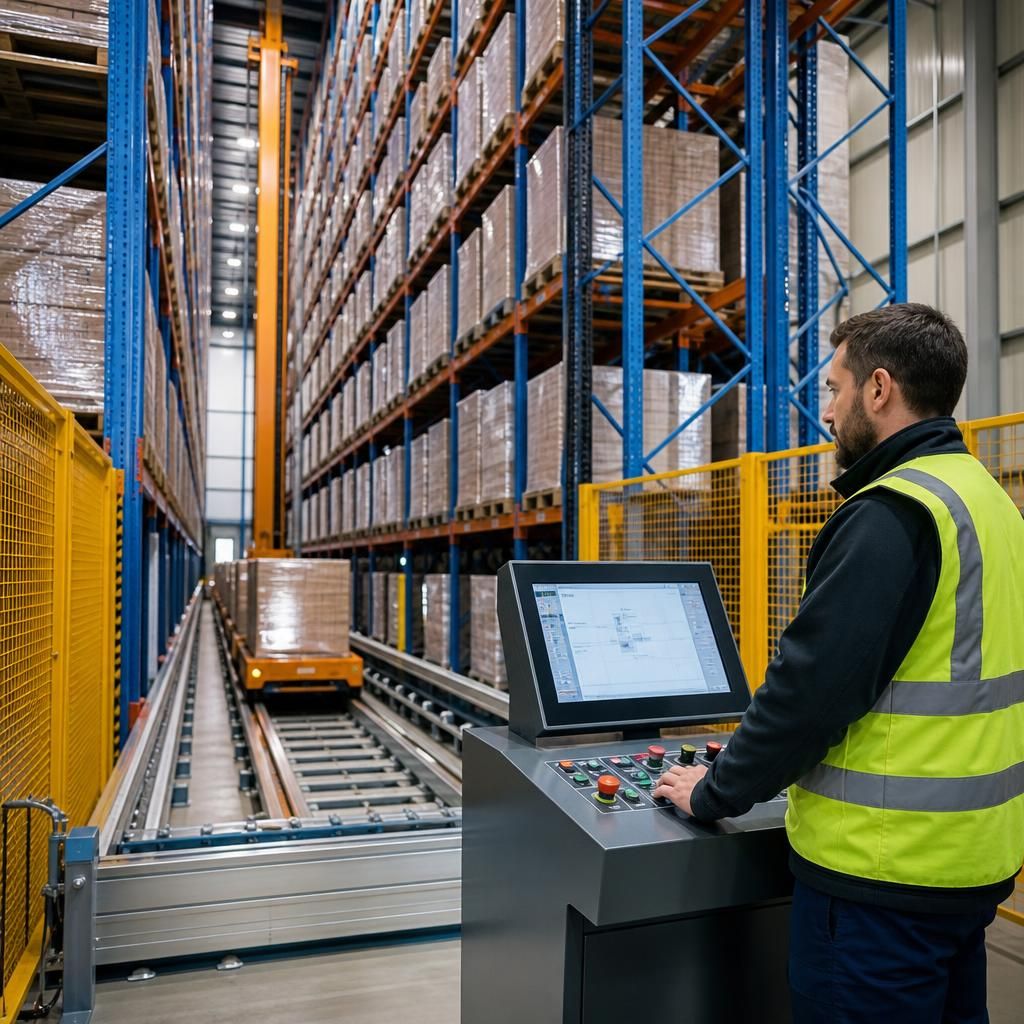
Safety in an automated racking system must be designed into the layout, equipment and operating procedures before installation begins. Guarding, interlocked access points, emergency stops, warning signs and safe isolation controls should protect people from moving machinery and unexpected system movement.
The assessment should cover normal operation as well as loading, fault recovery, cleaning, inspection and planned maintenance. Clear procedures are needed for entering restricted areas, responding to alarms and restarting equipment after an isolation. People and automated handling equipment should be separated wherever reasonably practicable.
Automation does not remove the need for competent warehouse racking inspections. Loads, beams, frames and protection must remain suitable for the applied forces and operating conditions, with damage reported and addressed promptly. Regular reviews are also necessary when pallet types, software, traffic routes or working practices change.
Discuss Your Automated Racking Requirements
Discuss your automated racking requirements with Able Racking to assess your warehouse layout, storage needs, safety controls, integration requirements and ongoing maintenance arrangements.