
What are the crucial factors to consider when integrating automated storage and retrieval systems (ASRS) into existing warehouse operations?
Integrating automated storage and retrieval systems (ASRS) into an existing warehouse requires careful assessment of available space, inventory profiles, workflows, load requirements, structural capacity, software compatibility and safety controls. Effective planning should also cover equipment integration, operator training, maintenance access, business continuity and the expected return on investment before installation begins.
Integrating an automated storage and retrieval system (ASRS) into an existing warehouse requires more than installing automated equipment. The project must align storage capacity, inventory characteristics, building constraints, material flow, control software, safety arrangements, maintenance access and future business requirements. A properly planned integration allows automation to support existing operations without creating avoidable restrictions, downtime or compliance risks.
Begin with a detailed operational assessment
The starting point should be a review of how the warehouse currently operates and what the ASRS is expected to achieve. This should cover receiving, put-away, storage, order fulfilment, replenishment, dispatch, returns and stock checking. Existing movement patterns should be mapped so that the proposed system addresses a genuine operational need rather than simply automating an inefficient process.
Useful questions include:
- Which products will be stored and retrieved automatically?
- What are the required throughput, response times and order profiles?
- Are goods handled as pallets, totes, cartons or other unit loads?
- Which products require special handling because of their weight, dimensions, fragility, temperature or hazardous properties?
- What happens to stock that falls outside the standard load profile?
- Which existing processes must continue during installation and maintenance?
Historical order data, inventory records and peak-demand patterns should be assessed rather than relying only on average activity. The system must be capable of handling realistic peaks, product changes and seasonal variation while avoiding unnecessary over-specification.
Check the building and available space
An ASRS is dependent on the physical conditions of the building. A survey should confirm floor condition and loading capacity, clear internal height, column positions, access points, fire protection arrangements, lighting, ventilation and the location of utilities. Floor levels and tolerances are particularly important because automated cranes, shuttles and conveyors require accurate alignment to operate reliably.
The survey should also consider vehicle access, delivery routes, installation clearances and the space needed to bring equipment into the building. Existing doors, walls, services and escape routes may limit the practical layout. Any structural alterations or changes to fire compartments should be reviewed by suitably qualified professionals before the design is finalised.
Future access is just as important as the initial installation. The layout should provide safe routes for inspection, cleaning, fault finding and component replacement. A design that uses every available area but leaves no practical maintenance access can increase downtime and make routine safety work unnecessarily difficult.
Match the system to the inventory
Automated equipment must be selected around the actual load, not an assumed standard load. Each unit should be assessed for dimensions, weight distribution, stability, packaging quality and suitability for repeated mechanical handling. Damaged, poorly wrapped or inconsistent loads can cause stoppages and create additional risks at transfer points.
Product information should be kept accurate and available to the control system. If dimensions, weights, batch information or storage restrictions change, the operating rules may also need to change. Provision should be made for non-conforming loads, quarantine stock, damaged goods and products that need manual handling.
Plan the material flow and equipment interfaces
The ASRS should connect logically with goods-in, picking, packing and dispatch. Conveyors, lifts, transfer cars, scanning stations and manual work areas need to work as one process. Poorly positioned interfaces can create congestion even when the automated storage equipment itself has sufficient capacity.
Consider how operators will present loads, confirm identification, remove completed orders and deal with exceptions. Ergonomics matter at every hand-off. Working heights, visibility, reach distances, pedestrian routes and the separation of people from moving equipment should be addressed during design rather than corrected after commissioning.
It is also important to identify single points of failure. A blocked conveyor, failed scanner or unavailable workstation should not bring the entire operation to a halt if a controlled alternative is reasonably practicable.
Confirm software and data compatibility
The warehouse management system, warehouse control system and equipment controls must exchange accurate information. The integration design should define how stock is identified, allocated, moved, held, released and reconciled. It should also establish what happens when communication is interrupted or data does not match the physical stock position.
Before going live, test the full range of transactions, including receipts, partial orders, stock adjustments, cycle counts, failed scans, rejected loads, urgent retrievals and system recovery. Access permissions, audit trails and change controls should be established so that modifications to locations, load parameters or operating logic are controlled.
Data quality is a practical safety and performance issue. Incorrect dimensions or weights can cause unsuitable storage decisions, failed transfers and equipment faults. A clear process is therefore needed for maintaining product master data after installation.
Build safety into the design
Automated storage equipment introduces moving machinery, restricted-access areas, transfer points and potential interaction between people and vehicles. A suitable risk assessment should identify foreseeable hazards and define guarding, interlocking, emergency stops, access control, isolation procedures and safe methods of work.
In the UK, the design and operation should be reviewed against applicable requirements, including the Provision and Use of Work Equipment Regulations and, where relevant, the Lifting Operations and Lifting Equipment Regulations. Fire precautions, electrical safety, workplace transport controls and emergency arrangements must also be considered. The precise requirements depend on the equipment and the way it is used, so competent advice should be obtained for the specific installation.
Emergency access must remain usable when the system is full. Operators and engineers should be able to reach designated areas safely without bypassing guards or entering hazardous zones unnecessarily. Isolation points should be clearly identified, accessible and covered by documented procedures.
Allow for installation within a live warehouse
Most existing warehouses cannot simply stop operating for the duration of an automation project. The implementation plan should define work zones, delivery routes, temporary storage, exclusion areas, isolation arrangements and the sequence of construction and installation activities.
Phased installation may reduce disruption, but it can also create temporary interfaces between automated and manual processes. These arrangements should be documented, supervised and reviewed as the project progresses. Staff should know which areas are available, which routes have changed and how to report hazards or equipment faults.
Commissioning should be staged. Mechanical completion, electrical testing, software integration, unloaded trials, loaded trials, fault testing and emergency-stop testing should be completed before normal operation. The handover should include operating instructions, inspection records, certificates, drawings, software information and a list of outstanding actions.
Prepare people and operating procedures
Automation changes tasks rather than removing the need for competent people. Operators need training in normal use, load presentation, exception handling, emergency stops and reporting defects. Maintenance personnel require additional instruction in isolation, access, stored energy and safe intervention.
Training should reflect the actual equipment and procedures in the warehouse. It should be refreshed when the system, software, product range or working method changes. Written procedures should cover start-up, shutdown, blocked equipment, rejected loads, loss of communication, power failure, stock discrepancies and recovery after an emergency.
Define inspection, maintenance and support requirements
Before selecting the system, establish who will inspect, service and repair each part of it. This includes automated storage machinery, conveyors, lifts, sensors, guarding, scanners, control panels and software interfaces. The maintenance plan should specify inspection frequencies, responsibilities, access arrangements, spare parts, response times and records.
Preventative maintenance is especially important because small faults can develop into repeated stoppages or unsafe conditions. Planned inspections should identify wear, impact damage, loose components, misalignment, damaged guards and changes to the surrounding environment. Maintenance work must be coordinated with warehouse operations so that equipment is isolated and returned to service safely.
Assess the business case and long-term flexibility
The investment decision should consider more than equipment cost. Include building work, software integration, training, commissioning, maintenance, energy use, support arrangements, temporary operating measures and likely future modifications. Compare the expected benefits with the cost of continued manual handling and the operational risks of doing nothing.
Capacity, labour requirements, throughput, accuracy, space use and service continuity are all relevant to the assessment. Assumptions should be documented and tested against realistic demand. The design should also allow for changes in product range, order patterns and business growth wherever reasonably possible.
Use a controlled integration process
A successful ASRS project normally involves warehouse operators, facilities specialists, IT personnel, health and safety advisers, equipment suppliers and competent installation and maintenance teams from the outset. Clear responsibility for design decisions, approvals, testing, training and handover prevents important details from being missed.
The most reliable approach is to survey the existing operation, define measurable requirements, verify the building and load information, design the interfaces, assess the risks, test the technology and plan maintenance before installation begins. Once the system is live, performance and safety should be reviewed against the agreed requirements, with issues recorded and corrected through a controlled improvement process.
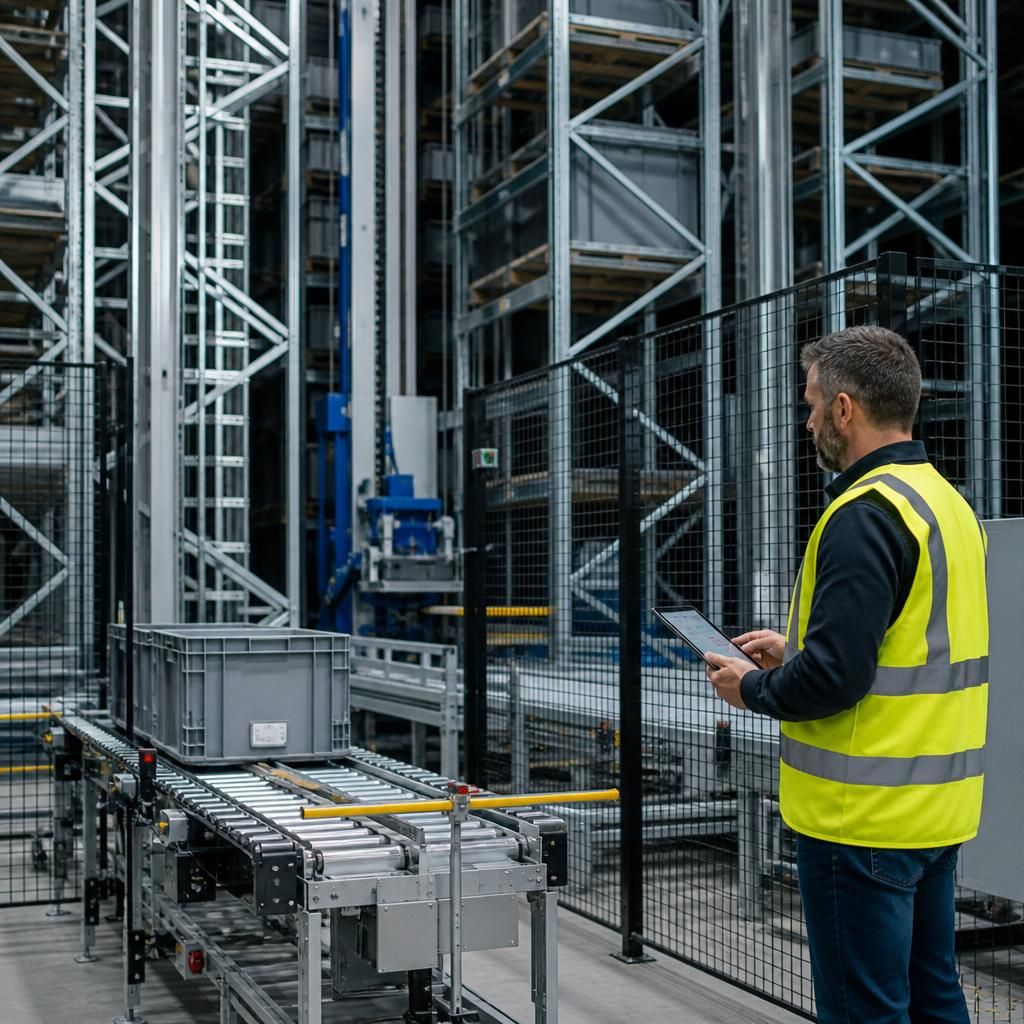
Integrating an automated storage and retrieval system (ASRS) into a live warehouse requires safety controls to be designed around both the new equipment and existing operations. Define installation zones, pedestrian routes, vehicle movements, temporary storage areas and emergency access before work begins. During commissioning, test guarding, interlocks, isolation points and emergency stops, while maintaining controlled procedures for manual handling and system faults. Operators and maintenance personnel should receive equipment-specific training before handover, with clear instructions for blocked loads, communication failures, power loss and safe intervention.
Discuss Your ASRS Integration Requirements
Discuss your ASRS integration requirements with Able Racking to review your warehouse layout, operational needs, safety controls and planned installation approach. Our experienced team can help identify practical inspection, maintenance and training requirements before the system is commissioned.