
What are the benefits of shuttle racking systems in warehouses?
Shuttle racking systems use powered pallet shuttles to move and store pallets within deep-lane warehouse racking, reducing the need for forklifts to enter each storage lane. They can increase storage density, improve loading and retrieval efficiency, support safer operations and reduce handling costs where high-volume, repetitive pallet movements justify the investment.
Shuttle racking systems improve warehouse storage by using a powered pallet shuttle to move loads along rails inside deep-lane warehouse racking. Forklift trucks place and remove pallets at the lane entrance, while the shuttle carries out the horizontal movements. This increases storage density, reduces forklift travel within the structure and can make high-volume pallet handling faster, safer and more consistent.
The benefits are most noticeable where a warehouse stores many pallets of the same product, handles frequent inbound and outbound movements, or needs to make better use of limited floor space. The system can be configured for either last-in, first-out (LIFO) or first-in, first-out (FIFO) operation, depending on the design and how pallets are loaded and retrieved.
- Higher storage density: Deep lanes reduce the number of aisles required compared with a fully selective layout. More pallets can therefore be stored within the available footprint, or the same stockholding capacity can be achieved in a smaller area.
- Better use of warehouse space: Shuttle systems make effective use of both floor area and vertical storage height. They are particularly useful where land or building space is restricted and expansion is not practical.
- Faster pallet movements: Once a forklift has positioned a pallet at the lane entrance, the shuttle moves it into storage without the forklift travelling along the lane. This can shorten loading and retrieval cycles where many pallets are handled repeatedly.
- Reduced forklift travel: Forklift trucks remain mainly in the operating aisle rather than entering every storage lane. This can reduce travel distances, turning movements and time spent positioning loads within deep storage areas.
- Improved operator safety: Keeping forklift trucks out of the storage lanes reduces the risk of vehicle contact with upright frames, guide rails and stored pallets. It also limits the need for operators to work in confined areas. Safe operation still depends on appropriate training, traffic management, inspections and adherence to the system manufacturer’s instructions.
- Less potential for structural impact: Because the shuttle performs the movement inside the lane, there may be fewer opportunities for forklift trucks to strike the warehouse racking components. This does not remove the need for regular inspections, impact reporting or prompt repair of damaged parts.
- Consistent pallet placement: A shuttle follows the installed rails and places pallets in a controlled position. This can help maintain orderly lanes and reduce the inconsistent positioning that may occur when forklift trucks travel into deep-lane storage.
- Support for FIFO and LIFO stock rotation: A single-access layout generally supports LIFO, which can suit products that do not require strict rotation. A two-sided arrangement can support FIFO, allowing pallets to enter at one end and leave from the other. The correct arrangement should reflect product shelf life, picking requirements and site workflow.
- Suitable for repetitive operations: Shuttle systems are well suited to production buffers, reserve storage, cold stores and distribution environments where pallet movements follow predictable patterns. They can handle repeated movements without requiring a forklift to access each individual position.
- Potentially lower operating costs: Reduced forklift travel can lower fuel or battery consumption, tyre wear and general vehicle use. Labour can also be used more effectively because operators spend less time driving into lanes and repositioning loads. The actual saving depends on throughput, working hours, forklift type, maintenance requirements and the level of system use.
- Adaptable storage configuration: Different lanes can be allocated to different products, batches or temperature requirements. Additional shuttle equipment can also be considered where demand grows, although the warehouse racking design, control system and operating process must be assessed before changes are made.
Shuttle racking can also improve stock control when it is integrated with warehouse management software. The control system can record pallet locations, direct put-away and retrieval tasks, and help operators follow the required stock rotation method. Integration does not replace good inventory procedures: pallet identification, accurate data, clear operating rules and disciplined exception handling remain essential.
The system is not automatically the best choice for every warehouse. Selective warehouse racking may be more suitable where there are many individual stock-keeping units and frequent access to single pallets. Shuttle storage is generally most effective when pallet loads are stable, lane depth is used efficiently and movements are sufficiently regular to justify the equipment and controls.
Before installation, consider the pallet dimensions and weight, load quality, product turnover, lane depth, required storage temperature, available clearance and the intended FIFO or LIFO process. Pallets must be in suitable condition for shuttle handling. Damaged, distorted or poorly wrapped loads can affect safe movement and may cause obstructions within the lane.
The existing building and warehouse racking must also be assessed. Floor condition, slab capacity, clearances, frame arrangement, guide rails, end stops, pallet supports and protection equipment all need to be compatible with the proposed system. Any change to the structure, load plan or operating method should be checked by a competent specialist rather than treated as a simple equipment replacement.
Maintenance is another important consideration. Shuttle units, batteries, sensors, wheels, rails and control equipment require planned servicing and inspection. Operators should know how to isolate the equipment, report faults, manage a trapped pallet and respond to an obstruction. A clear maintenance schedule helps identify wear before it affects availability or creates a safety risk.
Warehouse racking inspections should continue after a shuttle system is installed. Inspections should look for impact damage, displaced components, bent rails, damaged pallet supports, loose fixings, load instability and signs that the system is being used outside its design conditions. Any damage should be reported, the affected area controlled where necessary and repairs completed by a suitably competent person.
In practical terms, shuttle racking provides the greatest value when the warehouse needs dense pallet storage, repeatable movements and reduced forklift access to deep lanes. A properly specified system can increase usable capacity, improve material flow and support safer working practices, but its performance depends on suitable products, sound design, trained operators, accurate stock control and preventative maintenance.
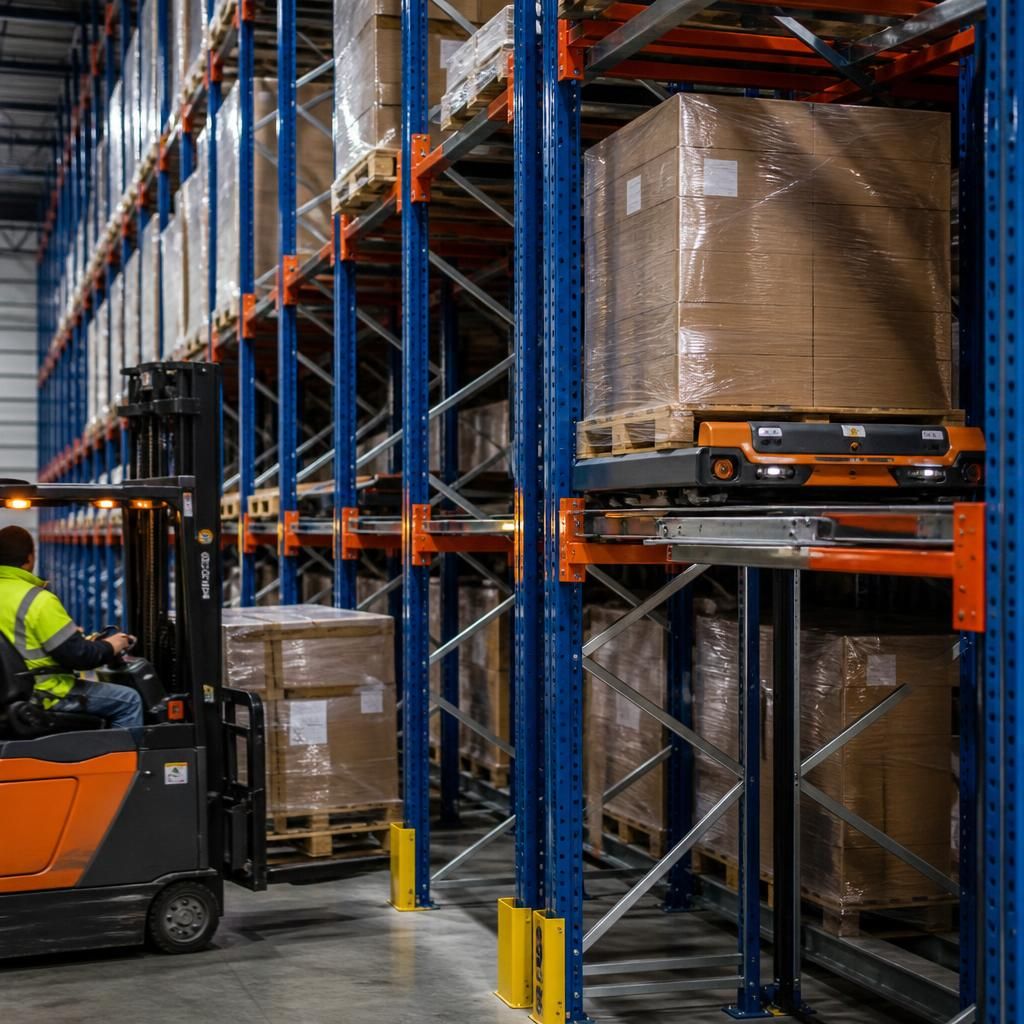
Shuttle racking systems can improve operational safety by keeping forklift trucks in the working aisle instead of requiring them to travel into each deep storage lane. The powered pallet shuttle moves loads along the rails, reducing reversing, turning and positioning movements close to warehouse racking components.
This can lower the likelihood of vehicle impact with frames, rails and stored pallets, but it does not remove the need for warehouse racking inspections, impact reporting, operator training and planned maintenance. Safe performance depends on using suitable pallets, following the manufacturer’s instructions and removing damaged equipment from service promptly.
Review your shuttle racking requirements with our experts
Review your shuttle racking requirements with our experts to confirm that your storage layout, equipment and operating processes are suitable for safe, efficient performance.