
What factors should be considered when maintaining a shuttle racking system?
Maintaining a shuttle racking system requires planned inspections of the structure, rails, pallet shuttles, safety components and controls, alongside checks for damage, wear, debris and correct operation. Maintenance should also include prompt repairs by competent operatives, manufacturer-led servicing, suitable operator training, up-to-date records and regular reviews of the warehouse’s risk assessment and working practices.
Maintaining a shuttle racking system requires a planned programme covering the storage structure, guide rails, pallet shuttles, controls, safety equipment, loads and operating procedures. Regular inspections should identify damage, wear, contamination and faults before they affect stability or warehouse operations. Any defect that could compromise safety should be controlled immediately and repaired by a competent person in accordance with the system manufacturer’s instructions.
Inspect the structural components
The upright frames, beams, bracing, connections, protectors and aisle-facing components should be checked for impact damage, distortion, corrosion, loose fixings and missing components. Particular attention is needed at loading and unloading positions, where contact with handling equipment is more likely. Defects should be assessed against the system’s inspection criteria rather than treated as cosmetic damage, as even apparently minor distortion can affect load distribution or the clearance available for a pallet shuttle.
Structural inspections should also confirm that the system remains correctly positioned, secured and level. Any unauthorised alterations, removed bracing or replacement components that do not match the original design should be investigated. The safe working load information must remain visible and correspond with the current configuration and stored loads.
Check rails, entry points and shuttle travel paths
Guide rails and running surfaces must be free from distortion, excessive wear, loose fixings and obstructions. The entry points into each channel should be checked for damage caused by pallets or handling equipment. Rails that are bent, contaminated or incorrectly aligned can affect shuttle tracking, increase mechanical stress and prevent the unit from positioning or stopping correctly.
Channels should be kept clear of broken pallet boards, stretch film, packaging, spilled materials and other debris. Cleaning should follow a safe procedure that prevents personnel entering hazardous areas unnecessarily. Where access into a channel is required, the shuttle and associated equipment should be isolated in accordance with the site’s safe system of work.
Service the pallet shuttles
Each pallet shuttle should be examined for damage, unusual noise, vibration, fluid leakage, worn wheels, damaged sensors and signs of overheating. Functional checks should confirm that it starts, travels, stops, positions pallets and responds correctly to the control system. Braking, anti-collision features, pallet detection and end-of-channel stopping functions are particularly important because a fault could result in a pallet being misplaced or equipment colliding with the structure.
Maintenance should include the components specified by the manufacturer, such as wheels, drive assemblies, bearings, sensors, electrical connections and protective covers. Lubrication, adjustment and replacement intervals should be based on the manufacturer’s instructions and actual operating conditions. Repeated faults should not be resolved by resetting the equipment without identifying the underlying cause.
Maintain batteries, chargers and controls
Battery-powered shuttles require checks of battery condition, charging performance, connectors, cables and charging areas. Batteries should be charged using suitable equipment and in a location that is safe, ventilated and protected from avoidable damage. Signs of swelling, leakage, exposed wiring, overheating or damaged connectors require the equipment to be withdrawn from use until it has been assessed.
Remote controls, indicators, sensors, emergency stops and software settings should be tested as part of planned servicing. Control devices must be clearly identified and protected against unauthorised operation. Any changes to settings, access permissions or control logic should be recorded and completed by appropriately authorised personnel.
Review pallets, loads and storage practices
The condition and suitability of pallets have a direct effect on shuttle system safety. Pallets should be compatible with the channel dimensions, support arrangements and load limits. Broken boards, protruding nails, damaged runners, unstable loads and contaminated pallet bases should be removed from service. Loads must be stable, evenly distributed and within the stated limits for the position and system configuration.
Maintenance checks should confirm that operators are not placing incompatible pallet types into the channels, overloading locations or allowing loads to project into travel paths. Changes to pallet dimensions, load weights, packaging or stock profiles should trigger a review of the system’s design assumptions and operating controls.
Keep safety features operational
Safety barriers, end stops, access gates, warning signs, isolation points and emergency stops should remain present, secure and easy to identify. Guards and physical protections must not be bypassed, removed or used as storage points. Where access to a channel or other restricted area is possible, the access control arrangements should prevent the shuttle being operated while people are exposed to moving equipment.
Emergency procedures should explain how to stop and isolate the system, report a fault, recover a stranded shuttle and deal with a damaged pallet. These procedures should be practical for the site and reviewed whenever equipment, layout, staffing or working methods change.
Use appropriate inspection and servicing arrangements
A maintenance programme should combine routine operator checks, planned preventive maintenance and periodic inspections by a suitably competent person. Operators can identify obvious damage, debris, unusual sounds and control faults before use, but these checks do not replace a detailed examination of the structure and equipment.
Inspection frequency should reflect usage, loading patterns, the warehouse environment, previous defects and the manufacturer’s recommendations. High-throughput operations, dusty or corrosive conditions, frequent pallet impacts and intensive battery use may require more frequent checks. A competent inspector should be able to distinguish between damage requiring immediate action and a condition that can be monitored under a documented control plan.
Control defects and complete repairs promptly
When a defect is identified, the affected channel, shuttle or section should be clearly isolated where necessary. Damaged components should not be straightened, welded, drilled or replaced with unsuitable parts as an informal repair. Structural repairs and alterations should be assessed and approved by a suitably qualified specialist, with replacement parts and installation methods matching the system design.
After a repair, the equipment should be checked before it is returned to service. The check should confirm that the repair has not affected clearances, load capacity, shuttle travel, pallet positioning or safety functions. Temporary controls should be recorded and removed once a permanent repair has been completed.
Train operators and reinforce safe working practices
Operators should receive instruction specific to the shuttle system they use, including loading and unloading methods, pallet quality checks, remote control operation, safe distances, emergency stops, fault reporting and isolation procedures. Training should cover the risks of entering channels, attempting unauthorised recovery of a shuttle and continuing to use equipment after an impact or fault.
Refresher instruction is appropriate when procedures change, new equipment is introduced, an incident occurs or inspection findings show recurring unsafe practices. Only authorised, trained personnel should operate, adjust, recover or service the shuttle equipment.
Keep complete maintenance records
Records should identify the equipment or location inspected, the date, findings, actions required, person completing the work and date of completion. They should also include details of recurring faults, replaced components, repairs, isolation arrangements, training and any changes to the system. Clear records help demonstrate that defects are being managed rather than repeatedly noted without resolution.
Inspection results should be reviewed for patterns. Repeated impact at the same location, recurring sensor faults, damaged pallets or frequent shuttle stoppages may indicate a wider issue with traffic routes, stock handling, system settings or operator procedures. Correcting the underlying cause is usually more effective than repeatedly repairing the immediate damage.
Review the system after changes or incidents
A shuttle racking system should be reassessed after an impact, equipment failure, significant change in stock or pallet type, layout alteration, change in throughput or modification to operating procedures. The warehouse risk assessment should reflect the current system, equipment and people exposed to its hazards.
Effective maintenance is therefore more than replacing worn parts. It combines structural inspections, equipment servicing, housekeeping, load control, competent repairs, operator training and documented review. This preventative approach helps preserve the system’s designed performance, reduces avoidable stoppages and supports safe, efficient warehouse operations.
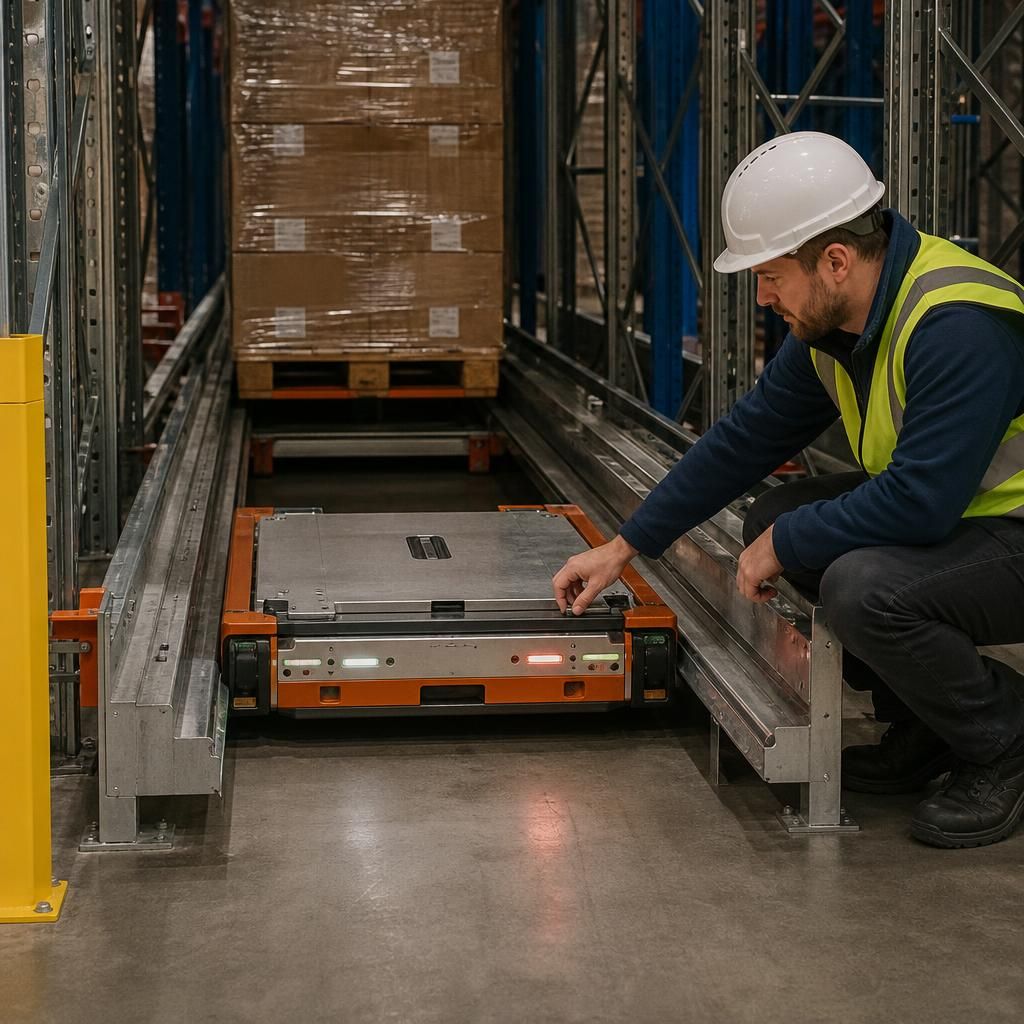
Promptly controlling defects is a central part of maintaining a shuttle racking system. If an upright, guide rail, pallet shuttle, sensor or safety device is damaged or malfunctioning, the affected channel or equipment should be isolated where necessary and reported to a competent person before use continues.
Repairs should follow the manufacturer’s instructions and use suitable replacement components. Unapproved straightening, welding, drilling or repeated system resets can hide the underlying fault and create further risks. After repair, the system should be checked to confirm that pallet clearances, load capacity, shuttle travel and safety functions remain correct before it is returned to service. Recording the defect, action taken and completion date also helps identify recurring problems and supports effective preventative maintenance.
Arrange a shuttle racking maintenance inspection
Arrange a professional shuttle racking maintenance inspection with Able Racking to identify damage, equipment faults and safety concerns before they disrupt warehouse operations. Our competent team can provide practical recommendations and help keep your system safe, compliant and efficient.