
What are the key components of a shuttle racking system?
A shuttle racking system comprises structural frames, support beams, guide rails, pallet shuttles, entry stops and safety components that work together to store and retrieve pallets within deep-lane channels. It also includes controls, sensors and power systems to direct shuttle movement and support safe, efficient warehouse operations.
A shuttle racking system is made up of structural warehouse racking components, powered pallet shuttles and control equipment that work together to store and retrieve pallets in deep-lane channels. The main components are the upright frames, support beams, guide rails, pallet shuttles, entry and end stops, safety protection, sensors, controls and power systems. Each part has a specific role in maintaining load stability, accurate pallet movement and safe warehouse operation.
Structural upright frames
Upright frames form the vertical structure of the warehouse racking system. They transfer the weight of stored pallets through the beams and frame bracing to the floor. Uprights must be correctly specified for the required pallet loads, channel depths, operating conditions and site layout.
Frame bracing keeps the structure stable and helps it resist forces created during loading, unloading and shuttle movement. The frames must be installed plumb, securely anchored and checked for damage or distortion. Any impact to an upright, brace or connection can affect the capacity and should be assessed by a competent person before the affected area is used again.
Support beams and pallet supports
Horizontal beams connect the upright frames and carry the loads transferred from the pallet positions. In a shuttle installation, the beams also support the rails and create the levels within each storage lane. Beam profiles, connections and spacing need to match the design specification and the type of pallet being stored.
Some systems use additional pallet support members or specially formed supports beneath the rails. These components help distribute loads and keep pallets at the correct height for the shuttle to pass underneath. They must not be removed, altered or replaced with unsuitable parts, as this can change the designed load path and operating clearance.
Guide rails
Guide rails run along the floor of each deep-lane channel. They guide the pallet shuttle and support its wheels as it travels into and out of the storage position. Rails must remain correctly aligned, level and securely fixed so that the shuttle can move smoothly without excessive vibration or lateral movement.
Rail condition is particularly important because debris, impact damage or misalignment can interfere with shuttle travel. Regular housekeeping and inspection should identify damaged rails, loose fixings and obstructions before they affect operation. The clearances around the rails must also be maintained to prevent pallets, packaging or other materials from entering the shuttle path.
Pallet shuttle unit
The pallet shuttle is the powered carrier that moves pallets within the channel. Depending on the system design, it may collect a pallet from the entry position, transport it along the rails and place it in the next available storage position. For retrieval, it collects the selected pallet and returns it to the operating face.
The shuttle normally includes drive wheels, lifting or pallet engagement equipment, batteries or another power source, control electronics and communication equipment. Its load capacity, dimensions and operating settings must be compatible with the warehouse racking layout and the pallets in use. Pallets should be in suitable condition, with sound boards, consistent dimensions and no protruding materials that could obstruct the shuttle.
Entry stops, end stops and pallet positioning equipment
Stops and positioning components help control where pallets are placed within a channel. An entry stop can help define the loading position, while an end stop prevents the shuttle or a pallet from travelling beyond the designed limit. These components must be correctly positioned and securely attached.
Stops are not intended to compensate for incorrect loading or poor shuttle control. Pallets should be placed squarely, with their bearers correctly supported by the rails or pallet supports. A pallet that is damaged, misaligned or unsuitable for the system can create a blockage or cause damage when the shuttle attempts to move it.
Control system and operator interface
The control system directs shuttle movements and allows operators to select functions such as loading, unloading, positioning and return to the operating face. It may include a handheld remote, fixed control panel, warehouse management system interface or other site-specific controls.
Controls should provide clear operating instructions and prevent unsafe commands where the system design allows. Access should be limited to trained operators, and operating procedures should cover start-up, normal movement, stopping, fault response and recovery. A shuttle should never be bypassed, forced or manually moved without following the manufacturer’s approved procedure.
Sensors and detection devices
Sensors help the system identify the position of the shuttle and pallets. They may detect the end of a channel, confirm pallet presence, monitor travel or identify an obstruction. This information allows the control system to stop or adjust movement when a programmed condition is reached.
Sensors need to remain clean, correctly aligned and free from damage. Faults can result in inaccurate positioning, unexpected stopping or failure to detect a pallet. Sensor checks should form part of planned maintenance, particularly where dust, cold temperatures, impact or frequent use could affect performance.
Power and charging equipment
Shuttle systems require a reliable power source. Battery-powered units usually include rechargeable batteries and a designated charging arrangement, while other designs may use a different fixed or mobile supply. Charging areas and equipment must be suitable for the battery type and managed in accordance with the manufacturer’s instructions and site risk assessment.
Battery condition, connectors, charging contacts and cables should be inspected for damage or deterioration. Operators should understand the permitted charging process and what to do if a battery becomes unusually hot, damaged or fails to charge correctly. Unauthorised modifications to power equipment can introduce electrical, fire and operational risks.
Safety protection and access controls
Protection may include upright guards, end-of-aisle barriers, rail protection, gates, fencing and other measures designed to reduce the risk of impact or unauthorised access. The appropriate arrangement depends on the site traffic, vehicle movements, operator access and the design of the warehouse racking system.
Safety signs, floor markings and physical barriers help identify operating zones and keep people away from moving equipment. Where personnel may enter a channel, the system should have suitable isolation and access procedures. Emergency stops must be accessible, tested as required and clearly understood by authorised users.
Load information and system identification
Safe operation also depends on accurate information about the system. Load notices should state the relevant pallet, level and channel capacities, together with any restrictions that apply. Identification labels can help operators select the correct storage lane and prevent unsuitable pallets being placed into the system.
Load limits must not be estimated from appearance or previous use. Changes to pallet dimensions, goods weight, storage levels or operating equipment can affect the original design assumptions. Any proposed alteration should be reviewed by the appropriate designer, supplier or competent warehouse racking specialist before implementation.
How the components work together
- The upright frames and beams provide the load-bearing structure.
- The rails create the guided travel route for the shuttle.
- The shuttle transports pallets into and out of the deep-lane channels.
- Stops and pallet supports maintain the intended position of pallets and equipment.
- Sensors and controls coordinate movement and identify operating conditions.
- Power and charging equipment keep the shuttle available for planned work.
- Guards, barriers, emergency stops and procedures reduce the risk to people and equipment.
These components should be considered as one engineered system rather than separate items. A fault in a rail, sensor, pallet support or protection device can affect the performance of the complete installation. Planned inspections, prompt reporting of damage, controlled repairs and suitable operator training help preserve the system’s safety and efficiency.
For existing installations, warehouse racking inspections should assess the structural condition, protection, load notices, clearances and signs of impact. Shuttle equipment should be maintained in line with the manufacturer’s instructions, with faults recorded and isolated where necessary. Combining structural inspections with shuttle maintenance gives the clearest view of whether the system remains suitable for continued operation.
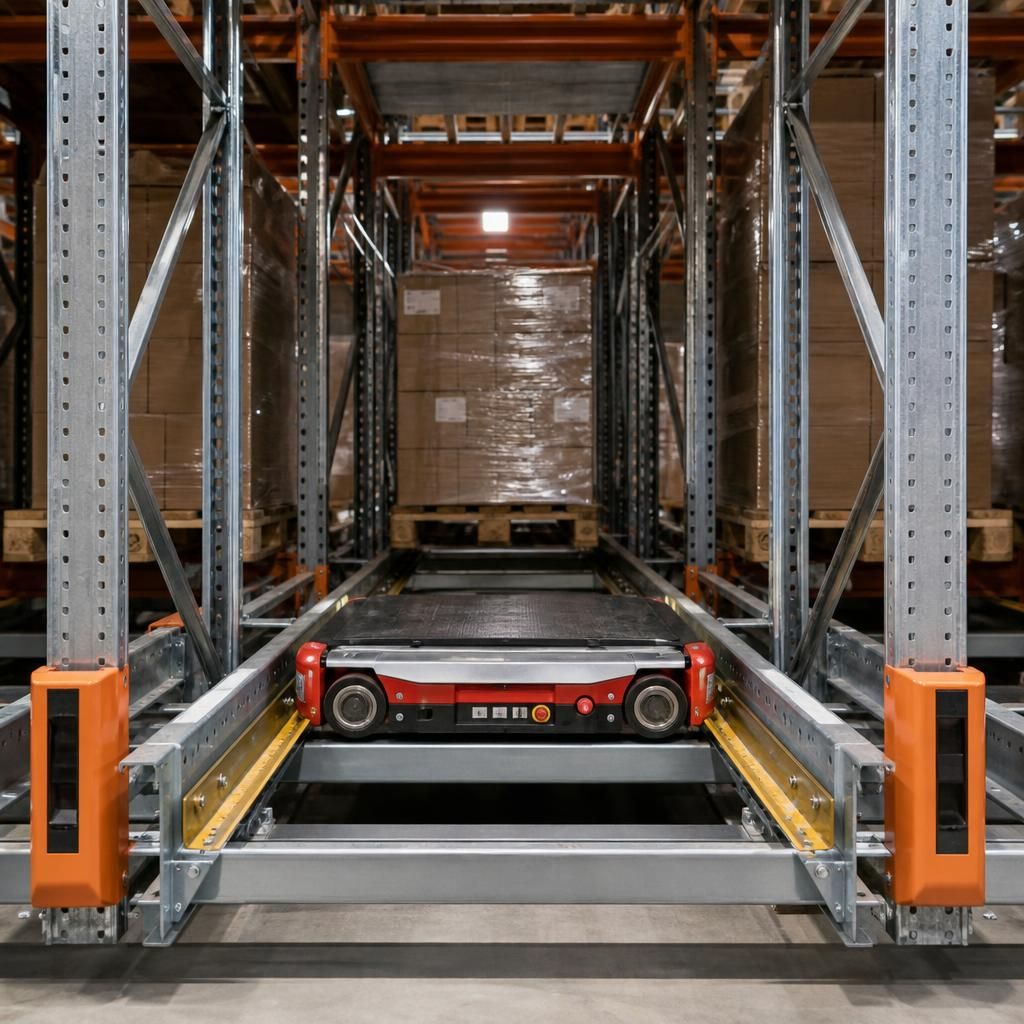
Guide rails are a critical component of a shuttle racking system because they provide the controlled travel route for the pallet shuttle inside each deep-lane channel. They must be correctly aligned, level and securely fixed so the shuttle can move smoothly while supporting the stored pallet.
Debris, loose fixings, impact damage or rail distortion can cause vibration, inaccurate positioning or a shuttle blockage. Keep the travel path clear and include the rails in routine inspections and planned maintenance. Any damage or alignment issue should be reported promptly and assessed before the affected channel is used again.
Book an Expert Shuttle Racking System Inspection
Arrange an expert shuttle racking system inspection with Able Racking to check structural condition, shuttle components, protection and operating controls. Contact our experienced team to discuss your inspection requirements.