
What are the key benefits of implementing a shuttle racking system in a warehouse?
A shuttle racking system uses remotely controlled pallet shuttles to move loads through deep storage channels, increasing warehouse capacity while reducing forklift movements within the system. Its key benefits include faster and more consistent pallet handling, improved safety, better space utilisation and greater operational efficiency, particularly where high-density storage is required.
A shuttle racking system is a high-density storage solution in which a remotely controlled pallet shuttle moves loads through deep storage channels. Its main benefits are increased storage capacity, faster and more consistent pallet handling, reduced forklift travel within the storage structure, improved safety and better use of warehouse space. It is particularly suitable for operations storing large quantities of the same or similar products on a last-in, first-out or first-in, first-out basis.
Higher storage capacity
Pallet shuttles allow storage channels to be deeper than those typically served directly by a forklift. This reduces the need for forklift aisles between every pallet position and makes better use of the warehouse footprint. The result can be more pallet locations within the same building, or equivalent storage capacity in a smaller area.
Improved space utilisation applies both horizontally and vertically. The system can be designed around the available building height, floor area, load requirements and stock profile. A properly planned layout can also reduce unused space around storage aisles and improve the relationship between storage, loading and dispatch areas.
Faster pallet handling
The shuttle carries pallets into and out of the channel, while the operator controls the movement from a safer position outside the storage structure. This reduces the time spent positioning a forklift inside a deep channel and can make repeated loading and retrieval tasks more consistent.
For warehouses handling regular batches of the same product, a shuttle can move pallets efficiently without requiring the forklift to travel to every storage position. This is useful during replenishment, order preparation and stock rotation, particularly where there is a high volume of pallet movements.
Reduced forklift movements in storage channels
Forklifts are generally used to place pallets on the shuttle and remove them from the channel entrance. The shuttle then performs the movement within the channel. Separating these activities can reduce forklift travel in confined storage areas, helping to limit unnecessary manoeuvring and making traffic management easier.
Reduced vehicle movement can also support a more orderly warehouse layout. However, it does not remove the need for trained forklift operators, suitable traffic routes, pedestrian controls and careful operating procedures around the loading faces.
Improved warehouse safety
Keeping forklifts out of deep channels can reduce the risk of contact with storage components caused by restricted visibility, turning or reversing. Remote operation also means that staff do not need to enter a channel to move every pallet. These features can help reduce exposure to vehicle and load-handling hazards when the system is correctly designed and operated.
Safety still depends on the complete installation and its day-to-day management. The system should include suitable end stops, guide rails, pallet position controls, access protection and clearly defined operating zones. Operators should follow the manufacturer’s instructions, use the correct shuttle settings and report damage, unusual movement or control faults immediately.
More consistent pallet handling
A shuttle follows a defined route within the channel, supporting repeatable placement and retrieval. This can help maintain consistent pallet alignment and reduce avoidable handling variation. Automatic stop functions, pallet detection and inventory controls may also help the operator manage the sequence of movements more reliably, depending on the specification of the equipment.
Consistency is especially valuable where pallets are stored in batches. The operating method can be adapted to the required stock rotation policy, such as loading from one end and retrieving from the other for first-in, first-out storage, or loading and retrieving from the same end where last-in, first-out storage is appropriate.
Better suitability for high-density and cold-storage applications
Shuttle systems are well suited to environments where storage density is more important than direct access to every individual pallet. They can support buffer storage, production staging, bulk goods, seasonal stock and other applications where multiple pallets share the same product channel.
They can also be useful in temperature-controlled warehouses. By reducing the amount of aisle space required, the system may help limit the volume of cooled or frozen air that must be maintained. The equipment specification, battery performance, materials and maintenance arrangements must be suitable for the operating temperature and environmental conditions.
Greater operational efficiency
A shuttle system can make the movement of goods more predictable by combining dense storage with a defined handling process. Fewer forklift movements inside the channels may reduce congestion and allow vehicles to spend more time on loading, unloading and other productive tasks.
Operational efficiency also depends on how the system connects with warehouse procedures. Stock location records, barcode or radio-frequency identification processes, battery charging, housekeeping and traffic management should all be considered during planning. A high-density installation will not deliver its full benefit if pallets are poorly positioned, channels are incorrectly allocated or access routes are regularly obstructed.
Potential reduction in product and structural damage
When pallets are handled by a shuttle rather than repeatedly driven into a channel, there can be fewer opportunities for forklift contact with the structure or stored goods. Controlled movement can also support more careful pallet placement, provided that pallets are suitable, stable and in good condition.
This benefit should not be assumed without inspection and management. Damaged pallets, excessive load overhang, incorrect pallet dimensions and uneven loads can create problems for both the shuttle and the storage structure. Loads should meet the agreed design criteria, and damage to beams, rails, guides, frames or protection should be reported and assessed promptly.
Efficient use of labour
Automation of movement within the channels can reduce the physical effort associated with repeated deep-lane pallet handling. It may also allow an operator to control shuttle movements while the forklift remains at the channel entrance. This can support a more efficient allocation of labour, although it does not eliminate the need for supervision, inspection, maintenance or competent equipment operation.
Staff must receive suitable instruction before using the system. Training should cover controls, load limits, battery handling, emergency procedures, channel access restrictions, fault reporting and the actions required when a pallet is not correctly positioned.
Important considerations before implementation
The benefits of shuttle storage depend on matching the system to the warehouse’s stock and handling requirements. Before installation, consider:
- the number, size and weight of pallets to be stored;
- whether stock requires first-in, first-out or last-in, first-out handling;
- the required access frequency for individual pallets;
- the available building height, floor condition and operating clearances;
- forklift compatibility, aisle arrangements and traffic separation;
- battery charging, spare equipment and contingency arrangements;
- integration with stock control and warehouse management processes; and
- inspection, maintenance and emergency recovery procedures.
Shuttle systems are less suitable where every pallet must be accessed immediately or where stock has a highly varied profile with limited batch quantities. In those situations, a different storage arrangement, or a combination of systems, may provide better access and overall performance.
Maintaining the benefits over time
Routine inspections and planned maintenance are essential for preserving capacity, safety and handling performance. The storage structure, rails, guides, stops, protection, pallets, shuttle and control equipment should be checked in line with the manufacturer’s requirements and the site’s risk assessment. Any impact damage should be isolated and assessed by a competent person rather than left in service.
Warehouse teams should keep channels clear, use only approved pallets and avoid unauthorised changes to the structure or control settings. Reviewing operating incidents, damaged loads and recurring faults can identify issues before they affect productivity or create a safety risk.
Overall, a shuttle racking system provides the greatest value where the warehouse needs dense pallet storage, repeatable handling and reduced forklift activity within storage channels. Its performance relies on accurate design, competent installation, appropriate training and ongoing inspection, so the system remains safe, accessible and aligned with the operation’s stock-handling requirements.
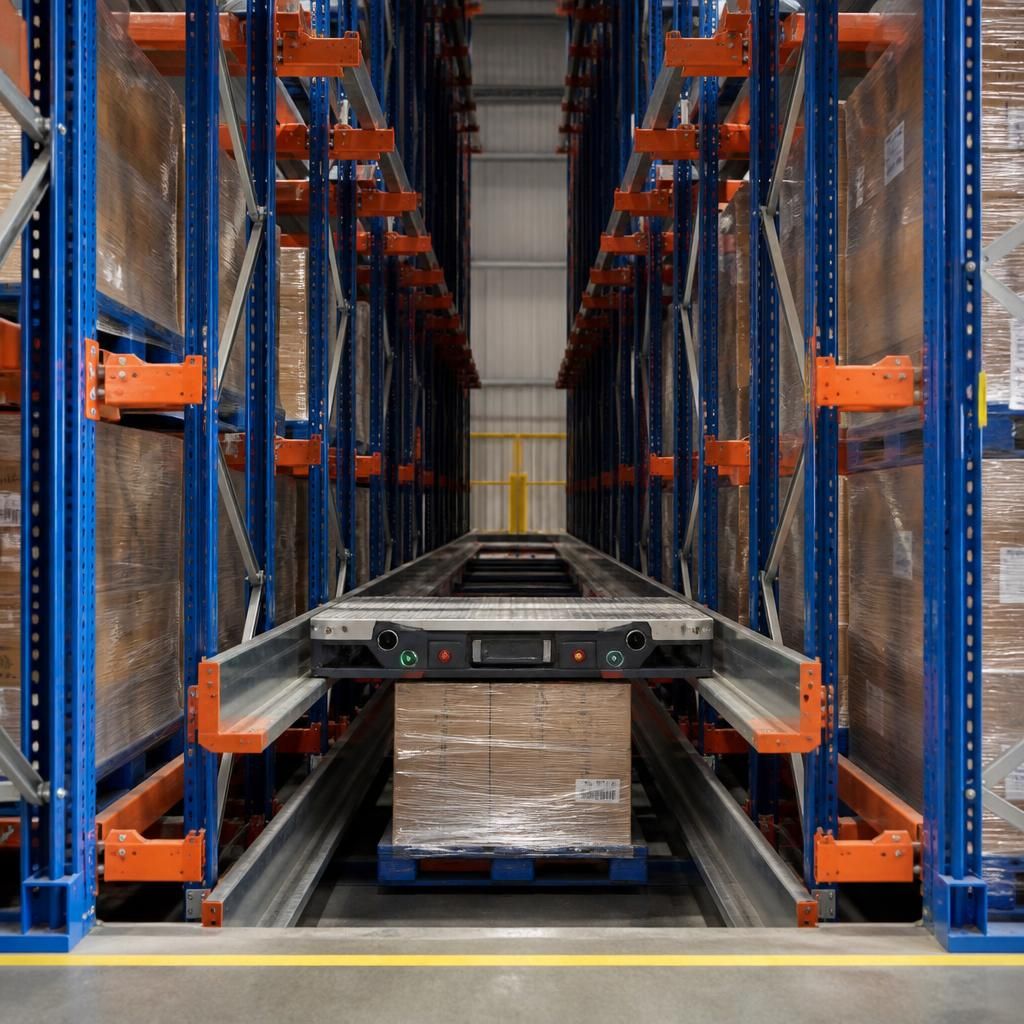
A key benefit of a shuttle racking system is that it increases pallet capacity without requiring a forklift to enter every deep storage channel. The pallet shuttle moves loads along the channel while the forklift remains at the loading face, helping reduce manoeuvring in confined areas and making repeated handling more consistent.
This arrangement can also improve warehouse safety when supported by suitable operator training, traffic controls, end stops, guide rails, load checks and routine inspections. It is particularly effective for warehouses storing batches of similar products, where dense storage and repeatable pallet movements are more important than immediate access to every individual pallet.
Discuss your shuttle racking requirements
Discuss your shuttle racking requirements with Able Racking to assess storage capacity, pallet handling needs, system suitability and ongoing safety arrangements for your warehouse.