
What are the differences between shuttle racking systems and traditional racking systems?
Shuttle racking systems use a powered pallet shuttle to move loads within deep storage lanes, whereas traditional pallet racking relies on a forklift entering each aisle and lane. Shuttle systems generally provide higher storage density and faster loading in suitable applications, while traditional systems offer more direct access to individual pallets and greater flexibility for varied stock.
Shuttle racking systems and traditional pallet racking differ mainly in how pallets are accessed and moved within storage lanes. A shuttle system uses a powered pallet shuttle to transport loads along deep lanes, while traditional pallet racking normally requires a forklift to enter the aisle and position or retrieve each pallet. Shuttle systems usually provide greater storage density and more efficient movement in suitable high-volume applications; traditional systems generally provide more direct access, greater selectivity and broader flexibility for different stock profiles.
How the systems operate
In a shuttle racking system, the powered shuttle runs on rails inside a storage lane. An operator or automated equipment places a pallet onto the shuttle, which then moves the load to an available position. The shuttle can bring pallets forward for collection or store them deeper within the lane without requiring the forklift to drive into the storage channel.
Traditional pallet racking is normally arranged in rows separated by forklift aisles. Forklift operators travel along the aisle, lift pallets to the required level and place them directly into individual locations. This arrangement gives the operator clear access to each pallet position, but the aisles and handling space take up part of the available warehouse footprint.
Storage density and use of space
The main space-saving advantage of shuttle racking comes from its deep-lane design. Several pallets can be stored behind one another, reducing the number of access aisles required. This can increase capacity within an existing building or help a business store more stock in a controlled-temperature area, where reducing the volume of space can be particularly useful.
Traditional pallet racking uses more aisle space because forklifts need room to manoeuvre and access individual locations. Its capacity may therefore be lower within the same footprint. However, the layout can be easier to adapt where stock dimensions, pallet types or access requirements vary regularly.
Access and stock selectivity
Traditional pallet racking offers high selectivity because each pallet position can normally be accessed without moving the pallets in front of it. This is useful where many product lines are held in relatively small quantities, or where orders regularly require specific pallets from different locations.
Shuttle racking is better suited to applications where pallets are stored in batches or where several pallets of the same product are held in the same lane. Because pallets are arranged in depth, accessing a pallet further back may require the loads in front of it to be removed or managed according to the system’s loading method. The system should therefore be planned around the required stock rotation method, such as first-in, first-out or last-in, first-out.
Handling speed and warehouse flow
A powered shuttle can carry out repeated storage and retrieval movements without a forklift entering every lane. This can reduce unnecessary forklift travel, support more consistent handling cycles and help separate vehicle movements from loading activity. It may be particularly effective where large volumes of similar pallets need to be stored or retrieved in an organised sequence.
Traditional pallet racking remains effective where operators need to move between many different locations and handle varied products. Forklifts can access individual positions directly, but performance depends more heavily on aisle congestion, operator movements and the availability of suitable handling equipment.
Forklift access and equipment requirements
Shuttle racking can reduce the need for forklifts to enter storage lanes. Forklifts may still be required to load and unload the system at the lane face, but the powered shuttle performs the horizontal movement inside the lane. This can reduce the risk associated with forklift travel in confined storage channels and may allow the warehouse layout to use narrower operating areas around the storage structure.
Traditional pallet racking requires handling equipment capable of safely reaching the relevant beam levels and working within the specified aisle width. The rack layout, forklift type, pallet dimensions and load weights must be considered together. Changing the handling equipment without reviewing the layout can create clearance, impact or stability risks.
Flexibility and stock variation
Traditional pallet racking is generally the more flexible option for mixed inventory. It can accommodate a broad range of product lines, provided the rack configuration, load capacities and pallet dimensions are suitable. Individual locations can be used for different products, which makes stock allocation and order picking more straightforward.
Shuttle racking is most effective when the stored loads have reasonably consistent dimensions and weights, and when lanes can be allocated logically by product, batch or stock rotation requirement. It may be less suitable where pallet sizes change frequently or where individual access to every pallet is essential.
Safety considerations
Both systems require competent design, correct installation, suitable load information and regular inspection. The structure must be used within its stated capacities, and pallets must be in good condition and suitable for the support arrangement. Damaged frames, beams, rails, guides or protective components should be reported and assessed promptly.
Shuttle systems introduce powered equipment, moving parts, control systems and batteries or charging arrangements. Operators need appropriate training in normal operation, isolation procedures, recovery of a stopped shuttle and safe access restrictions. Traditional pallet racking places greater emphasis on forklift traffic management, aisle discipline, impact prevention and maintaining safe clearances.
In either arrangement, unauthorised alterations, overloading, poor pallet placement and continued use after structural damage can compromise safety. Routine visual checks by warehouse staff should support, rather than replace, formal inspections by a competent person.
Installation, maintenance and operational disruption
Traditional pallet racking can often be installed in a straightforward layout, although the work still requires accurate setting out, suitable floor conditions and correct anchoring. Maintenance is primarily concerned with the structural components, protection systems, signage and the condition of the handling equipment used around the installation.
Shuttle racking requires attention to both the structure and the powered shuttle equipment. Rails must remain clear and correctly aligned, while shuttle batteries, controls, sensors and safety devices need inspection and planned maintenance. Any fault should be managed in accordance with the manufacturer’s instructions and the site’s isolation procedures.
Before choosing either arrangement, assess the likely installation programme, access to the warehouse during the work and the consequences of taking storage lanes out of service. A design that appears efficient on paper may not be suitable if it creates unacceptable disruption during implementation or maintenance.
Cost and long-term value
The most suitable comparison is not simply the initial purchase price. Shuttle racking may require greater investment in powered equipment, controls, batteries, protection and operator training. Its value comes from improved use of space, reduced forklift travel and efficient handling of repeat movements where the operating profile supports those benefits.
Traditional pallet racking may have a simpler equipment requirement and can be economical for varied, lower-volume or highly selective storage. However, the required aisles, forklift movements and available building space must be included when assessing its whole-life cost.
Which system is more suitable?
- Choose shuttle racking where high-density storage, repeat pallet movements, consistent loads and reduced forklift entry into storage lanes are important priorities.
- Choose traditional pallet racking where direct access to individual pallets, varied stock, frequent product changes or simple location flexibility is more important than maximum density.
- Consider a combined layout where bulk or reserve stock can use shuttle lanes while fast-moving, varied or order-picking stock remains in directly accessible storage locations.
The correct decision should be based on pallet dimensions and weights, stock rotation, product range, order frequency, available floor and clear height, forklift capability, operating procedures and future growth. A detailed site assessment can also identify floor, impact, access and inspection requirements before the system is specified. Whichever type of warehouse racking is selected, safe loading practices, operator training, planned maintenance and competent inspections are essential to preserve performance and protect people, stock and equipment.
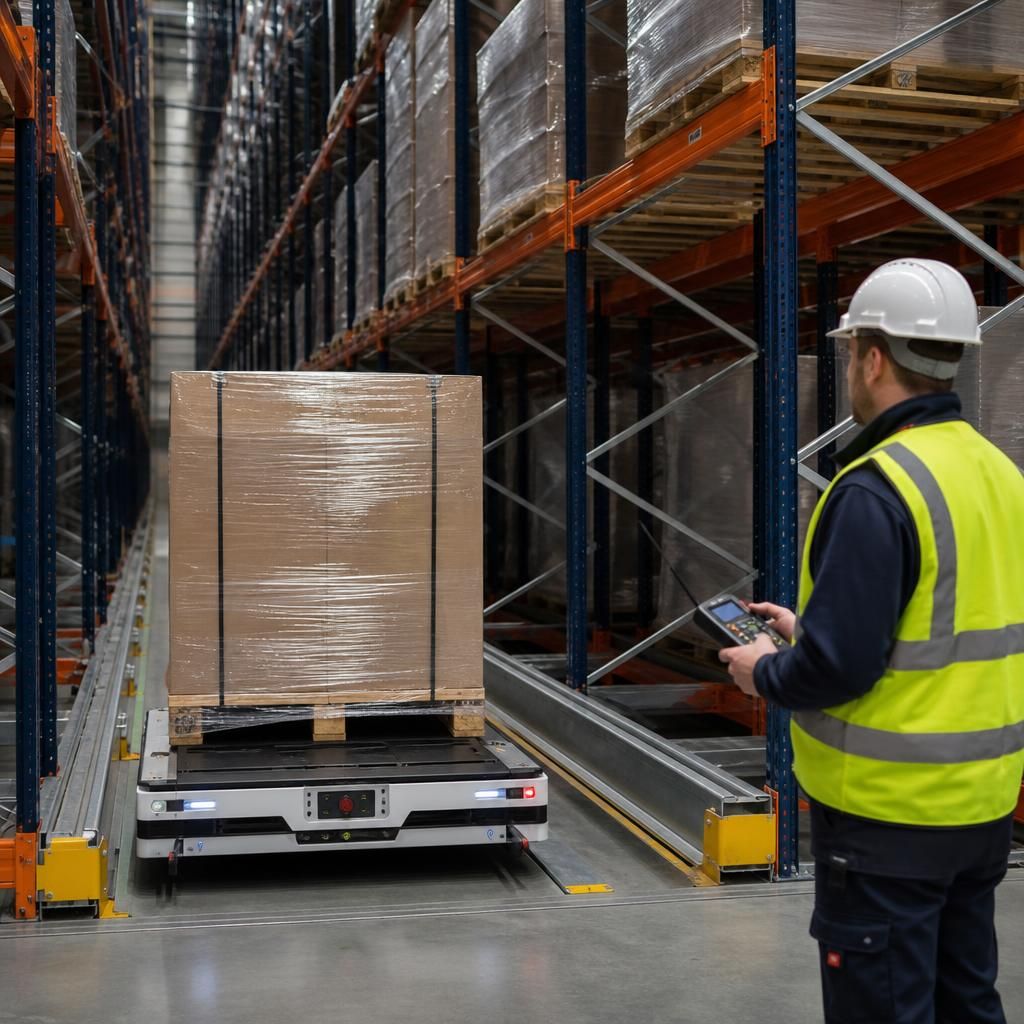
Shuttle racking systems use a powered pallet shuttle to move loads through deep storage lanes, whereas traditional pallet racking requires a forklift to access individual pallet positions from an aisle. This makes shuttle systems more space-efficient for consistent, high-volume stock, while traditional systems provide easier direct access to varied products.
The right choice depends on stock rotation, pallet dimensions, order frequency and the level of selectivity required. Shuttle racking is suited to batch storage and repeat movements, while traditional pallet racking is often preferable when operators need to reach specific pallets quickly. Both systems require suitable design, safe loading practices, operator training and regular inspections.
Discuss your shuttle racking requirements with our experts
Speak to our warehouse racking experts about your shuttle racking requirements. We can help assess your stock profile, space and operating needs to identify a suitable solution.