
What are the key safety measures for mobile racking systems? Key measures include competent design and installation, routine inspections, functioning safety controls and interlocks, clear operating procedures, planned maintenance and appropriate staff training.
Key safety measures for mobile racking systems include competent design and installation, routine inspections, effective safety controls and interlocks, clear operating procedures, planned maintenance and suitable staff training. These measures help protect people, prevent equipment and load damage, and maintain compliance with workplace safety requirements.
The key safety measures for mobile racking systems are competent design and installation, effective access controls, functioning safety devices, routine inspections, planned maintenance, clear operating procedures and suitable staff training. These controls must work together to protect people, prevent load and equipment damage, and keep the warehouse racking system compliant with applicable workplace safety requirements.
Use a competent designer and installer
Mobile racking should be designed for the building, floor construction, stored loads and intended method of operation. The design should account for the system’s total load, bay configuration, aisle requirements, rail layout, travel clearances and any interaction with handling equipment. Floor capacity and level tolerances are particularly important because the system moves along fixed rails and relies on accurate alignment.
Installation should follow the approved design and the manufacturer’s instructions. Rails, carriages, frames, guards, electrical components and control equipment must be correctly fitted and securely fixed. The completed installation should be checked before use, with any changes to the layout, load capacity or operating method assessed by a competent person rather than made informally.
Control access to moving aisles
Mobile systems create moving sections and opening aisles, so access must be controlled. Only authorised, trained employees should operate the system or enter an aisle while it is in use. Visitors, contractors and other people unfamiliar with the controls should be supervised and kept away from moving equipment.
Suitable arrangements may include key-operated controls, restricted operating areas, warning signs, barriers and clearly marked pedestrian routes. The operating area should be kept free from obstructions, with enough visibility for the operator to confirm that the aisle is clear before movement begins. Where visibility is limited, the site should provide an agreed communication method or additional safeguards.
Maintain safety controls and interlocks
Safety devices are essential because they help prevent movement when a person or obstruction is detected. Depending on the system, these may include emergency stop controls, light barriers, pressure-sensitive safety edges, proximity sensors, end stops, audible or visual warnings, door interlocks and anti-collision controls.
Operators should understand what each control does and should never bypass, isolate or obstruct a safety device. An interlock that prevents operation under unsafe conditions must not be treated as an inconvenience. If a safety control activates unexpectedly, stops responding or appears damaged, the system should be taken out of service or restricted until it has been assessed and made safe.
Emergency stops should be clearly identified, accessible and tested as part of the planned inspection regime. Testing must follow the manufacturer’s instructions and the site’s risk assessment so that it does not create an additional hazard.
Display load and operating information
Safe operation depends on keeping loads within the system’s stated capacities. Load notices should be legible and positioned where operators can see them. They should reflect the installed configuration, including bay capacities, shelf or beam capacities where relevant, and any restrictions on load placement.
Loads should be stable, suitable for the support equipment and positioned so that they cannot fall, project into the aisle or interfere with movement. Damaged pallets, unsuitable containers and poorly secured goods should not be stored. Operators should not alter components, remove protective parts or change the arrangement of stored loads without approval from a competent person.
Apply clear operating procedures
A written procedure should explain how to open and close aisles, check that people and obstructions are clear, operate the controls, respond to an alarm and deal with a fault. It should also cover pedestrian access, use of lift trucks or other handling equipment, parking arrangements and the action to take during a power failure or emergency.
Before moving a section, the operator should check the full travel path and confirm that nobody is working inside the aisle or between moving sections. Loads should be positioned within the designated storage space, and loose items should be removed before movement. Movement should be stopped immediately if a person enters the controlled area, an obstruction is detected or the system behaves abnormally.
Housekeeping is part of safe operation. Rails, floor channels and aisle areas should be kept clear of packaging, pallets, spillages and debris. Poor housekeeping can restrict movement, affect detection equipment or create a trip hazard for anyone accessing the system.
Complete routine inspections
Inspections should be proportionate to the system, its use and the risks identified at the site. Operators should carry out suitable pre-use or routine checks, looking for visible damage, unusual noise, control faults, damaged guards, displaced rails, obstruction of sensors and signs that the system is not travelling correctly.
A more detailed inspection should be completed at planned intervals by a technically competent person. This should consider the structure, rails, carriages, fixings, guards, electrical and control systems, safety devices, signage and the condition of stored loads. Findings should be recorded, prioritised and assigned to a responsible person. Any serious defect should lead to the affected area being isolated until the risk is controlled.
Inspection records should identify the date, equipment examined, defects found, recommended action and completion status. A record alone does not make the system safe; corrective work must be completed promptly and checked afterwards.
Plan preventative maintenance
Maintenance should follow the manufacturer’s recommendations and take account of operating conditions such as dust, temperature, humidity, cleaning chemicals, frequency of movement and the type of handling equipment used nearby. Planned work may include checking drive components, rails, wheels, bearings, fixings, electrical connections, sensors, controls and emergency equipment.
Maintenance should be carried out by appropriately competent personnel using safe isolation procedures. Before work begins, the system should be prevented from moving unexpectedly and the affected area should be secured. Following maintenance, safety devices and operating functions should be tested before the equipment is returned to normal use.
Train operators and other users
Training should be specific to the installed mobile system and the work carried out in the warehouse. It should cover the controls, load limits, aisle checks, warning devices, emergency stops, pedestrian safety, fault reporting and the site’s isolation procedure. Employees should know that they must not continue operating the system when a defect, impact or unusual movement has been identified.
Refresher training is appropriate when the system, layout, loads, staffing or operating procedure changes, and when inspections or incidents indicate that existing knowledge is insufficient. Training should be supported by supervision and documented so that managers can confirm who is authorised to operate the equipment.
Manage changes, impacts and emergencies
Any impact from a lift truck, pallet or other equipment should be reported, even when damage is not immediately obvious. The affected area should be assessed before further use because distortion to a frame, rail or guard can affect movement and stability. Repairs should use suitable components and be completed in accordance with the system design or manufacturer’s requirements; improvised straightening or unauthorised modifications can introduce further risk.
The site should also maintain an emergency plan covering entrapment, power loss, fire, system malfunction and evacuation. Employees need to know how to stop the equipment, raise an alarm, restrict access and summon assistance. Emergency arrangements should be reviewed alongside the warehouse risk assessment and tested where appropriate.
For established warehouse racking safety, the most effective approach is a documented cycle of competent design, controlled operation, staff training, routine checks, formal inspections and preventative maintenance. Reviewing these measures together helps identify recurring defects and ensures that mobile racking systems remain safe as workloads, layouts and warehouse activities change.
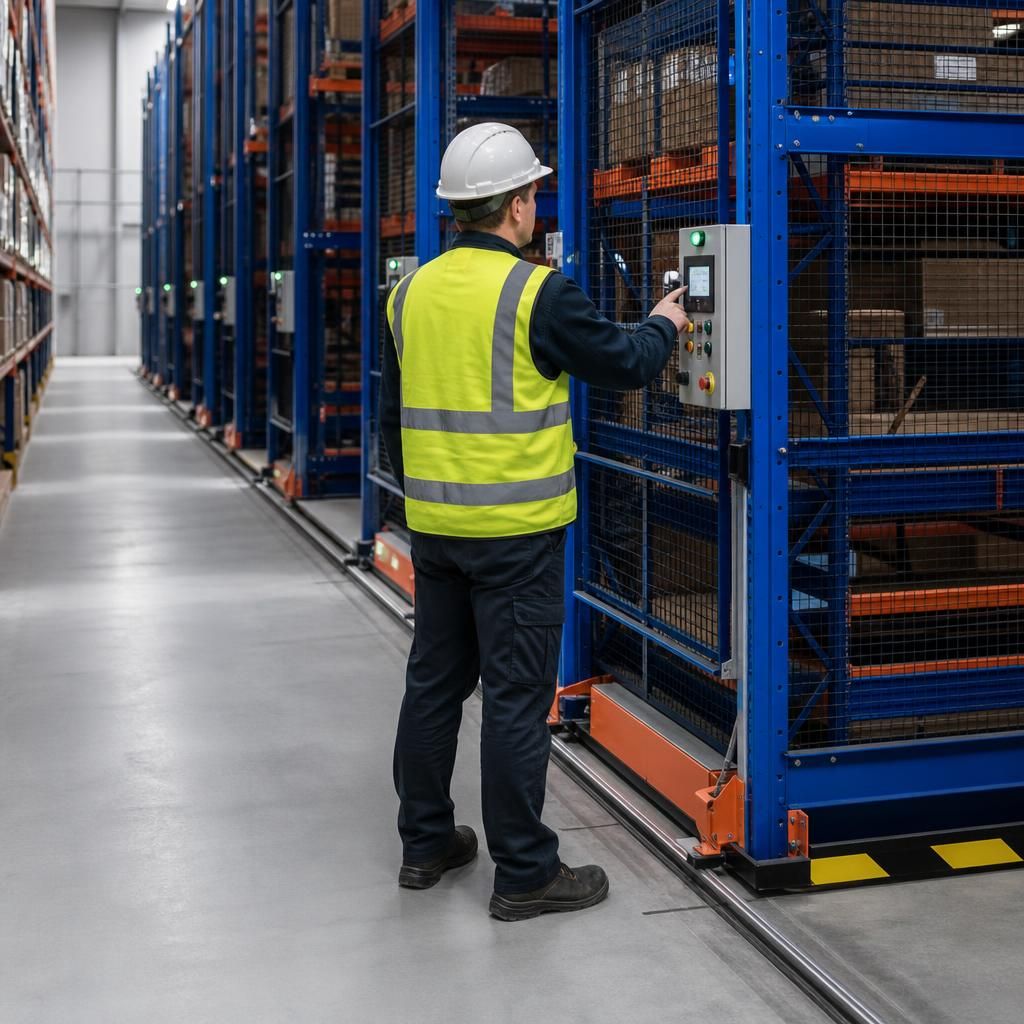
Routine testing of safety controls is a critical safety measure for mobile racking systems. Emergency stops, light barriers, pressure-sensitive edges, warning alarms and anti-collision devices must function correctly to prevent movement when a person or obstruction is detected.
Operators should never bypass or obstruct a safety device. If a control activates unexpectedly, appears damaged or fails during a check, the affected system should be isolated and assessed by a competent person before it is used again. Test results and any corrective action should be recorded as part of the planned inspection and maintenance process.
Book a mobile racking safety inspection
Book a mobile racking safety inspection with Able Racking to identify defects, check safety controls and confirm that your system remains safe to operate. Contact our experienced team to arrange an inspection.