
How do mobile racking systems ensure safety and compliance in a warehouse setting?
Mobile racking systems support warehouse safety and compliance through controlled movement, interlocks, access controls and physical protection that reduce collision, trapping and unauthorised-access risks. Compliance also depends on a suitable risk assessment, competent installation, documented inspections, prompt repairs, effective operator training and maintenance in line with the manufacturer’s instructions and applicable UK health and safety requirements.
Mobile racking systems support safety and compliance by controlling movement, restricting access to operating areas and protecting the structure from foreseeable damage. Safe performance depends on more than the equipment itself: the system must be correctly specified and installed, operated by trained people, inspected at suitable intervals and maintained in accordance with the manufacturer’s instructions and applicable UK requirements.
Risk assessment and system design
A suitable and sufficient risk assessment should consider how the mobile racking will be used, the stored loads, vehicle movements, pedestrian routes, floor condition, emergency access, lighting and the consequences of a power or control failure. The design should account for the building structure, floor loading capacity, aisle requirements, load dimensions and any environmental conditions such as temperature, dust or moisture.
Safety features should be selected according to the risks identified. These may include controlled-access systems, emergency-stop controls, end-of-aisle barriers, warning beacons, audible alarms, obstruction sensors, travel limits and interlocks that prevent movement when an aisle is occupied. The exact arrangement will depend on the equipment design and the operating environment.
Competent installation and commissioning
Installation should be completed by competent operatives using the approved layout, technical information and manufacturer’s instructions. The installation team should verify that the rails, drive units, frames, bracing, guards, controls and safety devices are correctly positioned and securely fixed. The supporting floor must be suitable for the loads and anchoring arrangements, with any deviations addressed before the system is put into service.
Commissioning should include functional checks of movement controls, emergency stops, access controls, sensors, alarms and obstruction protection. Operating instructions, load information and safe working procedures should be available to the people who use and supervise the system. Any changes to the layout, stored loads or control arrangements should be reviewed rather than treated as minor adjustments.
Controlled movement and access
Mobile racking creates moving aisles, so access control is essential. The system should prevent movement when people are inside a travelling aisle and provide a reliable method for stopping movement in an emergency. Operators should check that the aisle is clear before closing or moving it, follow the approved control sequence and never bypass interlocks, sensors or other protective devices.
Pedestrian and vehicle routes should be separated where practicable. Barriers, floor markings and site rules can help prevent collisions with the structure and reduce the risk of people entering an operating area unexpectedly. Good housekeeping is also important because pallets, packaging or loose materials in the travel path can cause obstruction, damage or unexpected system stops.
Loading and day-to-day use
Loads must be within the stated capacity of the system and should be stable, correctly positioned and suitable for the supporting beams, shelves or trays. Operators should not place damaged pallets, protruding goods or uneven loads into storage positions. Load notices should remain visible and reflect the current configuration; altering beam levels or adding components can change the safe capacity.
Impact from handling equipment is a common cause of damage. Drivers should use appropriate speeds, maintain visibility and keep forks or other attachments clear of the frames and guards. Damage such as bent uprights, displaced components, broken guards, rail defects or abnormal noise should be reported immediately. The affected area should be made safe and, where necessary, taken out of use until assessed by a competent person.
Inspection and maintenance
Routine checks by trained site personnel can identify obvious damage, leaks, unusual movement, control faults, missing components and housekeeping issues. These checks do not replace a formal inspection by a technically competent person. The inspection programme should be based on the system’s use, risk profile and manufacturer’s guidance, with more frequent attention where there is heavy vehicle traffic, frequent movement or a history of impact.
Inspection records should identify the equipment examined, findings, required actions and completion status. Defects should be categorised according to their seriousness, communicated to responsible managers and rectified within an appropriate timescale. A damaged component should not simply be straightened, welded or replaced with an unapproved alternative. Repairs and alterations should be assessed for compatibility and completed using suitable parts and methods.
Preventative maintenance should cover drive systems, rails, wheels, bearings, electrical equipment, controls, sensors, alarms, emergency stops, barriers and protective devices. Maintenance should be planned to minimise disruption without encouraging the system to remain in service with a known safety defect. Isolation procedures should be followed before maintenance or clearing an obstruction.
Training and supervision
Anyone who operates, loads, supervises, inspects or maintains the system should receive instruction appropriate to their role. Operator training should cover normal controls, access restrictions, load limits, emergency stops, fault reporting and actions following a power failure or unexpected movement. Refresher instruction is appropriate when the equipment, layout, work process or workforce changes, or when observations show that procedures are not being followed.
Supervisors should monitor compliance with site rules and ensure that only authorised people use the controls. Contractors and temporary workers also need clear information about access restrictions, traffic routes, emergency arrangements and reporting procedures.
Evidence of compliance
Businesses should retain the information needed to demonstrate that the system is being managed safely. This may include the risk assessment, design and installation information, commissioning checks, manufacturer’s instructions, training records, inspection reports, maintenance records, repair evidence and records of any modifications. Documentation should reflect the equipment currently in use rather than an earlier layout or specification.
UK duties will depend on the system and how it is used. They may include requirements relating to the provision and use of work equipment, workplace conditions, manual handling, workplace transport and electrical safety. A competent assessment should determine which requirements apply. Where the equipment includes lifting functions or other separately regulated machinery, additional checks may be necessary.
In practice, mobile racking remains compliant when safety is managed as an ongoing process: assess the risks, install the correct system, protect moving areas, train users, inspect regularly, maintain safety devices and close out defects promptly. Able Racking can support this process through warehouse racking inspections, safety advice, repairs, installation support and training tailored to the way the system operates.
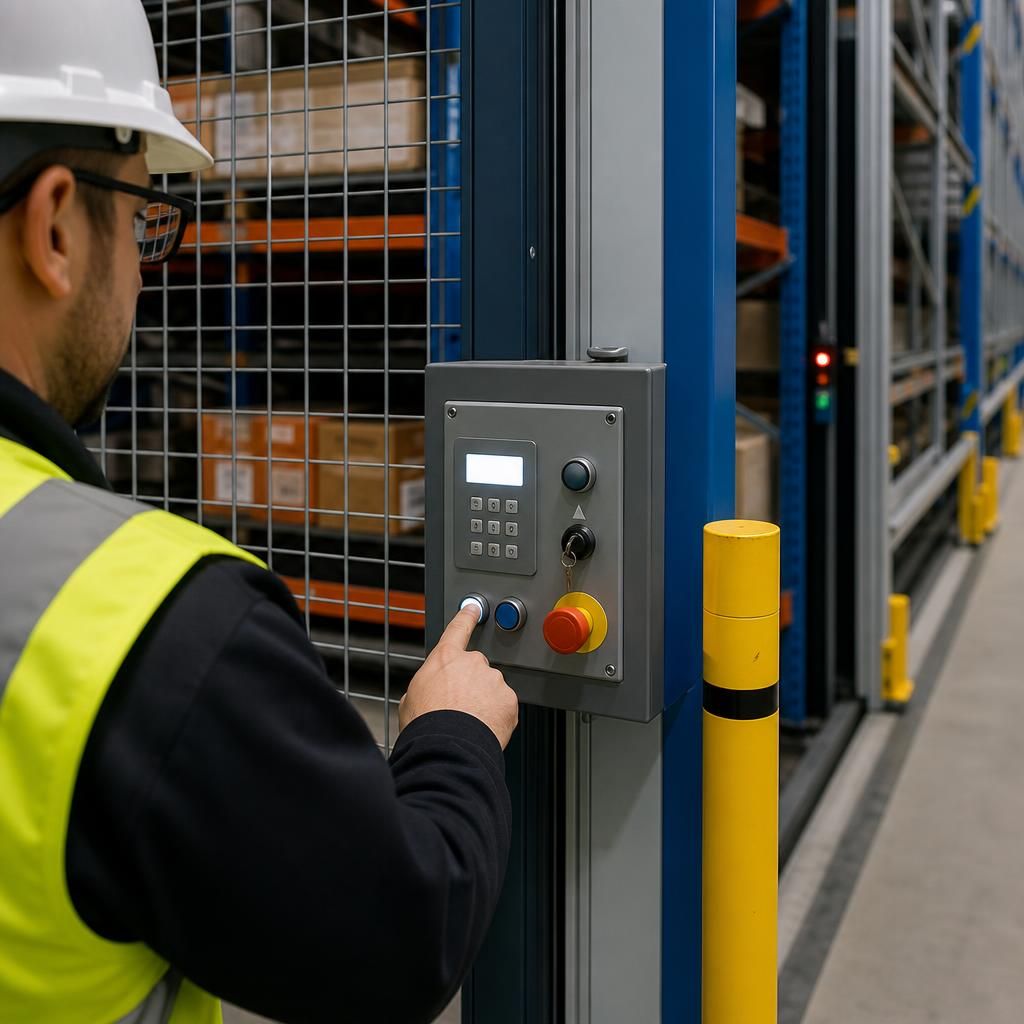
Interlocks and access controls are central to the safe operation of mobile racking systems because they prevent an aisle from moving while a person is inside it. Sensors, emergency-stop controls, warning alarms and travel limits should work together to restrict movement, identify obstructions and allow the system to be stopped quickly when required.
These safeguards must be checked during commissioning, routine inspections and planned maintenance. Operators should confirm that the aisle is clear before movement, follow the approved control sequence and never bypass a sensor or interlock. Any failed safety device, unexpected movement or damaged protection should be reported immediately, with the affected aisle isolated until a competent person has assessed it.
Arrange a mobile racking safety inspection
Arrange a mobile racking safety inspection with Able Racking to identify defects, check protective systems and support ongoing compliance. Contact our experienced team to book an inspection tailored to your warehouse.