
How do mobile racking systems differ from static racking options?
Mobile racking systems are mounted on powered or manually operated bases that move along floor tracks, allowing aisles to open only where access is needed. Static racking remains fixed in place, providing continuously accessible aisles but generally requiring more floor space for the same storage capacity.
Mobile racking systems are storage units installed on powered or manually operated bases that travel along floor-mounted rails, while static racking is fixed in position with permanent access aisles. The main difference is how space and access are managed: mobile systems open an aisle only when required, whereas static systems keep aisles continuously available. This affects storage density, picking speed, installation requirements, cost, safety controls and the suitability of each system for a particular warehouse.
How the two systems are arranged
Static racking consists of fixed upright frames, beams and accessories arranged in rows. Each row normally has an access aisle beside it, allowing operators and handling equipment to reach stored goods without moving the rest of the installation. This straightforward layout is widely used for pallet storage, order picking and applications where frequent access to many locations is required at the same time.
Mobile racking uses similar storage components, but the rows are mounted on movable bases. When an operator selects a location, the relevant bases move to create an access aisle. Once the task is complete, the aisle can be closed again, removing the unused passage from the layout. The system therefore provides direct access to selected locations without requiring a permanent aisle between every row.
Space utilisation and storage capacity
The most significant practical difference is the use of floor space. Static racking needs fixed aisles throughout the installation, so part of the available floor area is dedicated to circulation. Mobile racking can reduce the amount of permanently unused aisle space and may allow more storage within the same building footprint.
This does not mean that mobile equipment automatically provides the best solution for every warehouse. The available capacity depends on the building dimensions, load sizes, handling equipment, clearances, floor condition and the required number of open aisles. A properly designed static layout may be more effective where rapid access is more important than maximum density, while a mobile layout may be appropriate where floor space is restricted or storage demand is high.
Access and day-to-day operation
Static racking provides immediate access to multiple aisles. Several operators or trucks can work in different areas at the same time, subject to the site’s traffic management arrangements. This can support high-throughput picking and fast replenishment, particularly where stock locations are accessed continuously.
Mobile racking introduces an access sequence. The operator must request or select the required aisle, wait for the bases to move and then complete the task. Modern systems include controls and safety features to manage this process, but the movement of the installation still needs to be considered when planning workflow. If several tasks regularly require access to different aisles simultaneously, the layout and operating procedure must be designed to prevent delays.
Mobile systems can be configured with controls that allow authorised users to open an aisle from a local panel or other approved interface. Access permissions, emergency stop controls and operating instructions should be clear to all relevant staff. Static systems have fewer moving parts, but they still require controlled access, suitable handling equipment and safe working procedures.
Cost and installation considerations
Static racking is generally simpler to install because the frames and beams are fixed directly to the floor in a planned arrangement. Its initial cost is influenced by the storage configuration, load requirements, protection, access equipment and installation conditions.
Mobile racking includes additional components such as rails, bases, drive mechanisms, controls, sensors and safety devices. This can make the design and installation more complex and may result in a higher initial investment. The building floor must be suitable for the loads and the installation must be accurately levelled and aligned. Electrical supply, control equipment and safe access for installation and future maintenance also need to be considered.
Cost should therefore be assessed over the full operating life of the system rather than by purchase price alone. Potential benefits of mobile storage include better use of existing floor space and the ability to increase capacity without extending the building. These benefits need to be weighed against the cost of specialist installation, planned maintenance, inspections, energy use where applicable and any effect on operating speed.
Safety differences
Both systems must be correctly specified, installed, loaded and maintained. Static racking can be damaged by forklifts, pallet impact, overloading or unauthorised alterations. Mobile racking has these risks as well as hazards associated with powered movement, trapping points, unexpected movement and the opening or closing of aisles.
Mobile installations require additional controls to ensure that people and equipment are clear before movement takes place. These may include presence sensors, barriers, interlocked access controls, audible or visual warnings, emergency stops and defined operating zones. The exact safeguards depend on the equipment design, operating environment and risk assessment.
Routine visual checks should identify impact damage, displaced components, missing safety devices, unusual noise, rail obstructions and signs of uneven movement. Any defect that could affect stability or safe operation should be reported promptly and the affected area should be isolated where necessary. Formal inspections should be completed by a suitably competent person at the frequency required by the site’s risk assessment and relevant guidance.
Maintenance requirements
Static racking has relatively few moving parts, so maintenance is mainly concerned with structural condition, fixings, beam security, protection and damage caused by handling equipment. Regular housekeeping is also important because blocked aisles, loose packaging and damaged pallets can create additional risks.
Mobile racking requires these same checks plus maintenance of the rails, wheels, motors, chains or drive components, controls, sensors and emergency systems. Rails must remain clear and correctly aligned. Wear, contamination or obstruction can affect movement and place additional strain on the drive system. Maintenance should follow the manufacturer’s instructions and be carried out by people with the necessary competence.
Inspection records should identify the location and nature of any defect, the action required and the date of completion. Repairs should use compatible components and must not involve improvised alterations. Able Racking can help review the condition of the installation, identify developing faults and establish a practical inspection and maintenance routine.
Which option is appropriate?
Static racking is often suitable when:
- Goods must be accessed frequently and simultaneously from several aisles.
- Fast picking and simple traffic flow are the main priorities.
- The warehouse has sufficient floor area for permanent access aisles.
- The operation benefits from a familiar layout with minimal mechanical complexity.
Mobile racking may be more suitable when:
- Storage capacity needs to be increased within an existing building.
- Floor space is limited or expensive to expand.
- Goods are stored for longer periods and do not require every aisle to remain open.
- Controlled access and higher-density storage justify the additional design and maintenance requirements.
- The building floor, electrical supply and operating processes can support the installation.
The correct choice should be based on stock characteristics, pallet dimensions, load weights, access frequency, handling equipment, workforce movements, building constraints and future expansion plans. Temperature, dust, humidity and hygiene requirements may also affect the specification, particularly where electrical and mechanical components are exposed to demanding conditions.
Planning the change from static to mobile storage
Replacing fixed rows with mobile bases is not simply a matter of fitting the same storage equipment onto rails. The layout must account for open and closed aisle widths, emergency access, operator positions, fire protection, lighting, floor tolerances and the movement paths of handling equipment. A risk assessment should consider normal operation, faults, maintenance, cleaning and emergency release procedures.
Staff should receive instruction before using the system and should understand load limits, control functions, exclusion zones, emergency stops and the process for reporting damage. The installation should then be inspected after completion and whenever it is altered, relocated or affected by impact.
In summary, static racking prioritises continuously available access and operational simplicity, whereas mobile racking prioritises space efficiency and controlled access to storage locations. Neither option is universally better. A detailed assessment of the warehouse, stock profile and working practices will show whether the additional density of a mobile system provides a worthwhile benefit without compromising safe, efficient operation.
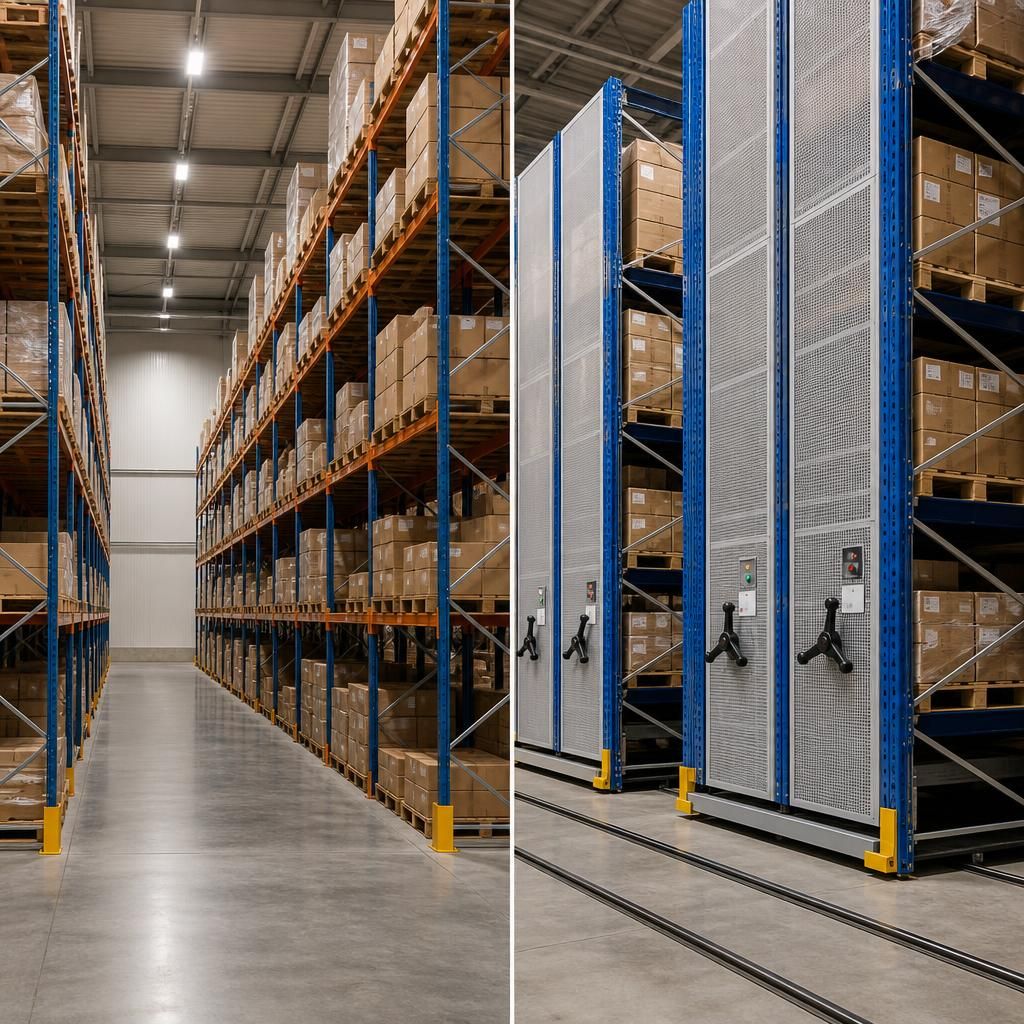
Mobile warehouse racking differs from static warehouse racking because its storage runs are mounted on powered or manually operated bases that move along floor rails. This allows an access aisle to be opened only where it is needed, whereas static warehouse racking has permanent aisles between fixed rows.
The space-saving benefit is most relevant where storage capacity is limited by the building footprint. By reducing the number of permanently open aisles, a mobile system may accommodate more storage in the same area. However, access is more controlled: operators must select the required aisle and wait for the bases to move before retrieving or placing goods.
Static warehouse racking can be preferable where several aisles need to remain available for simultaneous picking or replenishment. Mobile warehouse racking is more suited to operations where stock is accessed less frequently and higher storage density justifies the additional mechanical components, safety controls and maintenance requirements.
Get expert advice on mobile or static warehouse racking
If you are comparing mobile warehouse racking with static warehouse racking, Able Racking can assess your space, stock profile, access requirements and safety controls. Contact our experienced team for practical advice on selecting, inspecting and maintaining the right warehouse racking system.