
How do shuttle racking systems differ from traditional racking setups?
Shuttle racking systems use motorised pallet carriers to move loads within storage channels, whereas traditional warehouse racking relies on forklift access for placement and retrieval. This difference can improve storage density and handling efficiency, but traditional systems generally provide more direct access to individual pallets.
Shuttle racking systems use motorised pallet carriers to move loads through storage channels, while traditional warehouse racking normally depends on forklift trucks to place and retrieve pallets. The main differences are how pallets are accessed, how much storage density can be achieved, how goods flow through the warehouse and how the system is operated and maintained.
Neither approach is universally better. Shuttle racking is generally suited to warehouses storing high volumes of similar products, particularly where space is limited or pallet movements can follow a controlled last-in, first-out (LIFO) or first-in, first-out (FIFO) sequence. Traditional warehouse racking is often more suitable where individual pallet access, product variety and operational flexibility are the priorities.
How shuttle racking works
A shuttle system contains deep storage channels fitted with rails. A motorised pallet shuttle travels along these rails, carrying pallets into position and returning them to the channel opening when required. The operator typically places the pallet at the channel entrance using a forklift, then controls the shuttle using a remote control or warehouse management system, depending on the installation.
The forklift does not need to enter each channel to handle every pallet. This reduces the amount of aisle space required for direct access and limits the risk of impact caused by repeated forklift movements inside the storage structure. It does not remove the need for trained forklift operators, suitable traffic management or regular safety inspections.
How traditional warehouse racking works
Traditional selective pallet racking provides direct access to each stored pallet from an operating aisle. Forklift trucks place and retrieve loads at the required beam level, allowing stock to be selected without moving other pallets first.
This layout is highly adaptable where a warehouse holds many product lines, varying pallet quantities or stock with different turnover rates. However, the aisles needed for forklift access occupy valuable floor area, and the storage height and configuration must allow safe manoeuvring, load placement and retrieval.
Key differences between the two systems
- Access: Traditional warehouse racking normally offers direct access to individual pallets. Shuttle racking provides access through a channel, so pallets may need to be moved in sequence depending on the loading method and stock rotation policy.
- Storage density: Shuttle systems can store pallets more densely because they use deep channels and reduce the number of forklift aisles. Traditional layouts usually sacrifice some density to provide direct access.
- Handling equipment: Traditional systems rely more heavily on forklifts entering the storage aisles. Shuttle systems use forklifts mainly at the channel faces, with the carrier handling movement within the channels.
- Stock rotation: Shuttle systems can support LIFO storage efficiently. FIFO operation is also possible with an appropriate layout using loading and unloading faces, but the design must reflect the required flow of goods. Selective warehouse racking offers straightforward access for picking stock in the required order.
- Product range: Traditional warehouse racking is usually more flexible for warehouses with many stock-keeping units and low quantities per product. Shuttle systems are most effective where channels can be dedicated to consistent pallet types or product groups.
- Throughput: Shuttle carriers can reduce forklift travel and repeated entry into storage channels. Actual throughput depends on the number of carriers, channel layout, controls, loading processes, pallet condition and the wider warehouse operation.
- System dependency: Traditional storage can often continue operating with standard forklift procedures if a particular truck is unavailable. Shuttle systems depend on powered carriers, controls, charging arrangements and suitable maintenance procedures, so contingency planning is important.
Space utilisation and warehouse layout
Shuttle racking can make better use of available floor space by reducing aisle requirements and allowing greater storage depth. It can also use warehouse height effectively where the building structure, access equipment, fire strategy, lighting and load requirements permit. The available capacity should be assessed as usable pallet positions rather than simply as the maximum number of pallets that can fit inside the structure.
Traditional warehouse racking may require more floor area for aisles, but its open layout can make stock identification, order picking and replenishment easier. A warehouse with a broad product range may achieve better practical capacity with direct access than with a denser system that restricts stock placement or requires frequent pallet movements.
Operational and safety considerations
Shuttle systems reduce forklift movements within storage channels, but they introduce additional mechanical and electrical equipment. Operators need clear procedures for loading, unloading, remote control use, battery charging, fault reporting and recovery of a carrier that stops in a channel. Pallets must be suitable for the rails and carrier, with no damage or dimensions that could cause instability or obstruction.
Traditional warehouse racking requires careful control of forklift movements, pedestrian segregation, load placement and impact prevention. In both systems, the structure, protection, beams, uprights, decking, guides and associated components need to be checked for damage, displacement and overloading. Any defect should be reported and dealt with according to the site’s safety procedures before the affected area is returned to normal use.
Regular warehouse racking inspections remain important for both traditional and shuttle installations. A competent inspection should consider the structure, protection systems, loading information, operational damage and any changes made since the original installation. Shuttle equipment also requires planned servicing and checks of the carriers, rails, sensors, controls and batteries.
Which system is appropriate?
Shuttle racking is worth considering where the warehouse has high pallet volumes, repeatable product groups, a need to reduce forklift travel or limited space for additional aisles. It is particularly useful for buffer storage, chilled or frozen environments and operations where pallets are handled in batches rather than individually.
Traditional warehouse racking is often the better choice where the operation needs direct access to a wide range of products, frequent order picking from individual pallets or easy changes to stock locations. It may also be appropriate where the expected storage volume does not justify the additional controls, equipment and maintenance requirements of a shuttle installation.
A combined layout can be effective. For example, shuttle channels may hold reserve stock or high-volume products, while selective warehouse racking provides accessible locations for fast-moving lines, mixed pallets or picking activity. The correct arrangement depends on pallet dimensions, product characteristics, stock rotation, handling equipment, building constraints, fire protection and the warehouse management process.
Assessment before changing systems
Before choosing between shuttle and traditional warehouse racking, review the following:
- the number and type of pallets stored;
- the range and turnover of products;
- whether stock must follow FIFO, LIFO or another rotation method;
- required access to individual pallets;
- available floor area, clear height and slab capacity;
- forklift specifications, aisle requirements and operator routes;
- pallet quality and compatibility with the proposed carrier and rails;
- power, charging, controls, software and emergency arrangements;
- fire protection, inspection access and maintenance requirements; and
- how the system will operate during equipment faults or planned servicing.
The comparison should be based on the complete warehouse process rather than storage density alone. A design that holds more pallets but slows picking, restricts stock access or is not maintained correctly may not deliver better overall performance. A competent review of the layout, loading requirements and safety controls helps confirm whether shuttle racking, traditional warehouse racking or a combination provides the most suitable long-term solution.
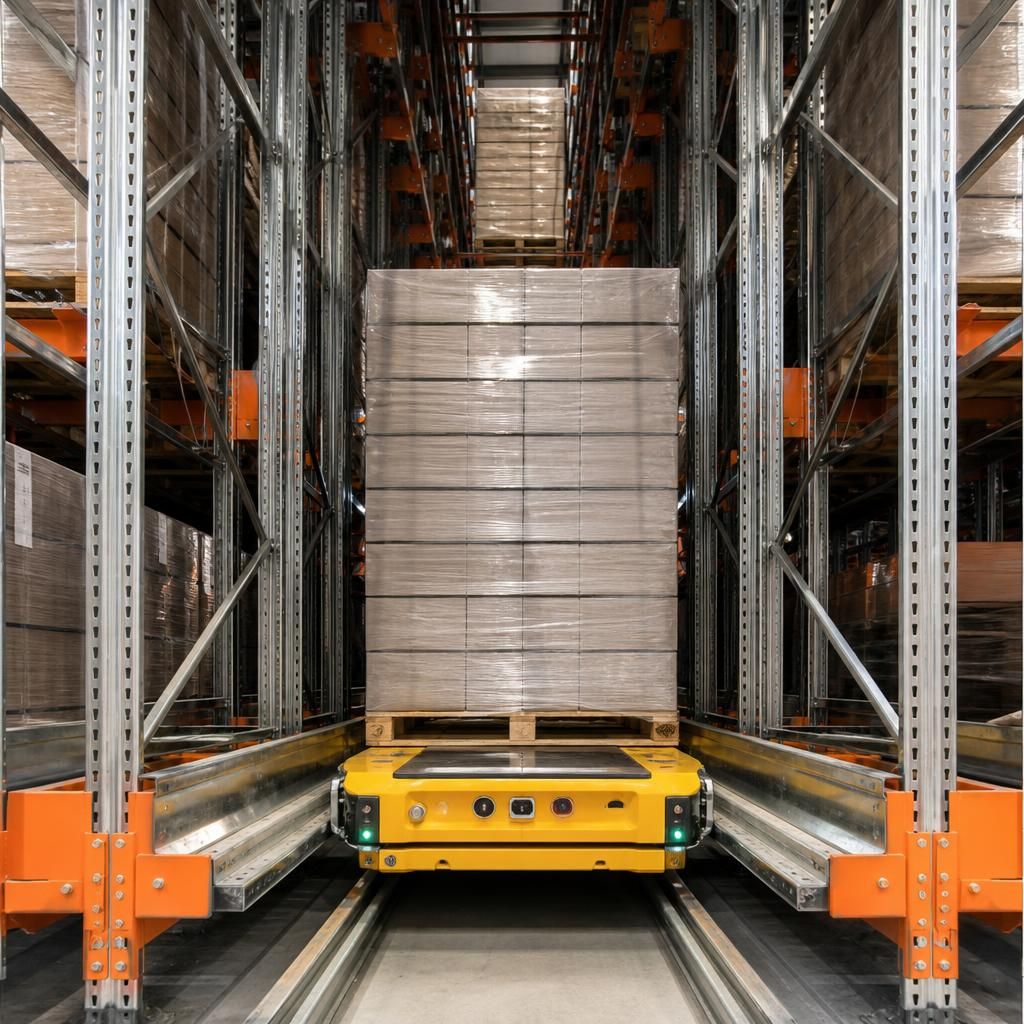
Shuttle racking systems use a motorised pallet carrier to move loads within deep storage channels, while traditional warehouse racking relies on forklift trucks entering aisles to place and retrieve each pallet. This allows shuttle systems to reduce aisle requirements and increase storage density where product volumes and pallet movements are consistent.
Traditional warehouse racking usually provides more direct access to individual pallets, making it suitable for varied stock and frequent order picking. The appropriate option depends on pallet compatibility, stock rotation, access requirements, available space and the warehouse’s handling processes.
Discuss Your Warehouse Racking Requirements
Discuss your warehouse racking requirements with Able Racking to assess whether shuttle racking, traditional warehouse racking or a combined solution is best suited to your storage, access and safety needs.