
What safety standards should be considered for drive-through warehouse racking systems?
Drive-through warehouse racking systems should be designed, installed and used in line with relevant BS EN standards, including BS EN 15629, BS EN 15512 and BS EN 15635, alongside HSE guidance such as HSG76. Safety controls should cover competent installation, declared load limits, impact protection, safe forklift operation, routine inspections, recorded repairs and prompt action on any damage.
Drive-through warehouse racking systems should be designed, installed and operated in accordance with the relevant British and European standards, particularly BS EN 15629, BS EN 15512, BS EN 15620 and BS EN 15635, together with HSE guidance such as HSG76. These requirements cover structural design, installation tolerances, declared load capacities, forklift movements, impact protection, inspections, maintenance and the control of changes or damage.
Compliance is not achieved by selecting a suitable system alone. The complete installation must be assessed in the context of the building, the stored goods, the pallets used, the handling equipment and the working methods followed by warehouse staff.
Relevant standards and guidance
- BS EN 15512 provides principles for the structural design of adjustable pallet storage systems. It supports the assessment of frames, beams, bracing, connections, stability and the loads imposed during normal use.
- BS EN 15629 covers the specification of storage equipment. It helps ensure that the system is selected and configured around the intended goods, pallets, handling equipment, building conditions and operating requirements.
- BS EN 15620 addresses installation tolerances and clearances. Correct alignment and suitable operating clearances are particularly important where forklift trucks enter storage lanes from either end.
- BS EN 15635 covers the application and maintenance of storage equipment. It sets out responsibilities for safe use, damage reporting, inspections, load notices, repairs and the management of altered systems.
- HSG76, Warehousing and storage, provides practical HSE guidance on workplace transport, storage arrangements, loading and unloading, pedestrian safety and the prevention of falling goods.
Other legal duties may also apply, including the Provision and Use of Work Equipment Regulations (PUWER) for forklift trucks and other work equipment, and the Health and Safety at Work etc. Act. The precise requirements depend on the installation and the activities carried out on site, so a competent assessment should be completed rather than relying on a generic checklist.
Design and structural safety
The system should be designed for the actual loads and operating conditions, not simply the maximum pallet weight quoted during procurement. The design assessment should consider pallet dimensions, load distribution, pallet quality, the number of storage levels, lane depth, frame height, floor capacity, building constraints, forklift characteristics and the impact of loading from both ends.
Drive-through lanes can be subject to repeated forklift movements and contact with supports, rails or pallet guides. The design should therefore account for the risks associated with entry and exit, turning or positioning loads, visibility and the possibility of uneven loading. Any site-specific design assumptions should be recorded and made available to the people responsible for operating and maintaining the system.
Installation must be carried out by suitably competent operatives in accordance with the design specification and manufacturer’s instructions. Frames should be plumb, connections correctly secured, bracing complete and floor fixings suitable for the substrate and imposed loads. Any deviation from the approved design should be assessed before the system is put into service.
Load capacity and identification
A clearly visible load notice should state the relevant capacity information and any restrictions needed for safe operation. It should reflect the installed configuration, including the beam or rail arrangement, storage levels, pallet type and permitted load distribution. The notice must be updated if the system is altered.
Operators should not guess whether a pallet can be stored safely. Loads that are heavier, wider, deeper or less stable than the design allows can overload components, reduce clearances or obstruct forklift access. Damaged pallets, poorly wrapped goods and unstable loads should be removed from service or made safe before entering a lane.
Changes such as moving beams, adding storage levels, replacing components with different parts or changing the type of forklift can affect structural performance. These changes should be approved by a competent person and, where necessary, supported by a revised design assessment. Unauthorised alterations can invalidate the original capacity information.
Forklift and workplace transport controls
Forklift trucks should be appropriate for the lane dimensions, load requirements and floor conditions. Drivers must be trained, authorised and familiar with the particular storage system. Operating procedures should address speed, visibility, safe positioning of loads, reversing, horn use where appropriate, pedestrian exclusion and the consequences of contacting the structure.
Drive-through arrangements require effective control at both ends of each lane. Measures may include defined traffic routes, one-way working where suitable, physical separation of pedestrians, signs, lighting, mirrors, barriers and agreed communication procedures. Both access points should be kept clear, and staff should never walk through a lane while a forklift is loading, unloading or travelling through it.
Forklift operators should approach squarely, keep loads stable and avoid using the structure to stop or guide the truck. Pallets should be placed fully and evenly on the intended support members. Where pallet guides, rails or other components are fitted, operators should understand their purpose and the limits of the equipment; they should not be treated as a substitute for careful driving.
Impact protection and falling-object prevention
Protection should be provided wherever the risk assessment identifies likely contact from forklift trucks or other mobile equipment. Depending on the layout, this may include upright guards, end-of-aisle barriers, guide rails, bollards and protection around exposed corners or vulnerable components. Protection must be compatible with the system and securely installed so that it does not create a new obstruction or trip hazard.
Protection does not remove the need for safe driving or inspections. A guard that has been struck may itself be damaged, displaced or no longer effective. It should be inspected after an impact and repaired or replaced when necessary.
The storage arrangement should prevent pallets or goods from being pushed through the rear of a lane, displaced from their supports or allowed to project into traffic routes. Backstops, pallet guides or other retention measures should only be used where they are suitable for the design and the loads. Goods should not be stored where they can fall into an adjacent working area or obstruct an escape route.
Inspection and maintenance requirements
BS EN 15635 places emphasis on a structured inspection and reporting process. The operator should nominate a person responsible for storage equipment safety, establish a method for reporting damage and ensure that concerns are assessed promptly.
Routine visual checks should look for bent or twisted uprights, damaged rails, loose or missing fixings, displaced bracing, impact marks, cracked welds, damaged guards, leaning frames, floor deterioration and changes to clearances. The condition of pallets and the stability of stored goods should also be checked. Any defect that could affect safe use should be reported immediately.
A competent expert inspection should be arranged at intervals not exceeding twelve months, or more frequently where the risk assessment, operating conditions or history of damage requires it. Inspection records should identify the location and nature of defects, the risk classification or action required, the person responsible and the date of closure.
Where damage is identified, the affected location should be unloaded and isolated if continued use could be unsafe. Repairs should use approved components and follow the manufacturer’s or designer’s instructions. Straightening damaged structural parts on site, welding without approval or using improvised materials can change the way the system carries load and should not be accepted as a routine repair.
Fire, housekeeping and emergency arrangements
Storage lanes, access routes, fire exits, firefighting equipment and emergency access points must remain clear. The arrangement should not interfere with sprinklers, lighting, fire detection equipment or building ventilation. Fire safety requirements can vary according to the building, commodity, storage height and protection system, so the warehouse’s fire risk assessment and any advice from the relevant fire safety specialists should be followed.
Good housekeeping reduces the likelihood of trips, collisions and unstable loads. Packaging, broken pallets, wrapping materials and spillages should be removed promptly. Floors should be maintained in a condition that allows forklifts to travel and position loads safely, particularly at lane entrances where damage or debris can affect control.
Practical compliance checks
- Confirm that the installed system has a suitable design specification and that the building and floor conditions have been considered.
- Check that the installation matches the approved design, including frames, rails, bracing, fixings, clearances and protective equipment.
- Verify that load notices are present, legible and correct for the current configuration.
- Assess forklift suitability, driver competence, traffic routes, pedestrian controls, lighting and visibility at both ends of the lanes.
- Check that pallets, goods and retention arrangements are appropriate for the system and do not create a falling-object risk.
- Maintain documented reporting, isolation, repair and reinspection procedures for damage.
- Arrange the required periodic expert inspection and retain evidence of completed corrective actions.
The safest approach is to treat drive-through warehouse racking as a complete work system rather than as isolated steelwork. Design compliance, competent installation, controlled forklift operation, suitable load information and disciplined inspection must work together. A documented review by an experienced storage equipment specialist can identify defects or unsafe practices before they lead to product loss, equipment failure or injury.
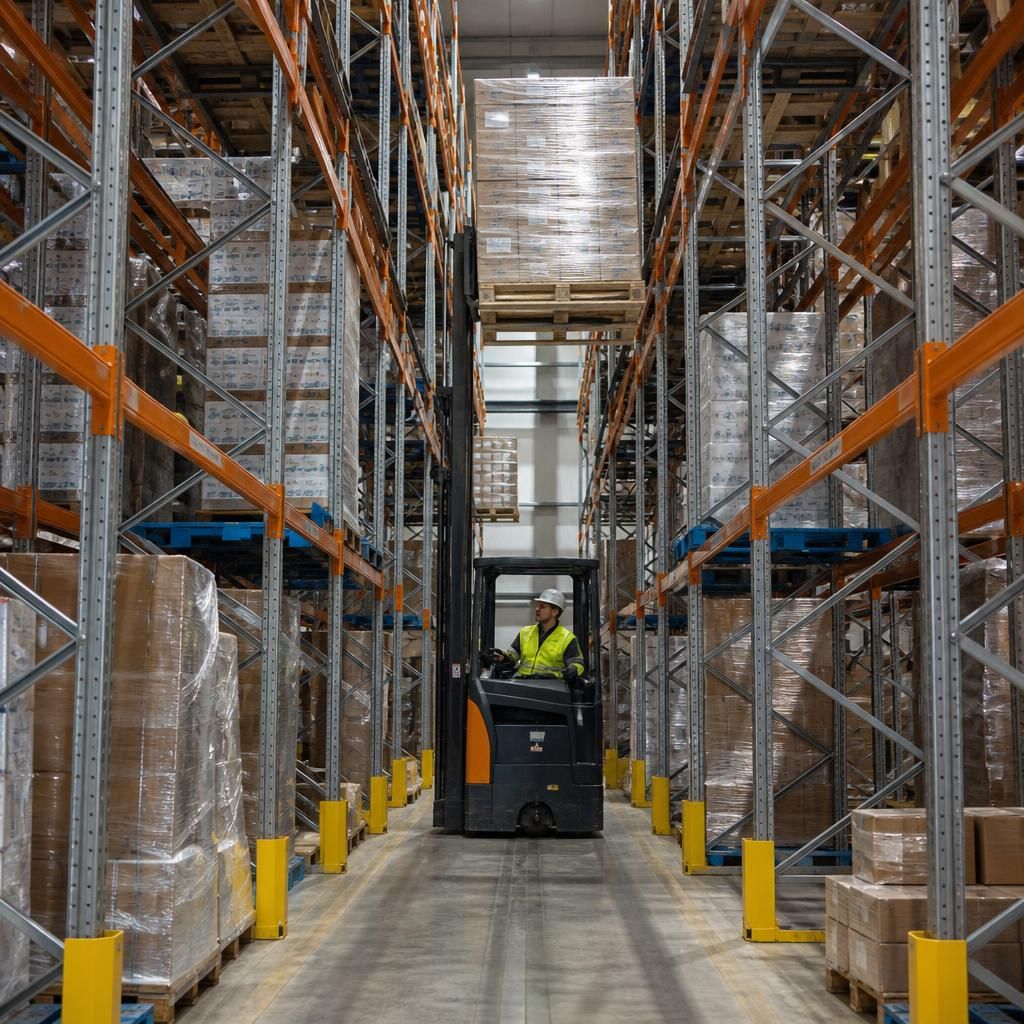
Regular inspections are a core safety requirement for drive-through warehouse racking systems because repeated forklift movements can damage uprights, rails, fixings and protective equipment. Visual checks should identify impact marks, leaning frames, loose components, damaged guards, poor pallet positioning and blocked access routes before the system is used further.
Any defect that could affect safe operation should be reported immediately, with the affected lane unloaded and isolated where necessary. Repairs must use suitable approved components, followed by a reinspection before the lane returns to service. A documented inspection process, supported by a competent expert assessment at appropriate intervals, helps demonstrate compliance with BS EN 15635 and supports safe day-to-day operation.
Arrange a Drive-Through Warehouse Racking Safety Inspection
Arrange a competent safety inspection of your drive-through warehouse racking system to identify damage, installation issues and compliance concerns. Contact Able Racking to discuss your inspection requirements and any recommended corrective work.