
What safety considerations are essential for drive-through warehouse racking systems?
Essential safety considerations for drive-through warehouse racking systems include a documented design and load assessment, clear operating procedures, protection against forklift impact, suitable pallet positioning, and routine inspections for damage or instability.
Forklift operators must be trained for the system and traffic layout, loads must remain within the specified limits, and any defect should be reported and repaired promptly by a competent person.
Essential safety considerations for drive-through warehouse racking systems are correct design and load assessment, controlled forklift movements, protection from impact, suitable pallet placement, clear operating procedures and regular inspections. Because forklifts enter storage channels and may approach from either end, poor visibility, incorrect pallet positioning and contact with the structure can create significant risks unless the system is properly managed.
Confirm the design and load limits
The drive-through warehouse racking system should be designed for the intended pallet dimensions, load weights, handling equipment and operating method. A competent designer or supplier should assess the building, floor condition, clearances, upright protection, pallet support arrangement and any restrictions on access from either end of a channel.
Every load notice should be accurate, securely displayed and easy for forklift operators to read. It should identify the permitted unit load, channel arrangement and any other restrictions relevant to the installation. Loads must never exceed the stated capacity, and changes to pallet type, product weight, forklift dimensions or storage layout should be reviewed before they are introduced.
Control forklift movements within the channels
Forklift operators should receive instruction specific to the drive-through warehouse racking layout, including the correct approach, speed, fork position, steering technique and exit procedure. Operators should be aware of the increased risk of striking rails, uprights or pallets when entering a channel, particularly where the load restricts forward visibility.
- Use a suitable speed for the aisle, floor condition, load and visibility.
- Keep forks level and positioned correctly before entering the channel.
- Do not turn, lift or reverse in a way that can contact the structure.
- Use designated pedestrian routes and follow site traffic controls.
- Prevent simultaneous movements where the channel layout or visibility creates a collision risk.
- Keep unauthorised people out of active storage channels.
Where forklifts can enter from both ends, the operating procedure should define how opposing traffic is prevented. This may involve one-way working, physical controls, communication arrangements or restrictions on using both ends at the same time, depending on the layout and risk assessment.
Protect the structure from impact
Impact protection should be selected for the actual risks presented by the forklifts and the installation. Upright guards, end-of-aisle protection, guide rails and other protective measures can reduce the likelihood and severity of contact, but they do not replace careful driving or regular checks. Protection must not obstruct access, interfere with pallet movement or conceal damage.
Any collision, even where there is no obvious distortion, should be reported immediately. The affected area should be isolated where necessary and assessed by a competent person before it is returned to service. Straightening, welding or improvised repairs should not be carried out without an appropriate technical assessment, as these actions can alter the strength and performance of the system.
Position pallets correctly
Pallets should be in good condition, compatible with the support rails and suitable for the loads being stored. Broken boards, missing components, loose loads and damaged feet can cause pallets to sit incorrectly or fall while they are being inserted or removed.
- Centre each pallet on its intended supports and keep it square to the channel.
- Make sure the load is stable, evenly distributed and not overhanging beyond permitted clearances.
- Do not place damaged pallets into storage until they have been assessed and made safe.
- Do not push one pallet against another or use the forklift to reposition a load by impact.
- Maintain the required clearances from uprights, rails, ceilings, lighting and other services.
- Keep stored goods within the approved load profile and prevent loose items from projecting into travel paths.
Particular care is needed when a pallet is stored at the rear of a channel. Operators should be able to identify the correct stopping position without relying on contact with the structure or another pallet. Physical stops or guidance equipment should only be used where they are part of the approved design and are suitable for the loads and handling method.
Maintain clear procedures and workplace controls
The site should have written procedures covering loading, unloading, access from each end, damaged pallets, product retrieval, pedestrian exclusion and emergency action. These procedures should reflect the actual warehouse racking arrangement rather than relying on general forklift training alone.
Good housekeeping is also a safety control. Floors should be kept free from shrink wrap, timber, spillages and other obstructions that could affect forklift stability or cause a person to slip. Lighting should provide sufficient visibility at channel entrances and exits, and signs should make traffic routes, restricted areas and operating rules clear.
Carry out routine inspections
Drive-through warehouse racking should be checked routinely for impact, movement, corrosion, missing components, loose fixings, damaged rails, distorted uprights and signs that pallets are not being supported correctly. Operators should report defects during their normal workplace checks, with findings recorded and passed to the person responsible for storage safety.
A more detailed expert inspection should be completed at planned intervals and at least within the period recommended by the applicable guidance and the installation risk assessment. In the UK, HSE guidance and BS EN 15635 are commonly used when establishing inspection arrangements. The frequency should be increased where the system experiences frequent forklift contact, harsh conditions, high turnover or repeated operational changes.
Inspection records should identify the location and nature of each defect, the action required, the responsible person and the completion status. Red-risk damage should result in the affected section being immediately offloaded and isolated until a competent person confirms that it is safe. Lower-risk defects should still be monitored and repaired within a defined timescale.
Manage alterations and repairs correctly
Components should not be removed, relocated or substituted without approval from a competent person. Altering beam levels, changing pallet supports or increasing the stored load can invalidate the original design assumptions. Any modification should be assessed, documented and reflected in the load notices and operating procedures.
Repairs should use suitable components and follow the system manufacturer’s or designer’s requirements. After repair, the affected area should be checked before use, and any temporary restrictions should remain in place until the work has been properly completed.
Provide suitable training and supervision
Forklift operators need the appropriate equipment training as well as site-specific instruction for the drive-through warehouse racking system. Refresher training or reassessment may be necessary after an incident, a significant layout change, a change of equipment or evidence that procedures are not being followed.
Supervisors should monitor loading practices, traffic behaviour and defect reporting. Training should cover the consequences of entering a damaged channel, exceeding load limits, using unsuitable pallets and allowing pedestrians into areas where forklifts are operating. A clear reporting culture helps prevent minor damage from developing into a more serious failure.
Consider fire and emergency arrangements
Stored goods, packaging and pallet materials can affect fire risk and access for emergency response. The warehouse racking layout should not obstruct fire equipment, emergency routes, sprinkler coverage or required clearances. Any fire protection requirements should be confirmed with the relevant competent fire safety professional, taking account of the building, stored products and insurance conditions.
Emergency procedures should explain how to isolate a damaged channel, deal with a fallen load, report a collision and prevent access while an assessment is taking place. Staff should know who is authorised to release an isolated section back into service.
In practice, the safest drive-through warehouse racking systems are those that combine a suitable design with disciplined daily operation. Capacity information, trained operators, controlled traffic, compatible pallets, impact protection and documented inspections must work together. Prompt reporting and competent repairs are essential: a system should never remain in use simply because damage appears minor or the warehouse is busy.
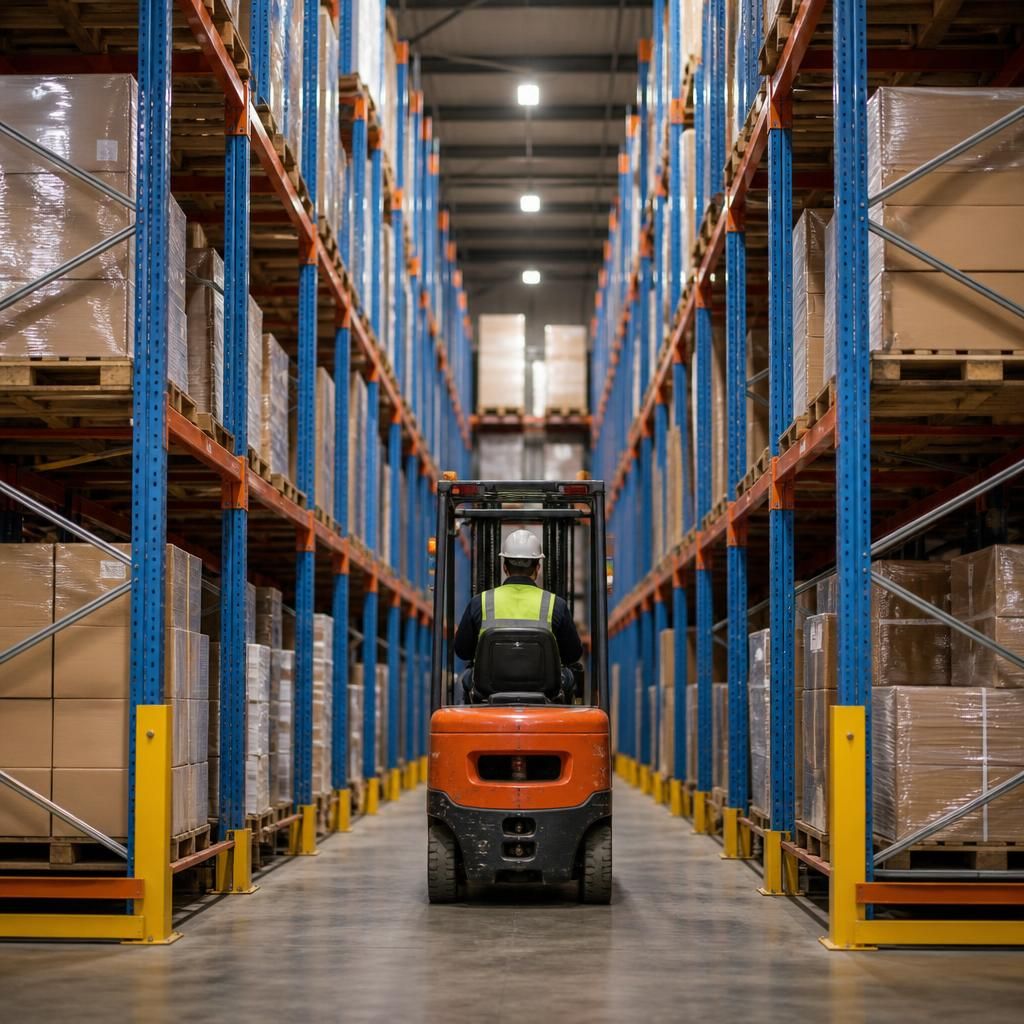
Routine inspections are essential for identifying damage in drive-through warehouse racking before it affects stability or safe operation. Check uprights, rails, fixings, pallet supports and protection equipment for impact, distortion, corrosion, looseness or displacement, paying particular attention to channel entrances where forklift contact is more likely.
Any damage should be reported immediately, with the affected area isolated and assessed by a competent person where necessary. Do not straighten, weld or improvise repairs. Record the defect, required action and completion status, and only return the storage location to service once it has been confirmed safe.
Book a Drive-Through Warehouse Racking Safety Inspection
Arrange a professional drive-through warehouse racking safety inspection to identify damage, confirm safe operation and support ongoing compliance. Contact Able Racking to book an inspection for your warehouse.