
What is the difference between drive-through warehouse racking and drive-in racking systems?
Drive-through warehouse racking is accessible from both ends, allowing forklifts to load from one side and unload from the other, while drive-in racking is accessed from one end only. This means drive-through systems support first-in, first-out stock rotation, whereas drive-in systems generally operate on a last-in, first-out basis and are suited to fewer product lines with larger quantities.
Drive-through warehouse racking is accessible from both ends of each storage lane, whereas drive-in racking is accessed from one end only. This difference affects how pallets are loaded and retrieved, how stock is rotated, the number of product lines that can be stored and the type of warehouse operation each system suits.
Both systems are designed for high-density pallet storage. Forklift trucks enter the storage lanes rather than placing pallets into individually accessible beam positions. This reduces the amount of space used for aisles, but it also means that the layout, operating method and stock-control requirements must be assessed carefully before installation.
Drive-through warehouse racking
In a drive-through system, forklifts can enter a lane from either end. Pallets may be loaded from one side and collected from the opposite side, creating a continuous flow through the storage lane. This supports a first-in, first-out stock rotation method, commonly referred to as FIFO, where the oldest suitable stock is picked first.
Drive-through warehouse racking is generally suitable where:
- Stock needs to move through the storage system in a controlled sequence.
- Goods have a defined shelf life or require regular rotation.
- There is a separate loading side and unloading side.
- High pallet throughput is more important than direct access to every pallet.
- The warehouse handles relatively consistent pallet types and product flows.
Because both ends need to remain usable, the system usually requires suitable access routes on each side. The warehouse layout must also provide enough space for forklifts to approach, align with and safely enter the lanes. Any obstruction, change in traffic flow or unauthorised use of an access end can reduce the intended benefit of the system.
Drive-in racking
Drive-in racking has one operating face. Forklifts enter and reverse out of the same end of a storage lane, with pallets loaded and retrieved from that access point. The last pallet placed into a lane is typically the first pallet removed, creating a last-in, first-out stock rotation method, known as LIFO.
Drive-in racking is generally suitable where:
- Large quantities of the same product or pallet type are stored together.
- Stock rotation is less time-sensitive.
- There is no operational need for separate loading and unloading sides.
- Storage density is a priority.
- The warehouse can manage a smaller number of product lines in deeper storage lanes.
Since drive-in racking only needs one operating face, it can often provide a denser storage arrangement than a comparable drive-through layout. However, this density comes with reduced selectivity. Pallets deeper in a lane cannot normally be reached without moving the pallets positioned closer to the access point.
Key operational differences
- Access: Drive-through warehouse racking has access at both ends, while drive-in racking has access at one end.
- Stock rotation: Drive-through systems can support FIFO rotation; drive-in systems generally support LIFO rotation.
- Product flow: Drive-through systems can separate loading and unloading activities, whereas drive-in systems combine both activities at the same face.
- Storage density: Drive-in racking can achieve greater density because it does not require an operating aisle at the rear of each lane.
- Selectivity: Neither system provides the same individual pallet access as conventional adjustable pallet racking, although drive-through layouts can provide more controlled movement through the lane.
- Product suitability: Drive-through systems are better suited to stock that must rotate in sequence, while drive-in systems are often better suited to bulk storage of fewer product lines.
- Traffic management: Drive-through systems require coordinated traffic arrangements at both ends. Drive-in systems concentrate forklift movements at one access face.
Stock rotation and inventory control
The choice between the two systems should reflect how goods are received, stored and picked. A drive-through layout may be appropriate where the oldest available pallet must be removed first, such as for products with expiry dates or other time-sensitive characteristics. It does not, by itself, guarantee correct rotation: lane assignment, pallet identification, warehouse procedures and forklift operation must all support the intended flow.
Drive-in racking can be effective for products that are not significantly affected by storage age or where batches are managed as complete loads. It is less suitable where individual pallets from the middle or rear of a lane need to be selected regularly. Attempting to use a LIFO system as though it were a FIFO system can lead to additional handling, misplaced stock and avoidable disruption.
Forklift access and safety
Both systems require forklift operators to enter a confined storage lane, so the design must account for truck dimensions, turning behaviour, load dimensions, visibility and operating clearances. The correct truck and attachment should be confirmed before the warehouse racking is specified. Pallet overhang, uneven loads and damaged pallets can create additional risks inside the lanes.
Drive-through warehouse racking needs clear controls for two-way access. Forklifts should not enter from opposite ends without an appropriate operating procedure, and pedestrians should be kept away from vehicle movements wherever possible. Drive-in racking requires particular care when forklifts reverse from a lane, as the operator may have limited visibility and may need to interact with other vehicles or pedestrians at the access face.
Protective measures can include clearly defined traffic routes, suitable end protection, upright guards, lane identification, speed controls and appropriate signs. The exact measures depend on the building, vehicle types, pallet loads and working practices. The completed installation should be inspected and maintained in line with the applicable requirements and the manufacturer’s guidance.
Which system is more suitable?
Choose drive-through warehouse racking when controlled stock flow, two-sided access and FIFO rotation are important. Choose drive-in racking when the main objective is dense bulk storage of consistent products and LIFO rotation is acceptable. Neither option is automatically better; the correct choice depends on product characteristics, turnover, batch control, available space, forklift movements and the consequences of moving pallets to reach stock further inside a lane.
Before making a decision, review the proposed storage method against actual warehouse activity. Consider the number of product lines, pallet dimensions and weights, daily receipts and despatches, expiry requirements, required access routes and how damaged or non-conforming pallets will be handled. A layout that appears space-efficient may be unsuitable if it creates excessive pallet movements or conflicts with safe forklift access.
Once installed, both types of warehouse racking require disciplined use and regular inspection. Operators should report impact damage, bent components, displaced supports and other defects promptly. Any damaged section should be assessed by a competent person, and repairs or replacement should be completed before the affected area is returned to service. This helps preserve the storage system’s structural performance and ensures that the chosen operating method continues to work safely and efficiently.
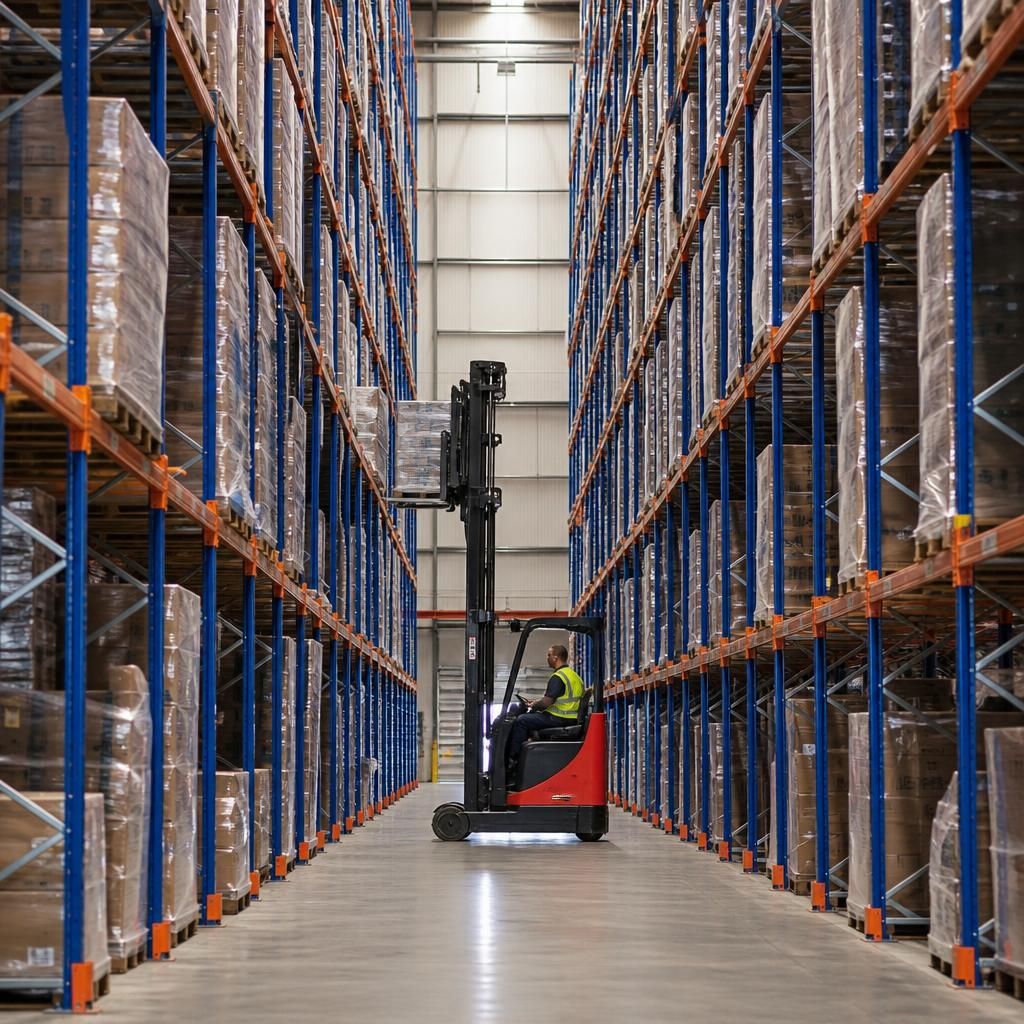
The main difference between drive-through warehouse racking and drive-in racking is the number of operating faces: drive-through warehouse racking is accessed from both ends, while drive-in racking is accessed from one end only.
This affects stock rotation and forklift movements. Drive-through warehouse racking can support first-in, first-out (FIFO) handling, with pallets loaded at one end and collected from the other. This is useful where goods need to move through the storage system in sequence, such as products with a defined shelf life. Drive-in racking normally supports last-in, first-out (LIFO) handling because the most recently stored pallet is usually the first one available for removal.
- Choose drive-through warehouse racking where two-sided access, controlled product flow and regular stock rotation are important.
- Choose drive-in racking where dense bulk storage is the priority and storing fewer product lines in deeper lanes is acceptable.
Both systems require suitable forklift clearances, compatible pallets and well-managed traffic routes. The correct option depends on product turnover, batch control, available access space and whether pallets further inside a lane may need to be moved before the required stock can be reached.
Compare your warehouse racking options with our experts
Speak to our warehouse racking experts to compare drive-through and drive-in options against your stock flow, access requirements and operational needs. We can help you identify the most suitable solution for your warehouse.