
What are the benefits of drive-through warehouse racking systems for high-turnover industries?
Drive-through warehouse racking systems support high-turnover operations by allowing forklifts to load and retrieve pallets from both ends, improving stock flow and reducing handling delays. They can also make better use of available storage space while providing direct access to frequently moved palletised goods.
Drive-through warehouse racking systems benefit high-turnover industries by allowing forklifts to load and retrieve pallets from opposite ends of each storage lane. This supports a first-in, first-out (FIFO) stock rotation method, reduces unnecessary handling, and creates a more direct route through the storage system for goods that need to move regularly.
Improved stock flow
Access from both ends allows inbound goods to be loaded at one side and outbound goods collected from the other. This separates replenishment and retrieval movements, helping to reduce congestion and limiting the need for forklifts to reverse or reposition within a lane. The arrangement is particularly useful where pallets are received and dispatched continuously throughout the working day.
Using separate loading and unloading faces can also make warehouse processes easier to organise. Goods can move through the system in a controlled direction rather than being loaded and retrieved from the same access point. This can support clearer traffic management and more consistent handling procedures when the layout, operating rules and forklift routes are properly planned.
Faster access to frequently moved stock
High-turnover operations depend on efficient pallet movement. Drive-through warehouse racking provides a direct route to stored pallets without requiring operators to work around fixed obstructions or relocate other stock to reach the required load. This can reduce handling steps and help operators complete loading and retrieval tasks more efficiently.
The system is most effective when pallet movements are planned around a clear stock-flow pattern. Products entering storage can be placed at the loading end, while completed orders or older batches are collected from the dispatch end. This approach helps prevent newly received stock from being selected before older stock, provided the warehouse team follows the agreed loading and retrieval sequence.
Better support for FIFO stock rotation
FIFO is important for products with a limited shelf life, batch control requirements or a defined release order. Drive-through warehouse racking makes FIFO easier to apply because the storage lane has a designated entry side and exit side. As a result, stock can progress through the lane rather than being accessed only from the front.
FIFO is not automatic. It depends on accurate labelling, suitable warehouse procedures, reliable stock records and operators using the correct access points. Regular checks are also needed to confirm that pallets have not been placed in the wrong lane or left in a position that disrupts the intended rotation sequence.
Efficient use of warehouse space
Drive-through warehouse racking can increase the amount of pallet storage available within a defined floor area by using deep storage lanes and reducing the need for a separate picking face for every pallet position. This can be valuable where a business handles substantial volumes of similar products or stores stock in pallet loads rather than picking individual cases.
Its space benefits need to be assessed alongside access requirements. Deep lanes can reduce the number of independent pallet positions available at any one time, particularly where different products must be kept separate. A suitable design should consider the number of product lines, pallet dimensions, replenishment frequency, required stock rotation and the space needed for safe forklift operation.
Reduced handling and improved productivity
When the system is correctly matched to the operation, pallets can pass through storage with fewer unnecessary movements. Forklift operators have clear access to the required side of the lane, and goods can be transferred between receiving and dispatch areas using a defined process. Reducing handling can help limit product disturbance and make daily warehouse activity more predictable.
Productivity improvements depend on more than the storage structure itself. Forklift suitability, operator training, aisle widths, load presentation, traffic controls and housekeeping all affect performance. A well-designed system can support faster work, but unsafe shortcuts or poor loading discipline can undermine both efficiency and safety.
Suitable for consistent product flows
Drive-through warehouse racking is generally well suited to operations that store palletised goods in relatively consistent batches and move those goods regularly. Common applications include distribution, manufacturing, food and beverage, retail supply and other environments where stock arrives, remains in storage for a planned period, and is then dispatched in sequence.
It may be less suitable where the warehouse holds many individual product lines with low quantities of each, requires immediate access to every pallet, or frequently changes its storage profile. In those circumstances, a different warehouse racking layout may provide more selective access, even if it uses the available floor space less intensively.
More controlled separation of warehouse activities
Because loading and retrieval can take place at opposite ends, drive-through warehouse racking can help separate inbound and outbound activity. This may reduce conflicts between forklifts carrying newly received goods and those collecting completed orders. The benefit is strongest when the wider warehouse layout includes clearly defined routes, suitable crossing points and effective controls for pedestrians and vehicles.
The storage design must still allow safe inspection, cleaning, maintenance and emergency access. End frames, protection equipment and lane entrances should remain visible and accessible, and the operating team should understand the restrictions that apply to each lane.
Important operational considerations
Before selecting or expanding a drive-through warehouse racking system, assess:
- the weight, dimensions and condition of the pallets being stored;
- the required stock rotation method and whether FIFO can be followed consistently;
- the volume and frequency of inbound and outbound pallet movements;
- the number of product lines and whether products need to be kept in separate lanes;
- the dimensions, turning requirements and operating characteristics of the forklifts;
- clearances for safe loading, unloading and vehicle movement;
- the warehouse floor condition and its suitability for the proposed installation; and
- the inspection, maintenance and operator training arrangements required after installation.
Loads must be positioned correctly, within the system’s rated capacity and without damaging frames, rails or other components. Impacts, bent members, missing safety features and changes to the stored loads should be reported and assessed promptly. Routine warehouse racking inspections, supported by competent advice and documented remedial work, help maintain safe and reliable operation as traffic levels increase.
Overall, drive-through warehouse racking is most beneficial for high-turnover industries that need efficient pallet flow, controlled stock rotation and good storage density without sacrificing access at the dispatch side. Its performance depends on a design that reflects the products, equipment and operating methods in the warehouse, followed by disciplined use, regular inspections and timely maintenance.
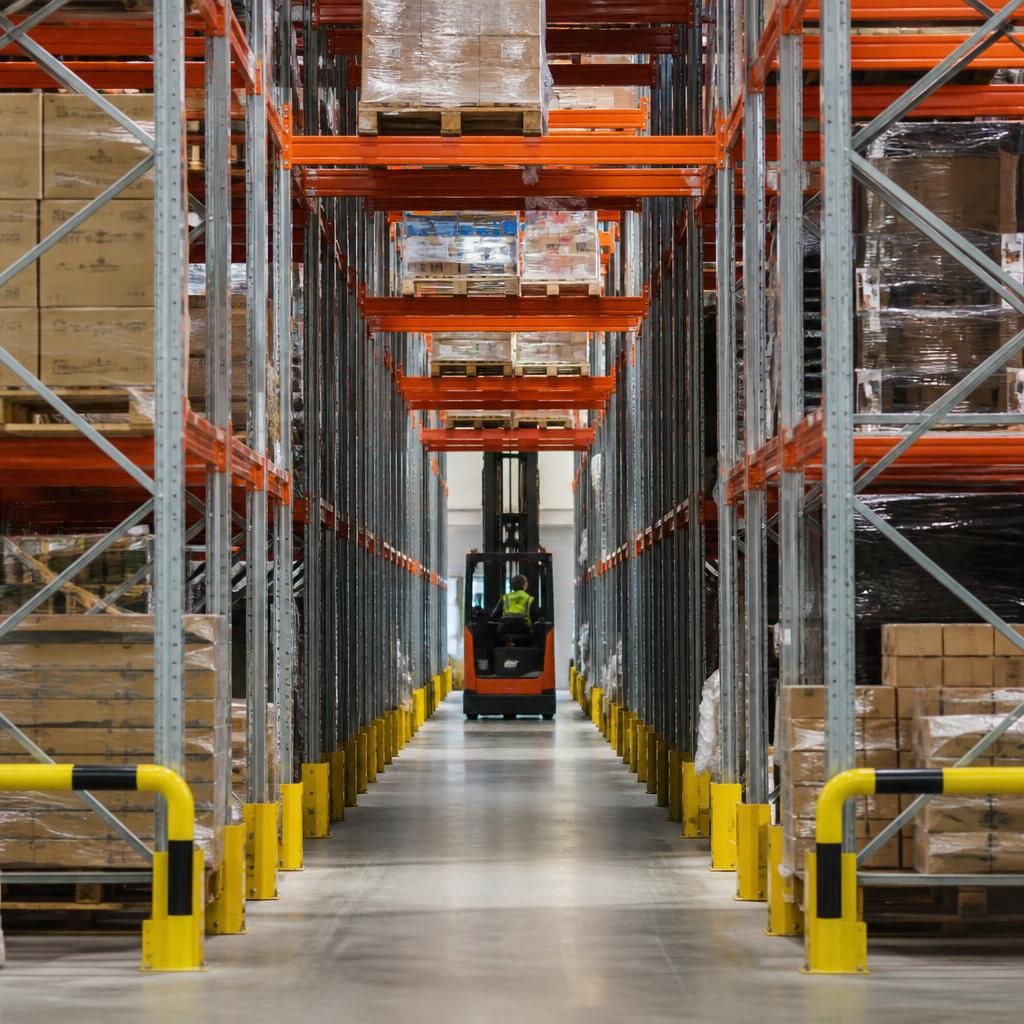
Drive-through warehouse racking improves stock flow by allowing pallets to enter storage at one end of a lane and leave from the other. This layout supports a controlled first-in, first-out (FIFO) process, helping older or earlier-received stock reach dispatch before newer pallets.
For high-turnover operations, separating loading and retrieval points can reduce unnecessary forklift movements and handling delays. FIFO still depends on accurate stock records, clear lane identification and consistent loading procedures, so regular checks should confirm that pallets remain in the correct sequence and that the system is being used safely.
Discuss your drive-through warehouse racking requirements
Discuss your drive-through warehouse racking requirements with Able Racking to assess stock flow, pallet access, load capacity and safe operation. Our experienced team can help you plan a suitable system and identify the inspection and maintenance arrangements needed for reliable performance.