
What are common challenges when implementing drive-through warehouse racking systems?
Common challenges when implementing drive-through warehouse racking systems include planning suitable access routes, confirming pallet and load compatibility, maintaining stock rotation, and managing vehicle movement safely. Careful layout design, clear operating procedures, appropriate protection and regular inspections help maintain efficiency, stability and compliance.
The common challenges when implementing drive-through warehouse racking systems are designing suitable access routes, matching the system to the pallets and loads, controlling vehicle movements, maintaining stock rotation and protecting the structure from impact. These challenges need to be addressed during design and commissioning, not after the warehouse is in operation. A suitable layout, clear procedures, trained operators and regular inspections are central to safe and efficient use.
Planning the layout and access routes
Drive-through warehouse racking systems require access from both ends of each storage lane. The available building space must therefore accommodate the racking, loading and unloading areas, vehicle turning movements, pedestrian routes and any required separation between operational zones. A layout that appears efficient on a plan may be difficult to use if forklift trucks have insufficient clearance or if staging areas obstruct the entrances to the lanes.
Designers should assess:
- Forklift dimensions, turning circles, lift heights and operating clearances.
- The position of loading and unloading areas in relation to despatch and goods-in operations.
- Pedestrian walkways, crossing points and restricted-access areas.
- Clearances around columns, doors, fire equipment, lighting and other building services.
- Whether the floor is suitable for the proposed loads and vehicle movements.
Traffic routes should be straightforward and visible. Where vehicles enter from opposite ends, the operating procedure must prevent conflicting movements within a lane. In some warehouses, one-way traffic arrangements, designated entry and exit points or controlled access periods may be appropriate.
Matching pallets and loads to the system
Drive-through warehouse racking is not suitable for every pallet type or product profile. Pallets must be sufficiently consistent in size, condition and construction to sit securely on the support rails. Damaged pallets, uneven loads or loads with unstable wrapping can increase the risk of products catching on the structure or falling during handling.
Before installation, the intended pallet dimensions, total load weights, load distribution and handling method should be confirmed. The design must account for the combined effect of stored loads and the way forklift trucks place and retrieve them. Changes to pallet types, packaging or product weight should be reviewed rather than introduced informally.
Loads should be stable, centred and positioned in accordance with the system design. Operators should not place loads that project into vehicle routes, overload support components or prevent the safe use of adjacent locations. Visible load notices and clear instructions help ensure that the approved configuration is followed.
Managing stock rotation
Drive-through warehouse racking can support access from both sides, but stock rotation still depends on disciplined warehouse procedures. If goods are loaded and retrieved from whichever end is most convenient, older stock can remain behind newer stock. This can create avoidable product ageing, picking errors and difficulty identifying the correct pallet.
Businesses should establish whether each lane will operate on a first-in, first-out basis, a last-in, first-out basis or another controlled method that suits the products. Lane identification, date or batch controls and warehouse management records should support the chosen process. Staff must understand which end is used for loading and which end is used for retrieval, particularly where products have shelf-life or traceability requirements.
Controlling forklift truck movements
Vehicle movement inside storage lanes is one of the most important operational challenges. Forklift trucks need to enter, position and withdraw loads without striking uprights, rails, guides or stored pallets. Restricted visibility, limited manoeuvring space and pressure to work quickly can increase the likelihood of impact.
Risk controls may include:
- Separating pedestrians from vehicle routes wherever reasonably practicable.
- Using suitable truck types and attachments for the aisle dimensions and load arrangement.
- Setting and enforcing appropriate speed limits.
- Providing adequate lighting and maintaining clear sight lines at lane entrances.
- Using signs, floor markings, barriers or other controls where traffic routes intersect.
- Requiring operators to report impacts, damage and unsafe conditions immediately.
Forklift operators should be trained and authorised for the equipment and tasks they undertake. Training should cover entry and exit from the lanes, load positioning, visibility limitations, reversing, pedestrian awareness and what to do after an impact.
Protecting the structure from impact
Repeated low-level contact can damage warehouse racking components even when there is no immediate collapse or obvious deformation. Uprights, guide rails, support rails and bracing can all be affected by forklift impacts. Damaged components may reduce the system’s ability to carry its designed loads.
Protection should be selected for the actual risks identified in the warehouse. Depending on the layout, this may include upright protection, end-of-aisle protection, guide rails, barriers and controls that reduce the likelihood of trucks entering the wrong area. Protection is not a substitute for careful driving or routine inspections, and it must not interfere with the intended loading clearances.
Any suspected impact should trigger a prompt assessment. Loads may need to be isolated or removed from an affected area until a competent person has determined whether the structure remains safe to use. Components should not be straightened, welded, drilled or repaired without an appropriate technical assessment and approved method.
Confirming structural capacity and floor suitability
The warehouse racking design must reflect the actual loads, pallet positions, handling equipment and building conditions. Problems can arise when a system is altered after installation, when load information is incomplete or when additional levels are added without checking the original design.
The supporting floor must be capable of carrying the imposed loads and resisting the forces created during vehicle operation. Floor condition, level tolerances, joint locations and potential settlement should be considered. Upright anchors and other fixings must be suitable for the floor construction and installed in accordance with the approved design.
Load notices should state the permitted configuration clearly. They should be updated if the system, pallets, beam levels or operating method changes. A new assessment is advisable before making changes that could affect stability or capacity.
Co-ordinating installation in a live warehouse
Installing drive-through warehouse racking in an operating facility can disrupt stock movements and create temporary hazards. Materials, tools and partially completed sections may obstruct normal routes, while installation teams and warehouse staff may be working in the same area.
A planned installation should define delivery routes, exclusion zones, work sequencing, storage of components and arrangements for keeping people away from incomplete or unstable sections. The system should not be put into service until it has been completed, checked and formally handed over. Any changes made during installation should be recorded and reviewed by the responsible technical team.
Maintaining safe operation after installation
Drive-through warehouse racking needs continuing control because its condition can change through daily use. Regular visual checks by trained warehouse staff can identify obvious damage, displaced loads, missing components and housekeeping issues. More detailed inspections should be completed by a competent person at appropriate intervals and after significant impacts, alterations or other events that could affect safety.
Inspection arrangements should cover:
- Uprights, bracing, rails, guides, connections and anchors.
- Signs of impact, bending, cracking, corrosion or missing components.
- Load positioning, pallet condition and overhangs.
- Clearance within lanes and at entry and exit points.
- Floor condition, lighting, signs, barriers and pedestrian controls.
- Whether the system still matches its approved design and load information.
Findings should be recorded, prioritised and closed out. Red-risk damage or conditions that could cause immediate harm require prompt action, which may include unloading and isolating the affected lane until suitable repairs are completed. Minor defects should also be monitored so that they do not develop into more serious problems.
Keeping the system compliant when requirements change
Warehouse operations often change after implementation. Product ranges, pallet sizes, vehicle types, staffing arrangements and throughput may all develop. A system that was suitable at installation may become unsuitable if these changes are not assessed.
Alterations should be approved before work starts, and the warehouse should retain the relevant design information, load data, inspection records and repair history. Operating procedures and training should be reviewed whenever the layout or equipment changes. Applying the manufacturer’s instructions, the agreed design and relevant workplace safety requirements helps maintain the system’s intended performance.
In practice, the most effective way to manage these challenges is to treat drive-through warehouse racking as part of the complete warehouse operation rather than as an isolated storage installation. Early survey work, accurate load information, suitable vehicle routes, competent installation, operator training and planned inspections provide the control needed to keep the system safe, efficient and compliant throughout its service life.
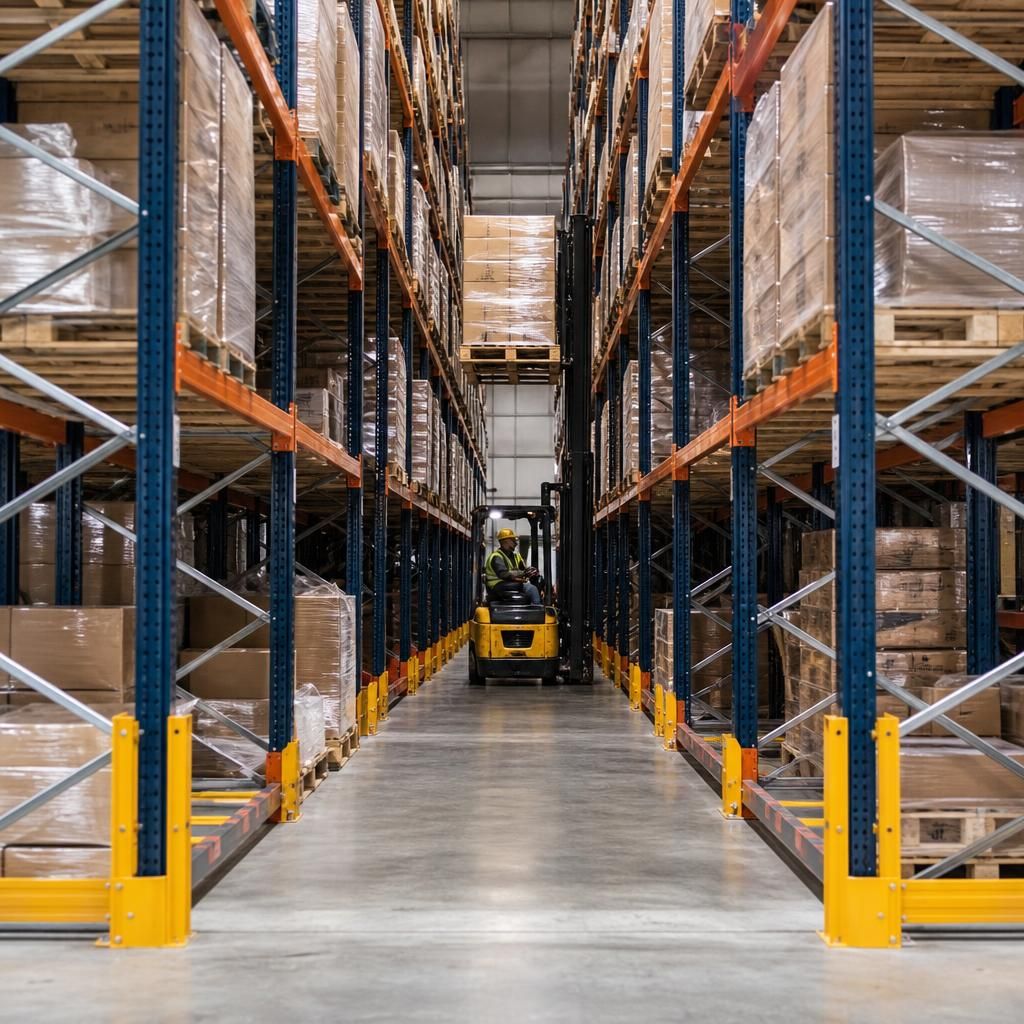
A key challenge when implementing drive-through warehouse racking is controlling forklift movements within the storage lanes. Limited visibility and restricted manoeuvring space can increase the risk of contact with uprights, rails, guides or stored pallets.
Safe operation depends on suitable truck selection, clear entry and exit procedures, visible traffic controls and trained operators. Upright protection, guide rails, floor markings and designated pedestrian routes may also be appropriate, provided they do not reduce the clearances required by the system. Any impact should be reported immediately, with the affected area assessed by a competent person before it is returned to service.
Arrange a drive-through warehouse racking safety assessment
Arrange a drive-through warehouse racking safety assessment with Able Racking to identify access, load, impact and compliance risks. Our experienced team can provide practical recommendations to support safer, more efficient operation.